Confucius vs Laozi: the difference between two Chinese sages
Confucius vs Laozi is the classic pairing in Chinese thought. Confucius says you become good by working at it: through family duty, ritual and study. Laozi says the striving itself is the problem, and you should want less and force less. This guide sets out who they were, how much of their lives is legend, what each taught, and where scholars still disagree. Then it walks one question through both minds, step by step.
Confucius vs Laozi: the short answer
Both men talk about the dao, or "way," and about de, usually translated "virtue." The Stanford Encyclopedia of Philosophy entry on Laozi puts it plainly: "both Laozi and Confucius are interpreters of de-virtue." They agree on the words. They disagree on what the words ask of you.
- Confucius asks you to cultivate virtues on purpose, shaped by ritual and family roles.
- Laozi asks you to drop desire and follow what is natural.
Who were Confucius and Laozi?
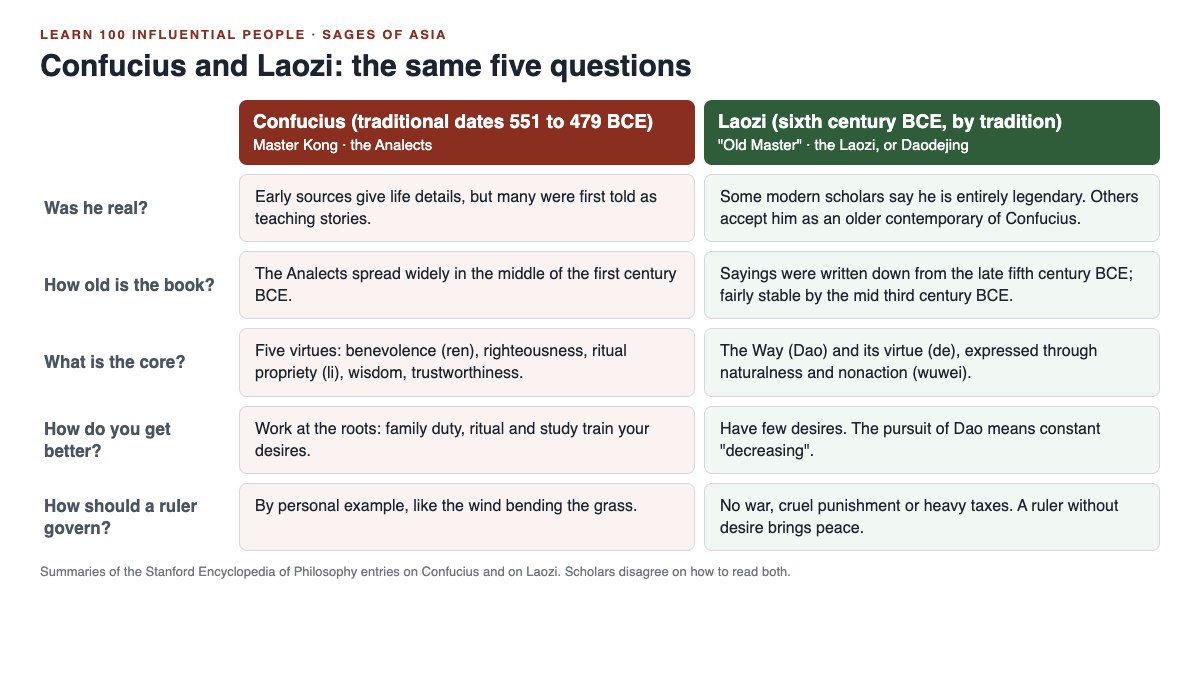
Confucius is the Latin form of Kong Fuzi, "Master Kong." His traditional dates are 551 to 479 BCE. The Stanford entry on Confucius calls him "arguably the most significant thinker in East Asian history." His father died when he was small, and as a young man he became known for expertise in Zhou ritual. He began a career as an official for aristocratic families in Lu, and late in life turned to teaching.
There is a catch. The entry warns that many details of his life "were first recorded in instructive anecdotes," stories told to teach a lesson. So linking his ideas to his life story is "risky and potentially circular."
Laozi is even harder to pin down. His name is best taken to mean "Old Master." Sima Qian's Records of the Historian says he kept archives at the Zhou court, that Confucius consulted him about ritual, and that he wrote a book of some five thousand characters before vanishing. The Stanford entry notes that "few scholars outside China today would subscribe fully" to this report. According to some modern scholars, "Laozi is entirely legendary."
To weigh why both make lists of history's key figures, see how to judge any list of the most influential people.
Two books with uncertain histories
Each thinker is tied to one short book, and neither book has a simple origin.
The Analects. A second century CE account by Ban Gu says it was compiled by first and second generation disciples of Confucius. In 1986, the classicist Zhu Weizheng argued that the lack of quotations from it before the second century BCE meant its status as the oldest layer of his teaching was "undeserved." Excavated copies confirm that the Analects spread widely in the middle of the first century BCE. The Stanford entry describes this as an attack on the authority of the Analects, not on whether Confucius was a real person.
The Laozi, or Daodejing. The traditional view is that Laozi wrote it in the sixth or early fifth century BCE. The Stanford entry calls this unlikely if you assume one author. Sayings were probably written down from the second half of the fifth century BCE and reached "a relatively stable form" by the middle of the third century BCE. The scholar D. C. Lau calls it an "anthology."
Confucius: virtue, ritual and family
The Analects names five qualities of the gentleman, the ideal person. They are benevolence (ren), righteousness (yi), ritual propriety (li), wisdom (zhi) and trustworthiness (xin).
- Ren means dealing with others guided by a sense of what is good from their point of view. The Analects sometimes calls it simply "caring for others," and also "overcoming oneself and returning to ritual propriety."
- Li covers the conventions of both ritual and etiquette, and a willingness to play all of your roles in them.
Ritual is not empty form for him. He says he cannot stand "ritual without reverence, or mourning without grief." On the Stanford reading, ritual and music train the emotions, limit desires and transform character.
Growth starts at home. The Analects says "The gentleman works at the roots. Once the roots are established, the way comes to life." The root is filial piety, the duty of a child to parents. Confucius ties it to loyalty in public life. He also stresses training over birth: "By nature people are close, by habituation they are miles apart."
Laozi: the Way, naturalness and nonaction
The Daodejing is about the Dao and how it shows up in de. The Chinese graph for dao suggests a path. In chapter 1, the constant Dao "cannot be defined or described." De is what a being has "obtained" from the Dao, a latent power that makes it what it is.
- Ziran, literally "self so," means naturalness: things going their own way.
- Wu wei (wuwei), "nonaction," does not mean doing nothing. The Stanford entry says it contrasts with "any form of action driven by self-serving desire."
So where Confucius adds learning, Laozi subtracts. The pursuit of Dao is constant "decreasing," chipping away at what desire has built. And the text turns Confucian virtue upside down: "The highest virtue is not virtuous; therefore it has virtue."
Where scholars disagree
Here are the main debates, set out with no verdict.
- Was Laozi a real person? Fung Yu-lan argued that Sima Qian confused a legendary Lao Dan with a later man, Li Er. A. C. Graham sees the story as several legends merged, starting with a tale of Confucius meeting Lao Dan. The Stanford author, by contrast, finds "little reason not to accept" that Laozi was an older contemporary of Confucius, noting that Laozi appears favorably in both Confucian and Daoist sources.
- What is the core of Confucius? Because many sayings once circulated, the entry calls his teaching "historically underdetermined," and the core is "still avidly debated."
- Is the Daodejing spiritual or political? Some interpreters see it as a deeply spiritual work. Others stress its ethics and political philosophy.
- How hostile is it to Confucius? Chapter 19 of the received text says "Cut off benevolence (ren), discard rightness (yi)." The oldest bamboo copy, found at Guodian, reads "cut off artificiality, discard deceit" instead. Yet another part of that copy says ren and yi arose only after the great Dao declined, so the entry warns it would be hasty to conclude the oldest copy has no critique of Confucian ideas.
Worked example: how should a ruler govern?
Run one question through each thinker. Compare our Machiavelli vs Hobbes guide: neither sage starts from fear.
Confucius, step by step:
- Start with the ruler's own character. The Analects compares the gentleman's influence to the wind blowing on grass, forcing it to bend.
- Add the limit of commands. On the entry's reading, a ruler "cannot expect to reform society solely by command," since only personal example transforms others.
- Add trust. Asked about good government, Confucius ranked trustworthiness above food and weapons: "If the people do not find the ruler trustworthy, the state will not stand."
- Add righteousness in office. If a superior has mastered it, "the common people will all comply."
- Answer: govern by being good yourself, keeping faith, and keeping the rituals and family roles in order. This last step is a summary that joins the quotes, not a quote itself.
Laozi, step by step:
- Start with the cause of disorder. The text traces political decline to excessive desire.
- Look at what it condemns: war, cruel punishment and heavy taxation, which reflect the ruler's own desire for wealth and power.
- Apply wu wei. If the ruler could rid himself of desire, the world would be at peace of its own accord. In a famous line, "governing a large country is like cooking a small fish."
- Compare with Confucius. The Laozi opposes "benevolent intervention," which treats at best the symptoms, not the cause.
- Answer: want less, interfere less, and stop trying to remake people. This step is reasoning from his ideas, not a quote. Note one hard passage too: chapter 65 tells the ruler to keep the people in "ignorance," and scholars disagree on whether to read it literally.
Frequently asked questions
What is the main difference between Confucius and Laozi?
Confucius teaches that you become good by cultivating virtues through ritual, family duty and study. Laozi teaches that you should reduce desire and act without forcing.
Did Confucius and Laozi ever meet?
Sima Qian says Confucius consulted Laozi on ritual and praised him, and the Zhuangzi also reports meetings. Whether this happened depends on whether Laozi was a real person, which scholars still debate.
Is wu wei the same as doing nothing?
No. Wu wei means not acting from self-serving desire, and the Stanford entry says plainly that it "does not mean total inaction."
Get started
Confucius and Laozi both appear in the Intermediate course Sages of Asia on Learn 100 Influential People, alongside the Buddha, Mahavira, Ashoka and Sun Tzu. The Intermediate level covers "How ideas, faiths, inventions and markets spread and changed the world." Lessons take about 9 minutes. Like this guide, the site does not pick a side: 38 cards set out where researchers disagree, and every lesson lists its sources. Sign in with your email and an emailed code. Accounts are for people aged 13 or older.
Comments
No comments yet.
Sign in or make an account to comment.