Stacking in Games: Upgrade Levels and Limits Explained
If you are asking what is stacking in games, the short answer is this: stacking is when more than one bonus applies to the same thing at once, so the effects add up or multiply. Upgrade levels are the steps of a stack, and limits are where the stack stops. This guide explains both with real numbers.
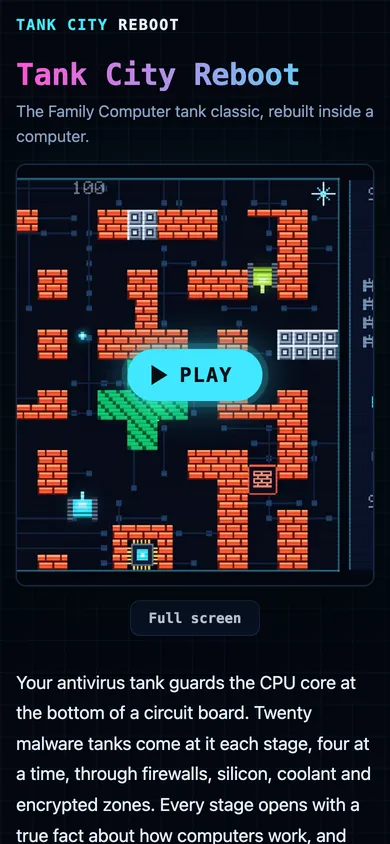
You can test every example below in Tank City Reboot, a free site of two tank games that play in your browser with nothing to install. Its second game hands you upgrades between waves, so you can watch a stack grow and hit its cap.
What is stacking in games? Upgrade levels and limits explained
A stack is a pile of bonuses that all affect one stat or one behavior. Your tank fires a shot. One upgrade makes the shots faster. Another makes them bounce. A third makes them pass through enemies. All three apply to the same shot, so they stack.
Stacking comes in two forms:
- Different upgrades combined. Speed plus bounce plus piercing on one shot.
- The same upgrade taken again. Level 1, then level 2, then level 3 of one card.
Most games add a third rule: a limit. Without a limit, the best choice is always the same card forever, and the game stops asking you to decide anything.
How upgrade levels stack step by step
In Tank City Zero Day, each wave ends with a Patch Tuesday screen. You get three upgrade cards and pick one. Upgrades last until the run ends and reset when a new game starts.
Take the Multithreading card. It changes how many shots leave your cannon in one volley, and the spread is fixed per level:
- Level 0: 1 shot.
- Level 1: 2 shots, angled 6 degrees either side of straight.
- Level 2: 3 shots, one straight and two at 12 degrees either side.
- Level 3: 5 shots, spread out to 20 degrees either side.
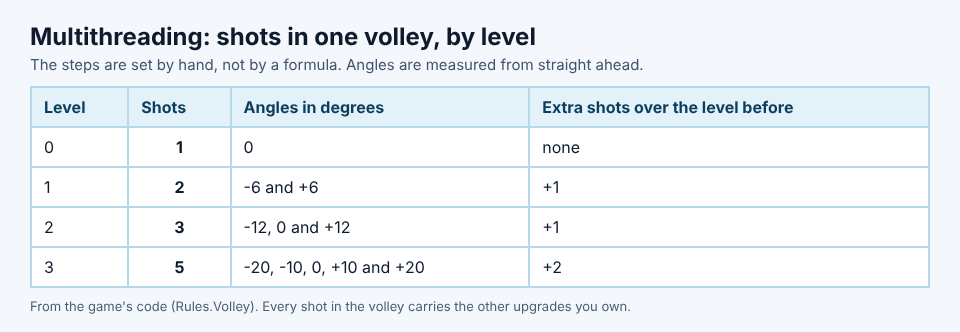
Notice what this is not. It is not "plus one shot each time". The jump from 3 to 5 is bigger than the jump from 1 to 2, because each step is set by hand rather than by a formula.
Each shot in the volley carries every other upgrade you own. If you have bouncing shots, all five bounce. That is where stacking gets strong.
Additive vs multiplicative stacking
This is the difference most players never see, and it changes how far a stack can run.
Additive stacking
Additive means each level gives the same flat amount. The Overclock upgrade in Zero Day is a clean case. Your dash recharge starts at 1.5 seconds. At level 1 it is 1.05 seconds. At level 2 it is 0.6 seconds. Each level takes off the same 0.45 seconds. Overclock also adds 15% to your starting move speed with each level.
Additive stacks are easy to predict. Two levels give you twice the bonus of one.
Multiplicative stacking
Multiplicative means each level scales the current value instead of the base value. The Cache upgrade works this way. The wait between shots is 0.3 seconds, times 0.75 for each Cache level:
- No Cache: 0.3 seconds
- Level 1: 0.225 seconds
- Level 2: about 0.169 seconds
- Level 3: about 0.127 seconds
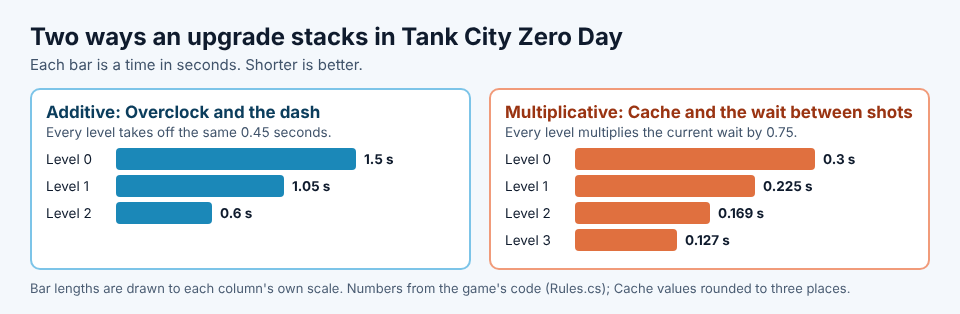
Look at the seconds you save per level: 0.075, then about 0.056, then about 0.042. Every level helps, but each one helps a little less in raw time. That is called diminishing returns, and it is a quiet kind of limit even before a hard cap appears.
Why games put limits and caps on stacking
A hard cap protects the game from its own best card. Zero Day sets a maximum level for each upgrade:
- Multithreading, Cache: 3 levels
- Pipelining, Load balancer, Encryption, Sandbox, Overclock, RAID: 2 levels
- Hot patch: 1 level, taken once
- Two-factor: never runs out
The offer screen enforces this. The three cards are drawn from upgrades not yet at their limit, other than Two-factor. About one offer in five draws only two cards, and whenever fewer than three are drawn, a Two-factor card (an extra life) fills the gap. So a maxed build still gets something useful on the screen.
Caps also exist on score stacks. The kill chain in Zero Day gives a multiplier of x1, plus one for every three kills in the chain, up to x8. You reach x8 on the 21st kill. The chain window is 2.5 seconds, so a gap that long drops it to zero, and losing your tank resets it too. This is a stack you have to keep alive, not one you own.
The first game has a version of this too. Its Overclock power-up has 3 levels: faster shots, then two shots on the field at once, then shots that break silicon. But the level goes back to 0 when you lose a life. Some stacks are permanent and some are fragile. Knowing which is which changes how you play.
Common stacking examples: speed, damage, and shots
Speed. Your shots travel at 200 in Zero Day. Pipelining level 1 multiplies that by 1.35, so 270. Overclock makes your tank move faster, and data bus terrain makes any tank on it move 1.4 times as fast. Those are separate sources acting on different things.
Damage. Here is a surprise: damage does not stack in this game. Every shot that hits an enemy takes exactly 1 hit point. Enemies have different totals: a botnet drone takes 1, a worm 2, ransomware 3, a cryptominer 5, and the first boss 40. So the way you deal more damage is more shots, not bigger shots.
Shots. This is where two stacks multiply each other. Multithreading raises shots per volley. Cache lowers the wait between volleys. At 5 shots per volley and a 0.127 second wait, you fire about 39 shots per second on paper. The wave 5 boss has 40 hit points, so that is 8 volleys if every shot lands. The spread means not every shot will land at range, but the numbers show why those two cards pair so well.
How stacking works with ricochet, piercing, and dash upgrades
Three upgrades change what a shot does after it leaves the cannon, and they combine with everything above.
- Load balancer gives each shot one bounce per level off silicon or the arena edge. Firewall still breaks and stops the shot. If you want the background on the idea, read what a ricochet shot is.
- Encryption lets each shot pass through one more enemy per level. That is the same idea described in piercing shots explained.
- Pipelining makes shots faster and breaks one more layer of wall behind the hit. At level 2 your shots also break silicon.
Because every shot in a Multithreading volley carries these effects, they stack across the whole spread. Five shots, each bouncing twice and passing through two enemies, covers a lot of arena.
The dash is the odd one. It is not about shots at all. A dash lasts 0.2 seconds and nothing can hit you during it. Overclock shortens its recharge from 1.5 seconds down to 0.6, so a full stack lets you dash through danger far more often. For more on the move itself, see what a dash move is in games.
How to build a smart stacking strategy
You cannot choose which three cards appear, so a strategy is really a set of priorities. Here is one worked example.
- Pick a pair when you can. Multithreading and Cache feed each other: more shots per volley, fired more often.
- Add a shot modifier next. Load balancer or Encryption gets more out of every one of those shots.
- Protect the core. The bonus for clearing a wave is 250 times the wave number times the share of core integrity left. On wave 8 with a full core (5 after two RAID cards), that is 2000 points. With 3 of 5 left, it is 1200. RAID raises integrity by 1 and repairs it fully, and you can take it twice.
- Take the one-time cards when they show up. Hot patch can only be taken once, and from then on every wave starts with the wall around the core built as silicon.
- Keep the chain alive. A big shot stack is worth more when your kills land within 2.5 seconds of each other, since the multiplier climbs to x8.
Also think about weak spots. Sandbox is a shield that stops one hit, then recharges in 12 seconds, or 8 at level 2. It is not a bigger gun, but it covers the one moment a big gun cannot. A build with only offense is fast until the first mistake.
Frequently asked questions
What does stacking mean in a game?
Stacking means several bonuses apply to the same stat or action at the same time. They can come from different upgrades or from repeated levels of one upgrade.
What is the difference between additive and multiplicative stacking?
Additive stacking adds the same flat amount per level. Multiplicative stacking scales the current value each time, so later levels give smaller gains in raw numbers.
Why do games cap upgrade levels?
A cap stops one upgrade from becoming the only sensible choice. It also keeps the game balanced as the player gets stronger.
Do upgrades carry over to a new run in Tank City Zero Day?
No. Upgrades last until the run ends and reset when a new game starts.
Does stacking more shots mean more damage per shot?
Not in Zero Day. Every shot that hits takes 1 hit point, so you deal more damage by landing more shots, not stronger ones.
Get started with Tank City Reboot
The fastest way to learn stacking is to build a stack and watch it work, then watch it hit its cap. Play Tank City Reboot: it is free, plays in your browser on a computer or a phone, and needs no account to play. Try Zero Day, take Multithreading and Cache whenever they are offered, and see how fast the arena clears.
The Family Computer tank classic, rebuilt inside a computer.
Visit tankcityreboot.vlvd.net↗
Comments
No comments yet.
Sign in or make an account to comment.