Standardized work at home: make a fix stick
You fix something at home, it works for a week, and then the old problem is back. The bin overflows again. The dishwasher smells again. The fix was real, but it never became the normal way of doing things. Standardized work at home means you write down the current best way, put it where the work happens, and check it so it does not drift. This guide shows you how.
Why home fixes slide back to the old problem
Most home fixes live in one person's head. You figured out that the dishwasher drains better if you clear the filter every Sunday. You did it twice. Then a busy week came, nobody else knew about it, and the smell came back.
Fixes slide back for a few plain reasons:
- Nobody wrote it down. The fix was a thought, not a step.
- It depends on memory. One forgotten week and the problem is back.
- Only one person knows. Everyone else keeps doing it the old way.
- Nobody checks. The fix fades slowly, so you do not notice until the problem is fully back.
Factories have a name for the answer: standardized work.
What standardized work at home looks like
The Lean Enterprise Institute describes standardized work as precise procedures for each person's work, displayed where the work is done. Once it is set, it becomes the object of continuous improvement through kaizen. Its listed benefits include a written record of the current process, less variation, easier training for someone new and a baseline for improvement. The key word is current. A standard is not a law. It is today's best answer, and it is supposed to change.
At home, this gets much simpler. You do not need a binder. You need three things:
- A short description of the best way you know right now.
- That description placed where the task actually happens.
- A habit of checking whether it still works, and updating it if not.
Capture the fix: write the current best way in one short card
Write the standard as if a guest had to follow it. Keep it to three to five steps. Use verbs. Leave out the reasons; those go in your notes, not on the card.
A good home standard card for the dishwasher might read:
- Sunday after dinner: pull the bottom rack out.
- Twist out the filter, rinse under hot water.
- Click it back in. Done.
That is it. If your card has more than five steps, you are probably describing two tasks. Split them.
Before you write any card, pick which problems deserve one. Not every fix needs a standard. Use the Pareto principle for everyday problems: find the few recurring issues that cause most of your frustration, and standardize those first.
Put the standard where the work happens
A standard in a drawer is a standard nobody reads. Put the card at the point of action:
- The dishwasher card goes inside the cabinet door under the sink.
- The laundry sorting standard goes on the wall above the machine.
- The "what goes in the school bag" list goes on the inside of the front door.
Better still, change the place so the standard is built in. A labeled shelf is a standard. A hook by the door is a standard. When the right way is also the easy way, people follow it without reading anything.
Check it: notice drift early and update the standard, not the person
Standards drift. A step gets skipped. A new kitchen tool changes the task. A child gets older and the old routine no longer fits.
When the problem comes back, ask one question first: is the standard wrong, or was it not followed?
- If it was not followed, ask why. Look at the step first: was it hard, hidden, or unclear? Fix that, not the person.
- If it was followed and the problem still came back, the standard is out of date. Update the card.
To catch drift early, make problems visible as soon as they start. The idea of andon at home pairs well with standards: someone notices the first sign of trouble and says so, before it becomes a full mess.
And when one standard works, look for similar spots in the house where the same fix applies. That is yokoten: apply one fix to every similar problem. A card that ended missed bin days can go on the recycling box too.
Example: a missed bin day becomes a one-line routine
Here is the whole process on one common problem.
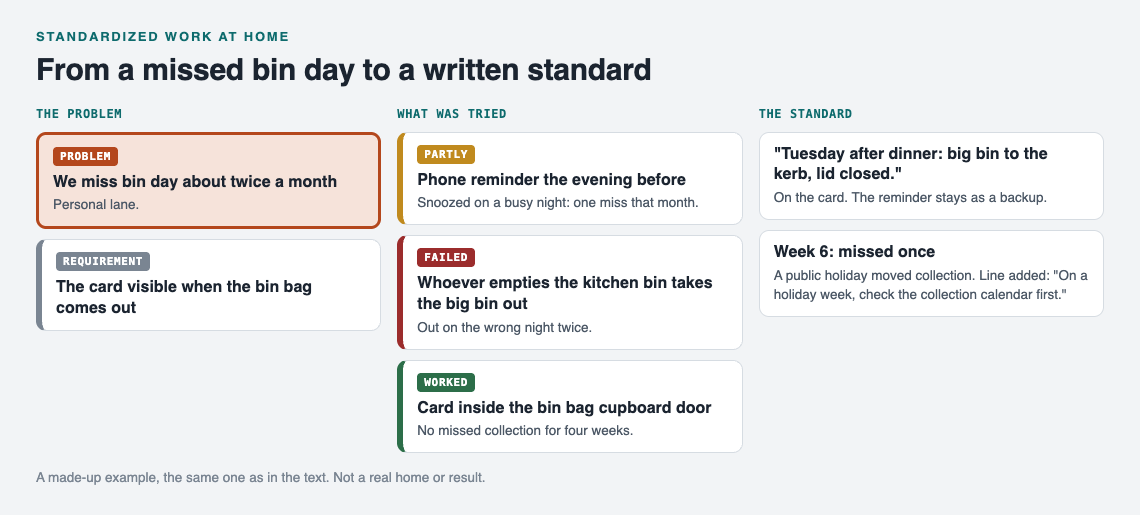
The worked example as a map: the problem, what was tried, and the standard that came out of it.
Step 1: name the problem in one line
"We miss bin day about twice a month and the bin overflows."
Step 2: list what you have tried and what happened
- A phone reminder on the evening before collection. Partly. It went off every week, but it was snoozed on a busy night and the bin was missed once that month.
- "Whoever empties the kitchen bin takes the big bin out." Failed. Nobody knew which night came before collection, so the bin went out on the wrong night twice.
- A card inside the cupboard door where the bin bags are kept: "Tuesday after dinner: big bin to the kerb." Worked. No missed collection for four weeks.
Notice that the failed and partial attempts matter. They tell you what not to try again, and why the card won: it sits where the person taking out a bag already looks.
Step 3: write the standard
"Tuesday after dinner: big bin to the kerb, lid closed."
One step, tied to something that already happens every evening.
Step 4: place it and build it in
The card stays inside the cupboard door. The phone reminder stays too, as a backup rather than the plan.
Step 5: check it
Six weeks later the bin is missed again. You ask why. A public holiday moved collection to Wednesday, and the card only said Tuesday. You add one line: "On a holiday week, check the collection calendar first." The standard changed; nobody got blamed.
Track fixes and standards together in a Problem Graph
The hard part of standardized work is remembering the history: what you tried, what failed, and why the current standard looks the way it does. That is what Problem Graph is built for. It is a personal problem and solution journal drawn as a knowledge graph.
Here is how the bin day example would look in it:
- Write the problem in one line. Type "Bin day missed about twice a month" and put it in the personal lane. It lands on the graph when you press Enter.
- Attach what you tried. Add the reminder, the kitchen bin rule and the card as solutions. Mark each outcome: worked, partly or failed. The failed rule stays on the map as failed, which is exactly what you want when someone suggests it again in six months.
- Link related problems. Link "bin day missed" to "recycling box overflowing" and "garden waste not collected." Patterns show up on the map that you would miss in a list, like the fact that three of your recurring problems are all about collection days.
The map key in the app names three kinds of node: problem, solution and requirement. A requirement is a good fit for what a standard needs to work, such as "the card visible when the bin bag comes out." Keep it next to the card solution, so the reason the standard looks the way it does stays on the map.
If you want the whole household on the same page, mark the bin day problem as a main node and share it into a private network. You create the network, give the invite code to your family, and they see that problem with its solutions, their outcomes and the requirements they need. Keep in mind that anyone with the invite code can join, so share it only with the people you mean to. Problems you only linked to the main node stay private, like the rest of your graph. Private is the default: if you never share anything, nobody else sees it.
You can also ask the app for suggestions. Its AI proposes new solutions grounded in what worked for others on problems like yours. Treat each proposal as an idea to test, then record the outcome like any other attempt.
Frequently asked questions
Is standardized work too rigid for family life?
No, as long as you treat each standard as today's best way, not a rule forever. Keep standards to a few steps, apply them only to recurring problems, and change them as soon as they stop fitting.
How detailed should a home standard be?
Three to five short steps, written with verbs, simple enough for a guest to follow. Put the reasons and the history of failed attempts in your notes, not on the card.
What if someone in the house ignores the standard?
Ask why before you push. Check whether the step is hard, hidden or unclear, and change the place or the step until the right way is also the easy way.
How often should I review a home standard?
Review it whenever the problem comes back, and do a quick check a couple of weeks after you first set it up.
Get started
Think of the last thing you fixed at home that later came back. Write it down as one line, list what you tried with an honest outcome for each, and turn the one that worked into a short standard you place where the task happens.
Open the Problem Graph app in your phone or computer browser. If the graph is empty, the "Load example set" button shows you how problems, solutions and outcomes fit together before you add your own.
Try Problem Graph: it is free, and you can look around the public network without an account. Write one problem down in a line and attach the first thing you will try.
Comments
No comments yet.
Sign in or make an account to comment.