Starting tiles in 2048: how many a new game begins with
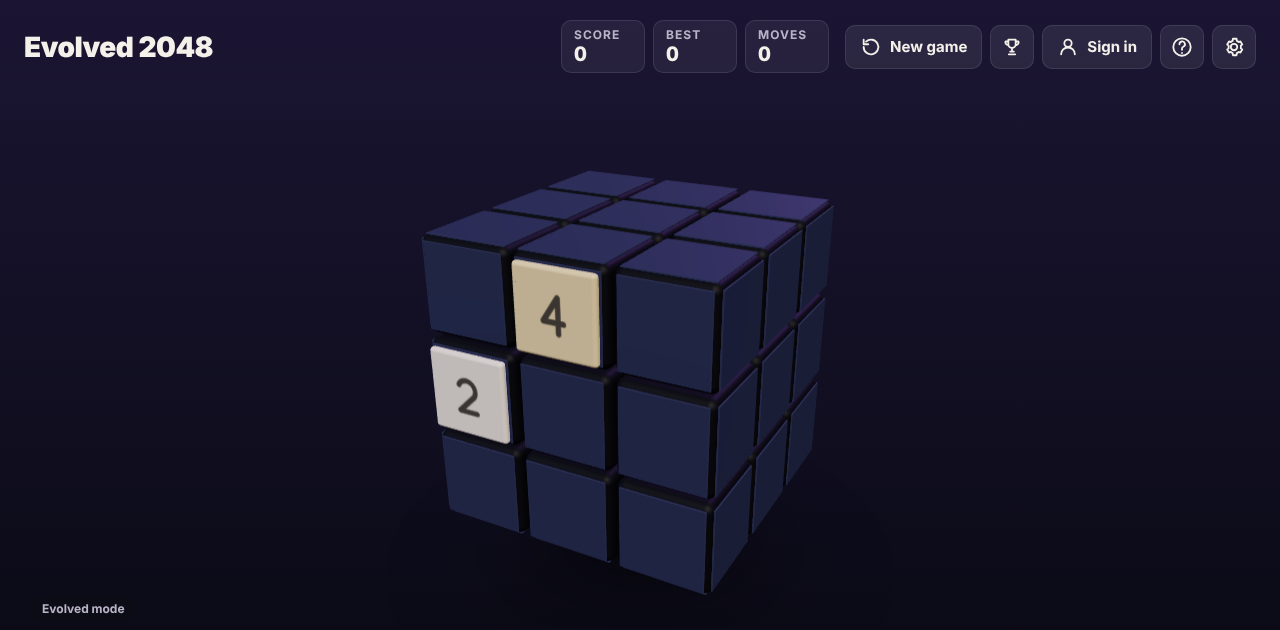
Starting tiles in 2048: a new game begins with two tiles, and each one is a 2 or a 4. In Evolved 2048, the 2048 puzzle on a cube, both sit on the front face of the cube, and you can read them on the cube as soon as you pick a mode. This post sets out what the opening pair can be, how often a 4 turns up, and how to play the first few slides.
Starting tiles in 2048: how many does a new game have?
Two. The game starts with two tiles on the front face of the cube, and the top bar reads Score 0 and Moves 0. The original flat game also began with two tiles, on a 4 by 4 board, as its code on GitHub shows. So the opening pair is the same idea on a flat board and on a cube: two tiles, and a lot of empty squares.
On the cube the front face is the 3 by 3 face you slide. The other five faces start empty. That is a lot of room, but only the front face takes your slides, so the first moves are played on nine squares with two tiles on them.
Which values can the starting tiles take?
Each starting tile is a 2 or a 4. The game picks them with the same rule it uses for every new tile. The page's script gives a tile the value 2 when a random number is under 0.9, and 4 otherwise. So about nine tiles in ten are 2s, and one in ten is a 4.
The game's own help box says the same about the tiles that come later: "Every slide or twist adds a 2 or a 4, on the front face when it has room." The start is just the first two draws.
What a test on the live game showed
On 19 October 2026 I opened the live game signed out in a fresh browser each time, picked a mode and read the saved game before touching a key. Five starts, three modes:
- Evolved: a 2 and a 2, then another 2 and 2 in a second game, then a 2 and a 4.
- Edge: a 2 and a 2.
- Fun: a 4 and a 4.
Every start had two tiles, both on the front face, each a 2 or a 4. The squares were different from game to game, so there is no fixed opening. Five games is a small sample, so it shows what is possible, not how often. The next section has the odds.
How often does a game start with a 4?
Often enough that you will see it, and rarely a pair of them. Take the game's own random number code, copied word for word and run outside the page for 10,000 new games. Of those, 1,909 started with at least one 4, and 87 started with two 4s. That is roughly one new game in five with a 4 in it, and fewer than one in a hundred with a 4 and a 4.
The 4 and 4 start I saw in Fun mode is therefore a rare one. Do not read anything into it. It is luck, not a mode rule.
Not in the way the game picks them. The game offers three modes in its Pick a mode box: Evolved, Edge and Fun. In the five starts I read, all three began with two tiles on the front face, each a 2 or a 4. What changes between modes is how a slide merges tiles afterwards. For that, read 2048 game modes: what Evolved, Edge and Fun change.
Worked example: playing the opening pair
Say the front face starts with a 2 in the top middle and a 2 in the middle right, as in the picture above. Here is a way to play the first moves.
- Look before you slide. Two 2s that do not share a row or column cannot merge yet. A slide will move both and add a third tile.
- Slide so the two tiles meet. Slide right, then up, or the other way round, and the two 2s can end up in one line. Each slide that moves tiles counts one move and adds one new tile on the front.
- Merge as soon as two equal tiles touch. Two 2s make a 4, and the Score rises by 4. Early merges keep the front face open.
- Turn the cube if the front gets crowded. A whole-cube turn adds no tile and counts no move, so use it to see a face you want to build on.
- Do not twist yet. A twist needs one empty square for its new tile and carries tiles from other faces. With three or four tiles in play it brings little, so wait until a face is busy.
If your pair is 4 and 4, the same plan works: line them up and merge to an 8. You are one merge ahead of a 2 and 2 start, but the board is just as empty, so the next tiles matter more than the first.
Can you restart for a better opening?
You can start again with New game, which asks first because the running game ends. A new game places two fresh tiles. The game keeps no undo, so a start you dislike can be replaced, but only by starting over. Since a 4 on the board is a small head start and the odds of a 4 are about one in five games, restarting for one rarely pays. Most of a game is decided by the tiles that come after the first two.
Frequently asked questions
How many tiles does 2048 start with?
Two. Each is a 2 or a 4, and in Evolved 2048 both are on the front face of the cube.
Can 2048 start with a 4?
Yes. A tile is a 4 when the game's random number is 0.9 or more. In 10,000 new games counted with the game's own code, 1,909 began with at least one 4.
Do the starting tiles change from game to game?
Yes. In the games I read, the two tiles sat on different squares and took different values each time.
Do the Evolved, Edge and Fun modes start differently?
In the starts I read, all three began with two tiles on the front face. The modes differ in how slides merge, not in how many tiles you start with.
Get started with Evolved 2048
The quickest way to learn the opening is to open a few new games and look at the pair each time. Play Evolved 2048: it is free in your browser on a computer or a phone. For what comes after the start, see where the next tile appears in 2048, and for the rules in full, 2048 rules explained.
Comments
No comments yet.
Sign in or make an account to comment.