Statement on Superintelligence: what it calls for
The Statement on Superintelligence is a one-sentence public statement, published in October 2025, that calls for a prohibition on building superintelligence until two conditions are met. It is hosted by the Future of Life Institute and has been signed by scientists, Nobel laureates, writers and public figures. This post explains what it says, why it was written, who is behind it, how it compares with earlier calls, and what critics and opponents say, with no verdict. The wording comes from the statement's own page, and the history from Wikipedia's Future of Life Institute article.
What the Statement on Superintelligence says
Here is the statement in full:
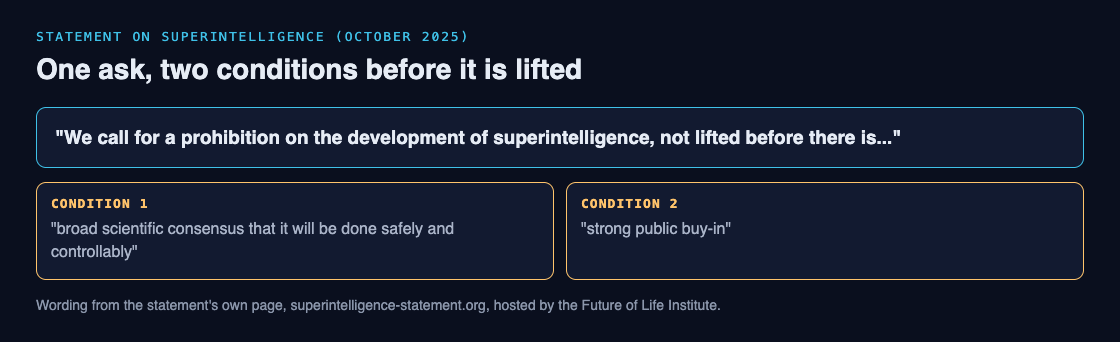
"We call for a prohibition on the development of superintelligence, not lifted before there is broad scientific consensus that it will be done safely and controllably, and strong public buy-in."
Read it as one ask with two conditions. The ask is a prohibition. The prohibition stays until both conditions hold: scientists broadly agree superintelligence can be built safely and controllably, and the public strongly supports it. Superintelligence here means AI that can significantly outperform all humans on essentially all cognitive tasks, as the page puts it.
Why it was written
The page gives its context. It grants that innovative AI tools may bring unprecedented health and prosperity. But it notes that many leading AI companies have the stated goal of building superintelligence in the coming decade. That, it says, has raised concerns ranging from people becoming economically obsolete and losing power, freedom, civil liberties, dignity and control, to national security risks and even possible human extinction. The statement aims to create "common knowledge" of how many experts and public figures oppose a rush to superintelligence.
Who is behind it: the Future of Life Institute
The Future of Life Institute (FLI) is a nonprofit that works against large-scale risks from technology, with a focus on existential risk from artificial general intelligence. Its stated mission is to steer transformative technology towards benefiting life and away from large-scale risks. It was founded in March 2014; its founders include the MIT cosmologist Max Tegmark and Anthony Aguirre.
FLI has a long record of public statements. After its 2017 Beneficial AI conference in Asilomar, California, it released a set of principles for responsible AI development (see our post on the Asilomar AI principles) and, in March 2023, an open letter calling for a six-month pause on the most powerful AI systems.
The case its president makes
FLI's president, Anthony Aguirre, said "time is running out". He expected the technology could arrive in as little as one to two years, and counted on "widespread realization among society at all its levels" to stop it. He added: "whether it's soon or it takes a while, after we develop superintelligence, the machines are going to be in charge", and "that is not an experiment that we want to just run toward".
Who signed it, and what the polling showed
The Wikipedia article lists a wide mix of signatories. They include the Nobel laureates Geoffrey Hinton, Daron Acemoglu, Beatrice Fihn, Frank Wilczek and John C. Mather; Yoshua Bengio, whom the article calls, with Hinton, a "godfather" of modern AI; and the author Yuval Noah Harari. Actors, a musician, members of a royal family and political figures signed too.
The count keeps growing. When we opened the page on 11 October 2026, it showed 77,258 signatures.
The polling
Polling released with the statement found that 64% of Americans agreed superintelligence "shouldn't be developed until it's provably safe and controllable". Only 5% thought it should be developed as quickly as possible.
How it compares with earlier calls
The statement is one of several, and each asks for something different:
- The 2023 pause letter asked for a six-month pause on training the most powerful systems. Our post on calls to pause AI covers it.
- The 2023 statement on AI risk of extinction is covered in our post on the statement on AI risk of extinction.
- The 2025 Statement on Superintelligence asks for a prohibition with no fixed end date, lifted only when its two conditions are met.
- The 2026 Pro-Human AI Declaration, also organized by FLI, sets out five principles: keeping humans in charge, avoiding concentration of power, protecting the human experience, human agency and liberty, and responsibility and accountability for AI companies. It too calls for a prohibition on superintelligence development until proven safe. By September 2026 more than 1 million people had signed it.
Criticism and opposing views
The sources opened for this post give two kinds of pushback, aimed at different targets.
"This distracts from harms today." FLI's 2023 pause letter drew criticism from Margaret Mitchell, an author of one of the papers it cited. She said that "by treating a lot of questionable ideas as a given, the letter asserts a set of priorities and a narrative on AI that benefits the supporters of FLI", adding: "Ignoring active harms right now is a privilege that some of us don't have." That was said about the earlier letter, not this statement.
"Slowing down is the bigger risk." At the other end, effective accelerationism holds that technology should advance "at all costs", that AGI will solve problems like poverty, war and climate change, and that slowing down is a greater risk than anything AI poses, according to Wikipedia's Accelerationism article. Our post on effective accelerationism explains that view.
Supporters, for their part, point to the risks the page lists and to the polling above.
A worked example: test the two conditions yourself
The statement's ask hangs on two conditions. Turning each one into something you could check is a good way to see what you think.
- Write the first condition as a test. "Broad scientific consensus that it will be done safely and controllably." Who counts as a scientist here? What share would make the agreement "broad": a majority, two thirds, nearly everyone?
- Write the second condition as a test. "Strong public buy-in." Would a poll do? A vote? How strong is strong?
- Use the one number you have. In the polling released with the statement, 64% agreed superintelligence should wait until it is provably safe and controllable, and 5% wanted it as fast as possible. Ask how far that is from your test in step 2, and in which direction.
- Check each side's worry. Would your tests answer Mitchell's point about harms today? Would they answer the accelerationist point that waiting has costs?
You do not need to reach a verdict. The exercise shows that most of the real argument sits inside those two conditions.
Exploring the idea in Contain ASI
Contain ASI is a story strategy game for 1 to 4 players that runs in your browser and needs WebGL 2. Chapter 1, Before ASI, starts in January 2024 with four fictional AI labs in one race. As a researcher, research manager, CEO or government, you try for three years to keep every lab from crossing into recursive self-improvement before 2027.
It is a game, not a forecast: the page says all its labs, people and events are fictional. The statement asks the world to hold superintelligence back; the game lets you try holding back a fictional race and see how hard it is.
Frequently asked questions
What does the Statement on Superintelligence call for?
A prohibition on developing superintelligence, not lifted before there is broad scientific consensus that it will be done safely and controllably, and strong public buy-in.
Who wrote the Statement on Superintelligence?
It is hosted by the Future of Life Institute, a nonprofit focused on large-scale risks from technology. It was published in October 2025.
How many people have signed it?
Its page showed 77,258 signatures on 11 October 2026. Signatories include Nobel laureates, AI researchers, writers and public figures.
Is it the same as the 2023 pause letter?
No. The 2023 letter asked for a six-month pause on the most powerful systems. The 2025 statement asks for a prohibition on superintelligence with no fixed end date, until its two conditions are met.
Get started
Want to see what holding back a race takes? Open Contain ASI in your browser and start a campaign as a researcher, research manager, CEO or government.
Comments
No comments yet.
Sign in or make an account to comment.