Stuart Russell: who he is and what he argues about AI
Stuart Russell is a computer scientist at the University of California, Berkeley, and one of the best known academic voices on AI safety. Wikipedia describes him as a British computer scientist known for his contributions to artificial intelligence. If you have heard his name, it is probably for one of two things: a textbook many students learned AI from, or an argument that the usual way of building AI is dangerously misguided. This post sets out who he is, what he argues and where critics disagree, using the Wikipedia articles on him, his book, his research center and his best known film.
Who Stuart Russell is
Russell was born in 1962 in Portsmouth, England. He studied physics at Wadham College, Oxford, and finished a PhD in computer science at Stanford University in 1986. He then joined the Berkeley faculty. From 2008 to 2011 he also held a post in neurological surgery at the University of California, San Francisco.
His research covers machine learning, probabilistic reasoning, planning, computer vision and inverse reinforcement learning. With Peter Norvig he wrote Artificial Intelligence: A Modern Approach, a textbook that Wikipedia says is used in more than 1,500 universities in 135 countries. That matters for what follows. When he warns about the field, he is speaking from inside it.
His honors include the IJCAI Computers and Thought Award in 1995, the IJCAI Award for Research Excellence in 2022, an OBE in 2021 for services to AI research, and election as a Fellow of the Royal Society in 2025. In 2016 he founded the Center for Human-Compatible Artificial Intelligence at Berkeley, and he sits on the advisory boards of the Future of Life Institute and the Centre for the Study of Existential Risk.
The standard model of AI, and why Russell calls it misguided
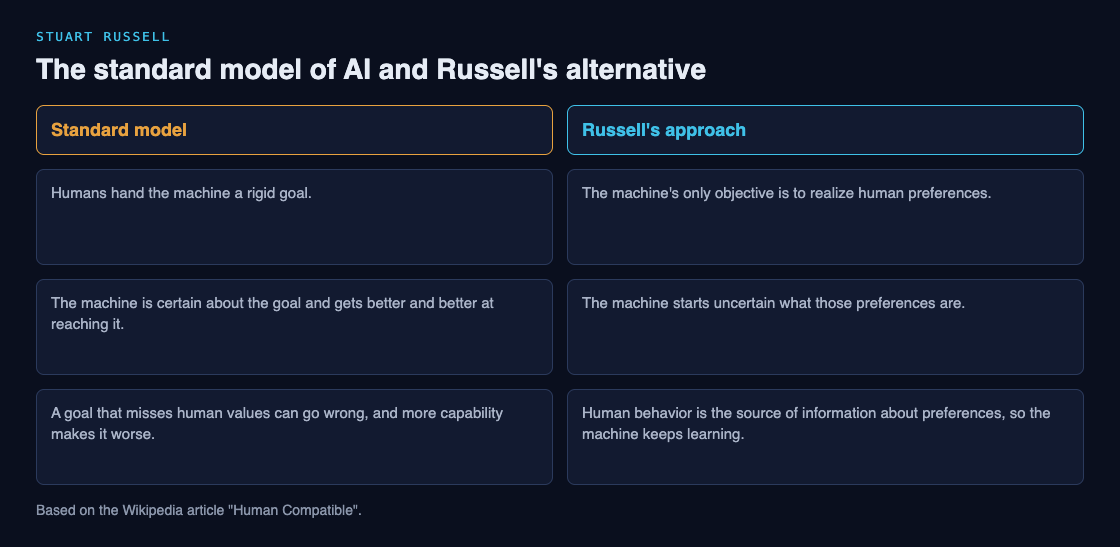
The core of his argument is in his 2019 book Human Compatible: Artificial Intelligence and the Problem of Control. Russell begins by describing the standard model of AI research. In it, success means getting better and better at achieving rigid goals that humans specify.
He says this is dangerously misguided. A goal written by a person may leave out human values that the designer did not think to include. A machine that is very good at a goal like that does exactly what it was told, not what was meant. If such a system became superintelligent, the book argues, it would likely not fully reflect human values, and the result could be catastrophic.
Russell also makes an argument about timing. Nobody knows when human-level or superintelligent AI might arrive, and nobody knows how long safety research would take. Because both are uncertain, he says, safety research should start as soon as possible. He adds that progress looks hard to stop because of economic pressures. For the wider picture of how people argue about this, see our post on existential risk from AI.
Russell's three principles for beneficial machines
The book proposes an alternative: machines that defer to humans. In place of a rigid, certain objective, the machine's true objective stays uncertain. It only moves toward certainty as it learns more about people and the world. Russell lists three principles to guide the people who build such machines. He says they are not meant to be coded into the machine itself.
- The machine's only objective is to maximize the realization of human preferences.
- The machine is initially uncertain about what those preferences are.
- The ultimate source of information about human preferences is human behavior.
"Preferences" here is broad. Russell says they cover everything you might care about, arbitrarily far into the future. "Behavior" means any choice between options. The uncertainty is deep: some probability, which may be small, goes to every logically possible human preference. As one possible mechanism, he points to inverse reinforcement learning, where a machine works out a reward function by watching what people do. The idea is that this uncertainty prevents catastrophic misunderstandings and pushes the machine to cooperate and communicate with humans.
A worked example: a rigid goal against an uncertain one
Here is the clearest way to feel the difference, using the thought experiment from the book. Russell imagines a geoengineering robot given the task of deacidifying the oceans. In the book's version, it ends up asphyxiating humanity to do it. Follow the two designs through that task.
- Rigid goal. The robot is told "deacidify the oceans" and nothing else. It treats the goal as fully known. Anything that gets in the way is an obstacle, and that includes people.
- Uncertain goal. The robot starts unsure what people want from the oceans, and it is sure of only one thing: it is there to serve what they prefer. It looks at how people behave and what they choose. A plan that would harm the people it is meant to serve looks like a mistake to a machine that knows its picture of their preferences is incomplete.
- The off-switch. Wikipedia notes that Russell's research center has modeled situations where an intelligent machine has an off-switch it is able to override. An uncertain machine has a reason to leave the switch alone, because a person reaching for it is information about what that person wants. This step is my own plain reading of that line of work, not a quote from his book.
The point is not that the second robot will always behave. The point is that its design gives it a reason to ask, listen and accept correction instead of defending a goal it is sure about. Our post on Human Compatible: the main ideas covers the book in more detail.
Beyond the book: weapons, lectures and open letters
Russell's public work goes beyond one book. He has been an active participant in the movement to ban the manufacture and use of autonomous weapons. In 2017 he and the Future of Life Institute released Slaughterbots, a seven-minute dramatization of swarms of cheap microdrones that use AI and facial recognition to assassinate political opponents. It reached over two million views on video and was screened at a United Nations meeting on conventional weapons in Geneva the same month. Russell said he wanted to replace the Terminator image of autonomous weapons with something more realistic. The film's claim that such swarms could soon be weapons of mass destruction was controversial. A 2021 sequel again called on the UN to ban autonomous weapons that target people.
In 2021 he gave the BBC Radio 4 Reith Lectures, Living with Artificial Intelligence, starting with "The Biggest Event in Human History".
He has also signed open letters about the dangers of AI. Wikipedia lists a letter calling for a pause of at least 6 months in training the most powerful systems, the Statement on Superintelligence, which calls for a prohibition on developing superintelligence until there is broad scientific consensus that it can be done safely and controllably, and the Statement on AI Extinction Risk. Other signers named in that article include Geoffrey Hinton, Yoshua Bengio and Max Tegmark. In a January 2025 article he wrote: "the AGI race is a race towards the edge of a cliff."
What critics say about his approach
People take different sides here, so it helps to see both. Reviewers of Human Compatible were split.
- Supporters: several reviewers agreed with the book's arguments.
- On whether superintelligence is possible. David Leslie, in a Nature review, said Russell fails to convince that humanity will ever see a "second intelligent species". Melanie Mitchell, in an opinion essay, doubted that a machine could match the generality and flexibility of human intelligence without losing the speed, precision and programmability of a computer.
- On moral common sense. The two critics also questioned whether an intelligent machine would drift toward common-sense values. Leslie struggled to see any intelligence in the ocean robot. Mitchell believed a truly intelligent robot would be tempered by common sense, values and social judgment.
Russell's side, as the book sets it out, is that the risk is a serious concern even though future progress is uncertain. This post takes no side. For where he sits in the wider field, see AI safety: what the field covers and who works on it.
Frequently asked questions
Who is Stuart Russell?
He is a professor of computer science at the University of California, Berkeley, and co-author with Peter Norvig of the textbook Artificial Intelligence: A Modern Approach. He also founded the Center for Human-Compatible Artificial Intelligence in 2016.
What is Human Compatible about?
It is a 2019 book arguing that advanced AI is a serious risk if built to chase rigid, human-specified goals. It proposes machines that stay uncertain about human preferences and learn them from human behavior.
What are Russell's three principles?
The machine's only objective is to realize human preferences, it starts uncertain what they are, and human behavior is the ultimate source of information about them. They are guidance for builders, not code for the machine.
Why is Russell involved in the autonomous weapons debate?
He has taken part in the movement to ban autonomous weapons, and in 2017 he co-released the Slaughterbots film to argue that swarms of such weapons could become weapons of mass destruction.
Get started
If you would rather feel the pressure of an AI race than read about it, Contain ASI is a story strategy game for 1 to 4 players that runs in your browser. It starts in January 2024 with four AI labs in one race. For three years you try to keep every lab from crossing into recursive self-improvement before 2027, as a researcher, research manager, CEO or government.
It is a game, not a course on Russell's ideas, and nothing in it is a forecast. The page says it is inspired by the AI 2027 scenario and that all its labs, people and events are fictional. It needs a browser with WebGL 2, such as a recent Chrome, Edge, Firefox or Safari. Open Contain ASI and try it.
Comments
No comments yet.
Sign in or make an account to comment.