Superflip: the cube position with every edge flipped
The superflip is a 3 by 3 cube position where every piece is in its home slot and every corner is turned correctly, but all twelve edges are flipped. Wikipedia's Superflip article also calls it the 12-flip. It looks almost solved, yet it sits as far from solved as any position can. This guide explains why it is a legal position, why it takes 20 moves, how to make it with a 20-move sequence, and what it has in common with a 2048 puzzle played on a cube.
What the superflip is
A 3 by 3 cube has 8 corners with three stickers each and 12 edges with two stickers each. The six centres turn in place but never change slots. An edge can sit in its correct slot the wrong way round, with its two colours swapped. That is a flipped edge.
In the superflip, all 12 edges are flipped at once, and nothing else is out of place. Every face shows its own colour on its centre and its four corners. Its four edge squares show the colours of the neighbouring faces instead, which gives each face a plus-shaped pattern.
The word is used two ways. It names the position, and it also names any sequence of moves that takes a solved cube there.
Why every edge flipped is still a legal position
Not every arrangement of a cube can be reached by turning. Wikipedia's Rubik's Cube article puts it this way: eleven edges can be flipped freely, and the flip of the twelfth depends on the others. In plain terms, the number of flipped edges is always even. You can never have one flipped edge on its own, which we cover in flipped edge on a Rubik's cube: why it takes a pair.
Twelve is even, so the superflip passes. Its corners are all correct, so the corner twist rule is met too. That is why you can reach it by turning, and get back by turning.
The same rule is where a famous number comes from. Because 11 edges flip freely, edge flips contribute 2 to the 11th, or 2,048, to the count of all cube positions. We build that count step by step in cube permutations: 43 quintillion positions explained.
Why the superflip needs 20 moves
How far a position is from solved depends on how you count moves. The most common way, the half-turn count, treats any turn of a face, a quarter or a half, as one move.
Wikipedia's Superflip article says the shortest path between a solved cube and the superflip needs 20 moves in the half-turn count, and that no position needs more. That second part is God's number: every one of the cube's positions can be solved in 20 moves or fewer. According to the Rubik's Cube article, a team of researchers, working with computers provided by Google, proved that in July 2010.
So the superflip sits at the very edge of the cube's space. It is not alone there: Wikipedia notes that many other positions also need 20. But it is the easiest of them to describe, and it shows that "looks close to solved" and "is close to solved" are different things. We explain the 20-move limit in God's number explained.
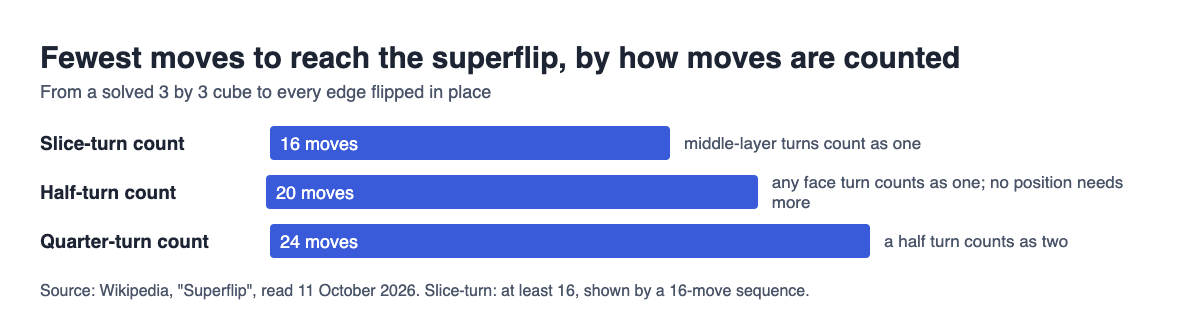
The same position, three ways of counting moves, from Wikipedia's Superflip article.
Change the counting and the number changes. In the quarter-turn count, where a half turn counts as two, the superflip needs at least 24 moves, and it is not the farthest position. Combined with the "four-spot" pattern, where four faces swap centres with their opposite faces, it needs 26 quarter turns. In the slice-turn count, where a middle-layer turn counts as one move, a 16-move sequence makes it.
Two odd properties of the superflip
Wikipedia lists a few properties that make the superflip unusual. Two are easy to see on a real cube.
- It undoes itself. Do a superflip sequence twice and you are back to solved.
- It looks the same however you hold the cube. It is completely symmetrical, so a superflip sequence gives the same position from any starting hold. Wikipedia says only three other positions share this.
A third property is more abstract. The superflip is the only position, apart from solved, that you can apply before or after any other sequence and get the same result. Mathematicians call that being central.
Worked example: make the superflip in 20 moves
First, the letters. Each one is a face: U up, D down, F front, B back, R right, L left. A letter alone means a quarter turn clockwise, as if you were looking straight at that face. A prime, like U', means a quarter turn the other way. A 2, like R2, means a half turn. Our notation guide for beginners covers these in more detail.
Here is the first 20-move sequence Wikipedia gives, split into four groups of five so you do not lose your place:
U R2 F B RB2 R U2 L B2R U' D' R2 FR' L B2 U2 F2
Start from a solved cube, held one fixed way. Do not turn the whole cube while you work. After each group, check you are still holding it the same way.
When you finish, every face should show its own colour on the centre and corners, with the neighbouring colours on the four edges. Because the superflip undoes itself, doing the same 20 moves again takes the cube back to solved. If the cube looks scrambled instead of patterned, a move was missed: solve it and start again.
Layers, edges and the 2048 cube
Evolved 2048 is the 2048 puzzle on a cube you turn like a Rubik's cube: six faces of nine squares, 54 in all. It is a number puzzle, not a cube to solve, so it will not teach you the superflip. But it asks you to think in faces and layers in a similar way.
- The same face letters. The game's script names its six faces F, R, B, L, U and D. In our test, Shift and Left brought the right face to the front, which cube notation calls a y turn, and Moves did not change: turning the whole cube is free.
- Layers carry pieces between faces. A twist turns one layer a quarter and carries its tiles to the next face, the way a face turn carries edges and corners. Keys 1, 2 and 3 twist the top, middle and bottom rows, 4, 5 and 6 the left, middle and right columns, and Shift twists the other way.
- Tiles, not stickers. Each of the 54 squares is empty or holds a tile, and equal tiles merge when you slide the front face. There is no wrong way round for a tile, so there is no superflip on this cube.
Frequently asked questions
Is the superflip the hardest cube position?
It is one of the hardest. In the half-turn count it needs 20 moves, the most any position needs, but many other positions need 20 as well.
How many moves does the superflip take?
Twenty in the half-turn count, at least 24 in the quarter-turn count, and 16 in the slice-turn count, according to Wikipedia.
Can you flip just one edge on a cube?
No. The number of flipped edges is always even, so a single flipped edge means a piece was taken out and put back the wrong way.
How do you undo a superflip?
Do the same sequence again. The superflip undoes itself, so the cube returns to solved.
Get started
If thinking in faces and layers appeals to you, try a cube where every twist moves tiles you need. Slide the front face with the arrow keys or W A S D, twist a row with the keys 1 to 6 to bring a matching tile round, and press Shift and an arrow key to look at another face for free. You can play without an account, and your game, best score and settings are saved on your device.
Play Evolved 2048: it is free and plays in your browser on a computer or a phone.
Comments
No comments yet.
Sign in or make an account to comment.