Tank game scoring: points, chains and multipliers
If you want a bigger number at the end of a run, you need to know where the points come from. This guide explains tank game scoring using the two free browser games on Tank City Reboot as the worked example: what each enemy is worth, how a kill chain grows into a multiplier, what resets it, and how the end of wave bonus rewards you for protecting the core. Every number here comes from the games' code.
The two games score differently. In the first game, Tank City Reboot, each kill is worth a flat amount. In the second, Tank City Zero Day, kills feed a chain, and the chain sets a multiplier of up to eight. Most of this post is about Zero Day, because that is where scoring decisions matter most.
How tank game scoring works
Every score in these games is built from a few sources:
- Kills. Each enemy type has a base value. Tougher enemies pay more.
- Pickups. In the first game, grabbing a power-up scores 500 points.
- The chain multiplier. In Zero Day, fast back to back kills multiply what each kill is worth.
- The wave bonus. In Zero Day, clearing a wave adds a bonus based on how healthy the CPU core is.
Both games save your best score in the browser you play in, so you always have a number to beat.
Base points: what each enemy tank, base and bonus is worth
The first game
Your antivirus tank guards the CPU core while 20 malware tanks come at it each stage. Kills score:
- Worm: 100
- Trojan: 200
- Spyware: 300
- Rootkit: 400
Power-ups are worth chasing for points as well as for their effect. The 4th, 11th and 18th tank of each stage blink because they carry a power-up. Your first hit on a carrier drops it, even if the tank survives. Picking it up scores 500, which is more than any single kill.
One trap: Garbage collection destroys every enemy on the field, but those tanks score nothing. They still count toward the stage's 20, and a carrier destroyed this way drops nothing. It saves the core. It does not help your score.
You start with 3 lives and get one more the first time your score reaches 20,000 in a game.
Tank City Zero Day
Here every kill is multiplied by your current chain multiplier. Base values:
- Botnet drone: 50 (one hit)
- Worm: 100 (two hits), and each half after it splits: 50 (one hit each)
- Ransomware: 200 (three hits)
- Cryptominer: 250 (five hits)
- Zero-day boss: 2,500 (40 hits on wave 5, 15 more on each later boss)
Notice the worm. Killing it and both halves gives 200 base points and three kills for your chain. That makes worms one of the best chain builders in the game.
Chains: how consecutive kills build a combo
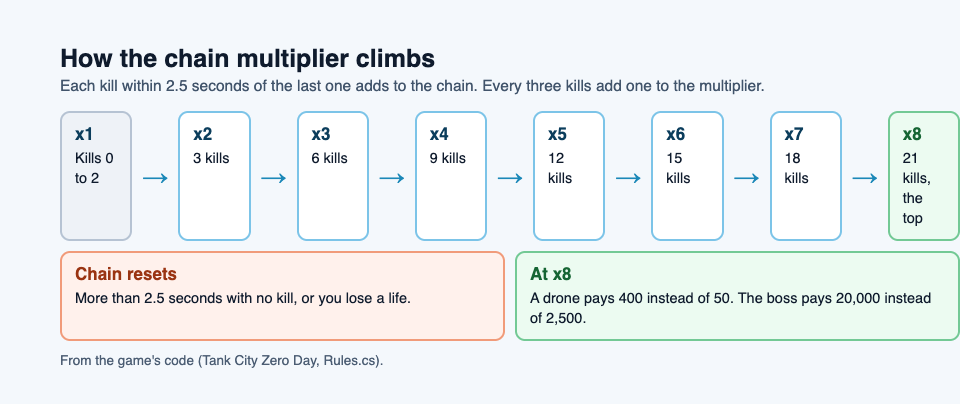
A chain in Zero Day is simple. Every kill made within 2.5 seconds of the last one adds to it. Wait longer than that and the chain is over.
Waves 1 and 2 only send botnet drones, in threes, and worms. That is a good place to practice. Drones come in groups and hunt you rather than the core, so they come to you. A drone group plus a worm and its two halves is six kills, if you keep each one inside that 2.5 second window.
Ransomware joins from wave 3 and cryptominers from wave 4. These take more hits, so they are harder to fit inside the window. A good habit: weaken a tough enemy first, then finish it right after a quick drone kill so it lands inside the chain.
Multipliers: how they stack and when they reset
The multiplier starts at x1. It goes up by one for every three kills in the chain, and tops out at x8 once the chain reaches 21 kills.
Here is what that means in points. At x8:
- A botnet drone pays 400 instead of 50.
- A ransomware pays 1,600 instead of 200.
- A zero-day boss pays 20,000 instead of 2,500.
Two things reset it. The first is the 2.5 second gap. The second is losing a life, which resets the chain no matter how long it was. So a long chain is also a reason to play carefully. One stray shot can cost you more points than the kill you were chasing.
The wave bonus: a reward for an untouched core
Zero Day's end of wave bonus is not about speed and not about your own lives. It is about the CPU core. The formula is:
250 × wave number × (core integrity left ÷ maximum integrity), rounded.
A worked example. You start a run with a core integrity of 3 out of 3.
- Clear wave 5 with the core whole: 250 × 5 × 1 = 1,250.
- Clear wave 5 with 1 of 3 left: 250 × 5 × 1/3, about 417.
- Clear wave 10 with 4 of 5 left: 250 × 10 × 0.8 = 2,000.
The bonus grows with the wave number, so a damaged core costs you more the deeper you go. The game's own tip says it plainly: keep the core whole, the wave bonus grows with its integrity. It pays for an untouched core, not an untouched tank. There is no bonus for clearing a wave quickly.
Habits that keep a chain alive (and the mistakes that break it)
Habits that help:
- Hold fire. Holding Space, J or Z shoots again as soon as the wait between shots is over. You never lose time to slow tapping.
- Dash through shots. A dash lasts a fifth of a second and you cannot be hit during it. It is the safest way to cross open ground toward the next kill.
- Shoot enemy shots. Your shots cancel enemy shots, so firing ahead of you is also defense.
- Use diagonals. Zero Day moves and fires in eight directions, and diagonal shots break firewall too. A diagonal line often reaches an enemy without repositioning.
Mistakes that break chains:
- Chasing a kill into a crossfire and losing a life, which resets the chain.
- Starting on a cryptominer, which takes five hits, when nothing else is close enough to keep the chain going.
- Letting enemies hit the core while you hunt a combo. That lowers the bonus at the end of the wave.
How upgrades and controls change your scoring potential
After each Zero Day wave, Patch Tuesday offers three upgrades and you pick one. Several of them are scoring tools in disguise:
- Multithreading adds shots per volley in a spread, up to 5 shots at level 3. More shots, more kills per second.
- Cache cuts the wait between shots: 0.3 seconds, then 0.225, then about 0.17, then about 0.13.
- Encryption lets each shot pass through one more enemy per level. Great for lined up drones.
- Load balancer gives each shot one bounce per level off silicon or the arena edge.
- Overclock makes you faster and shortens the dash recharge from 1.5 seconds to 1.05, then 0.6.
- RAID raises core integrity by 1 and repairs it fully, which restores the full wave bonus share.
- Hot patch builds the core's wall as silicon at the start of every wave, which protects the bonus.
- Sandbox is a recharging shield that stops one hit, which protects your chain.
For a deeper look at which card to take and when, read tank game upgrades: what to pick after each wave.
Controls matter too. Keys only reach the game once it has focus, so click or tap the game first. On a phone, Zero Day's direction pad reads eight directions and the second button is Dash. For a full rundown of keyboard, gamepad and touch, see tank game controls.
Frequently asked questions
Do multipliers apply to wave bonuses too?
In Zero Day, the chain multiplier is applied to kill points. The wave bonus has its own formula: 250 times the wave number times the share of core integrity left.
What breaks a kill chain in a tank game?
In Zero Day, a chain ends if more than 2.5 seconds pass between kills. Losing a life also resets it.
Is it better to play safe or chase multipliers?
Chase multipliers when enemies are close and you have a shield or a dash ready. A lost life resets the chain and a hit core shrinks every later wave bonus, so reckless chasing usually costs more than it earns.
Do later stages and waves give more points?
There is no difficulty setting; the challenge rises as you play, and tougher enemies pay more. In the first game, later stages send more rootkits at 400 points each, and in Zero Day the wave bonus grows with the wave number.
Get started
Start with the first game to learn the flat values and grab every blinking carrier for 500 points. Then move to Tank City Zero Day and practice chains on waves 1 and 2, where drones and worms give you easy kills to link. Watch the core, and watch your 2.5 seconds.
Play Tank City Reboot: it is free, plays in your browser on a computer or a phone, and needs no account.
Comments
No comments yet.
Sign in or make an account to comment.