Technological singularity: what it means
The technological singularity, often just called the singularity, is a hypothetical point where technology grows so fast that it slips beyond human control and changes civilization in ways nobody can foresee. It is one of the most quoted ideas about the future of AI, and one of the most disputed. The catch is that "the singularity" names at least three different ideas, which do not fully agree. This post separates them, shows where the word came from, sums up what researchers think, and sets out the criticism, with no verdict. Every claim comes from Wikipedia's Technological singularity article.
Technological singularity: the short definition
The most popular version of the idea comes from I. J. Good in 1965. An intelligent agent that can upgrade itself could enter a feedback loop: each smarter generation builds the next one faster, causing an explosion in intelligence that ends in a superintelligence far beyond human minds. Good put it this way:
the first ultraintelligent machine is the last invention that man need ever make, provided that the machine is docile enough to tell us how to keep it under control.
That last clause, about keeping it under control, is why the singularity matters to AI safety. For Good's idea on its own, read Intelligence explosion: what it means and why people disagree. For what "superintelligence" means, see Artificial superintelligence (ASI): what it is and is not.
Where the word came from
The first person known to have talked about a "singularity" in technological progress is the mathematician John von Neumann. In 1958, Stanislaw Ulam recalled a conversation with him about "the ever accelerating progress of technology and changes in the mode of human life, which gives the appearance of approaching some essential singularity in the history of the race beyond which human affairs, as we know them, could not continue."
The term was popularized by Vernor Vinge. In a 1983 article in Omni magazine, he argued that once humans create intelligences greater than their own, a transition will happen that is similar in some sense to "the knotted space-time at the center of a black hole". His 1993 essay, "The Coming Technological Singularity: How to Survive in the Post-Human Era", spread widely online and made the idea famous.
Three ideas behind one word
Eliezer Yudkowsky argued in 2007 that the different definitions of the singularity are in tension rather than reinforcing each other. Here they are side by side:
- The intelligence explosion (Good). A sudden upswing: self-improving machines quickly leave human intelligence behind.
- The event horizon (Vinge). The point is unpredictability: beyond smarter-than-human minds, we cannot see what happens next.
- Accelerating returns (Ray Kurzweil). Technological change speeds up exponentially, following what Kurzweil calls the "law of accelerating returns". He defines the singularity as the point when computer-based intelligence far exceeds the sum of all human brainpower, and he expects it by 2045. Unlike Vinge, he sees a gradual climb rather than a sudden jump.
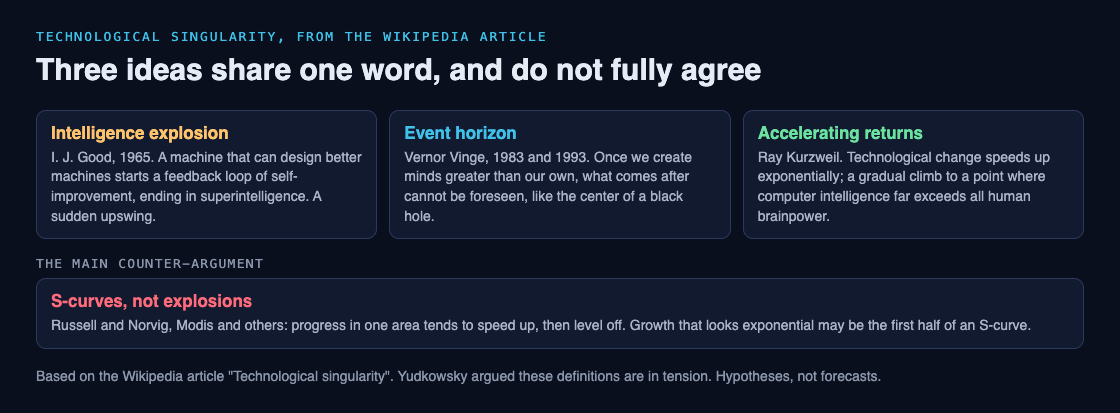
The difference matters. Kurzweil extends today's trends forward; Good and Vinge describe a break where trends stop being a guide. The question of how fast such a change could be is covered in Hard takeoff vs soft takeoff.
What would it take?
The article lists three factors for an intelligence explosion:
- Each improvement makes new improvements possible.
- But as intelligence rises, further advances get harder, which may cancel out the gain.
- And the laws of physics may eventually block further progress.
For the process to keep going, each improvement has to lead to at least one more, on average. The article also names two separate sources of gains: faster computing hardware and better algorithms. Some researchers argue the software side will be the harder one.
What researchers think
A 2017 email survey asked authors who had published at two major machine learning conferences in 2015 how likely it was that "the intelligence explosion argument is broadly correct". The answers were spread out:
- 12% said quite likely;
- 17% said likely;
- 21% said about even;
- 24% said unlikely;
- 26% said quite unlikely.
So in that survey, about half leaned against the argument, a fifth called it a coin flip, and under a third leaned towards it. In another exchange, the cognitive scientist Gary Marcus agreed with the computer scientist Grady Booch that major advances would probably come as a slow, gradual increase in reliability and usefulness rather than as a single event.
The main criticisms
- S-curves, not explosions. Stuart J. Russell and Peter Norvig note that improvement in any one area of technology tends to follow an S curve: it speeds up, then levels off. Theodore Modis argues Kurzweil mistakes an S-curve for an exponential.
- Imagination is not evidence. The cognitive scientist Steven Pinker wrote in 2008: "There is not the slightest reason to believe in a coming singularity. The fact that you can visualize a future in your imagination is not evidence that it is likely or even possible."
- People, not technology, decide. Jaron Lanier denies the singularity is inevitable: "I do not think the technology is creating itself."
- A distraction. The philosopher Daniel Dennett said in 2017 that the idea "distracts us from much more pressing problems", such as people trusting AI tools more than they deserve.
- No sign in the data. The economist Robert J. Gordon points out that measured economic growth slowed around 1970 and again after 2008, and argues the data show no trace of a coming singularity.
- A modern myth. Some critics compare the build-up to the singularity to religious end-times stories.
Supporters answer that past trends in computing support acceleration, and the debate stays open.
A worked example: read any singularity claim in four questions
When you see a headline or a post that says the singularity is near, or has arrived, try these four questions:
- Which singularity? Good's explosion, Vinge's horizon, or Kurzweil's acceleration? A claim that mixes them is hard to check.
- Exponential or S-curve? What evidence shows the trend keeps speeding up, rather than about to level off?
- Does each step pay for the next? Using the three factors, is each improvement producing at least one more, or are gains getting harder?
- What would change your mind? Gordon looks at economic growth; Modis looks for big milestones. Name one sign that would count for or against the claim.
Answering these will not settle the debate, but it turns a vague claim into one you can test.
Frequently asked questions
What is the technological singularity in simple terms?
A hypothetical point where technology, especially AI, improves so fast that it moves beyond human control and changes civilization in ways nobody can foresee.
Who coined the term?
John von Neumann is the first person known to have spoken of a singularity in technological progress; Vernor Vinge popularized the term from 1983.
Do AI researchers believe in it?
Opinion is split. In a 2017 survey of machine learning authors, 29% thought the intelligence explosion argument likely or quite likely, and 50% unlikely or quite unlikely.
Is Contain ASI about the singularity?
Contain ASI is a game, not a forecast. Its page names the AI 2027 scenario as its inspiration and says all its labs, people and events are fictional.
Get started
The singularity debate turns on one question: what happens if machines start improving themselves? Contain ASI makes that question the goal of a game, as fiction. Chapter 1, Before ASI, starts in January 2024 with four fictional AI labs in one race. As a researcher, research manager, CEO or government, you try for three years to keep every lab from crossing into recursive self-improvement before 2027. It runs in your browser on WebGL 2, so use a recent Chrome, Edge, Firefox or Safari.
Play Contain ASI: a story strategy game for 1 to 4 players that runs in your browser. Its labs, people and events are all fictional.
Comments
No comments yet.
Sign in or make an account to comment.