Technological unemployment: will AI take our jobs?
Technological unemployment is the loss of jobs caused by new technology. People type "technological unemployment" when they really want to know one thing: will AI take our jobs? This post separates the old question from the new one. It uses one source, Wikipedia's article on technological unemployment, and where the honest answer is "experts disagree", it says so.
What is technological unemployment?
The article defines it as the loss of jobs due to technological change, and calls it a key type of structural unemployment, meaning joblessness that does not go away even when the economy is doing well. The technology can be a labour-saving machine that does the work of muscles, or a more efficient process that does the work of minds. In both cases the human role gets smaller.
Two examples show the range. Artisan weavers lost work when mechanized looms arrived, which led to the Luddite protests. Today, retail cashiers are being displaced by self-service tills and cashierless stores.
The phrase was popularised by John Maynard Keynes in the 1930s. He called it "only a temporary phase of maladjustment". Whether he was right, and whether that still holds, is the whole debate.
A short history of the worry
The fear is not new. In the early 1800s several leading economists, including Ricardo, Malthus and Mill, argued that innovation could cause long-term unemployment. Jean-Baptiste Say replied that displaced workers would find work elsewhere once the market had adjusted. Marx later took a deeply pessimistic view. By the 1870s in Britain the worry had faded, because innovation was visibly raising prosperity for every section of society, including the working class.
In the 20th century the concern came back twice, in the 1930s and in the 1960s. The article notes the pattern: each debate began with a rise in unemployment, and each faded when war brought unemployment down. At the end of each, a major US federal study broadly found that long-term technological unemployment was not occurring. The same studies agreed that innovation was a major cause of short-term displacement, and advised help for those workers.
That is the history in one line: the long-run warning of disaster has repeatedly not arrived, and the short-run pain has repeatedly been real.
Why many economists expect new jobs to appear
The optimistic case rests on what the article calls compensation effects: consequences of innovation that make up for the first job losses. Cheaper goods raise demand, new products need new workers, and so on. Optimists hold that these effects create at least as many jobs as were destroyed.
Two phrases come up. The "Luddite fallacy" is the claim that people who fear long-term job loss are forgetting compensation effects. The "lump of labour fallacy" is the belief that there is a fixed amount of work, so every task a machine takes leaves less for people. Economists say that limit does not exist.
The article also records a quieter version of the optimistic case. A 2015 study in McKinsey Quarterly found that computerization in most cases does not replace employees but automates parts of the tasks they do. Two MIT professors, writing in 2011, put the hopeful stance this way: "the key to winning the race is not to compete against machines but to compete with machines".
Why AI might be different
The pessimistic case does not need a fixed amount of work. It says the amount of work can be unlimited, yet machines may take the "easy" work, the definition of "easy" keeps expanding as technology improves, and what lies beyond it may need more brainpower than most people have. Pessimists accept that compensation effects worked through most of the 19th and 20th centuries. They doubt they will keep working in the age of computers.
Since about 2017 the worry has focused on artificial intelligence. The article gives several views, each from a named commentator:
- Calum Chace and Daniel Hulme warn that unchecked AI could cause an "economic singularity", with job churn too fast for people to adapt. They also say the right responses could make AI a net positive for workers.
- Martin Ford argues that many jobs are routine and predictable to an AI, and that many new jobs may not be reachable for people of average ability, even with retraining.
- Marian Krakovsky argues that the jobs most likely to be fully replaced are in middle-class areas such as professional services. She also argues that AI will mostly complement people rather than copy them.
- Geoffrey Hinton is cited as believing that advanced AI and robotics will eventually automate all intellectual and physical tasks, which would call for a basic income. Daron Acemoglu is cited as arguing that humans remain necessary or complementary. The World Bank's 2019 World Development Report argues that, on balance, innovation creates more new industries and jobs than it destroys.
The same article cautions that several barriers stop researchers from predicting AI's effect on job markets accurately. The idea of AI that does nearly every thinking task is covered in Ray Kurzweil: who he is and what he argues about AI, and the field's swings between big promises and disappointment in what an AI winter was.
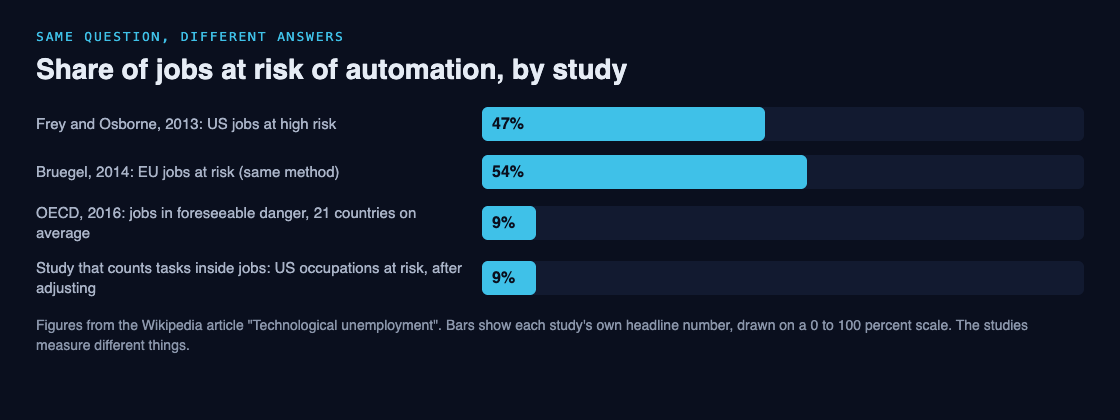
Why estimates of job risk range from 9% to 54%
Headline numbers are where most confusion starts. The article lists many studies, and they do not agree:
- A 2013 study by Frey and Osborne estimated that 47% of US jobs were at high risk of automation. It looked at tasks that follow well-defined procedures.
- A 2014 study by the think tank Bruegel used the same approach and put 54% of jobs across 28 European Union countries at risk.
- A 2016 study by the OECD found that, on average, only 9% of jobs in 21 countries were in foreseeable danger. It did not base its estimate mainly on job tasks, and it added factors such as age and education.
- Another study argued that US risk had been overestimated because jobs contain many different tasks. Once it accounted for that, the share of occupations at risk fell from 38% to 9%.
Same country, same question, and the answer moved from 47% to 9% depending on the method. A 2018 study of 28 industries in 18 OECD countries found a different kind of effect: automation did not reduce the number of jobs overall, but it cut human labour's share of the value created and helped slow wage growth. So "will jobs vanish?" and "will wages fall?" are two separate questions.
The surveys of experts split too. A 2014 Pew Research canvass of 1,896 technology professionals and economists found 48% expecting new technologies to displace more jobs than they create by 2025, and 52% disagreeing.
A worked example: audit your own week
A job is a bundle of tasks, and the studies above differ mostly in how they treat that bundle. You can do the same sorting yourself in ten minutes:
- List the tasks you do in a normal week, down to small ones.
- Mark each task "routine" (follows clear steps) or "judgment" (needs context, trust or a decision you answer for).
- Write beside each how many hours it takes.
- Add up the routine hours. If they are most of your week, a study that counts tasks would rate your job as exposed. If they are a small part, the job is more likely to change than to vanish.
For a bookkeeper, entering invoices and matching statements are routine. Chasing a late client and explaining to the owner why cash is tight are judgment. The result is a guide, not a forecast, in the same way the article says even careful studies are not forecasts.
What people propose to do about it
The article groups responses into two kinds: preventing net job losses, and living with them. Four stand out.
- Shorter working hours. The average US working week fell from about 75 hours in 1870 to about 42 before World War II. Some economists have proposed cutting it further to share work out. Others call that a lump of labour error.
- Education and retraining. It is welcomed across the political spectrum, even by optimists. Several academics say education alone will not be enough, because demand for many middle skills has fallen and not everyone can reach the most advanced ones.
- Welfare payments. Even the classical economists who believed in compensation effects advocated aid for displaced workers, because markets do not adjust instantly.
- Basic income. Supporters and sceptics come from both left and right. One objection is that it could discourage work. The article says evidence from older pilots in India, Africa and Canada does not show that.
None of these ends the debate. They are the menu people argue over. For readers who work in software and want to go from jobs to the wider safety questions, AI alignment for software engineers: where to start is a practical next step.
Frequently asked questions
What is technological unemployment in simple terms?
It is job loss caused by new technology doing work people used to be paid for. Keynes popularised the term in the 1930s and called it a temporary phase of maladjustment.
Will AI take our jobs?
Experts disagree. Some expect AI to automate nearly all tasks, while others expect it to complement workers and create new roles. The sources do not give a settled answer.
Has technology ever caused lasting mass unemployment?
The article says the consensus through the 20th century, among economists and the public, was that technology does not cause long-term joblessness. It also says short-term displacement of workers was real, and that more recent concern is that the benefits are not equally shared.
Why do studies disagree on how many jobs are at risk?
They measure different things. Some count tasks that could be automated, some add age and education, and some ask whether jobs actually disappear. Estimates for the US ranged from 9% to 47% depending on the method.
What is the lump of labour fallacy?
It is the belief that there is a fixed amount of work, so when machines do some, less is left for people. Economists say no such fixed limit exists.
Get started
This post is about jobs. Contain ASI is about a different question: a race between AI labs. It is a story strategy game for 1 to 4 players that runs in your browser and needs WebGL 2. It starts in January 2024 with four fictional AI labs in one race, and for three years you try to keep every lab from crossing into recursive self-improvement before 2027.
The page says it is inspired by the AI 2027 scenario and that all its labs, people and events are fictional. It is a game, not a forecast and not a course.
Comments
No comments yet.
Sign in or make an account to comment.