Tense underscore for a mystery podcast episode: a guide
A tense underscore for a mystery podcast episode is quiet music under the narration that keeps the listener unsure, without telling them what to feel. It is built from a few choices: how slow, how dark, how sparse, and when it goes silent. This guide plans those choices beat by beat and uses what Wavecrate's catalog really holds.
When you are ready to audition tracks, Wavecrate lets you filter music by mood, tempo, key and energy, and every download comes with a license certificate and a code you can paste into your show notes.
What the catalog holds for suspense
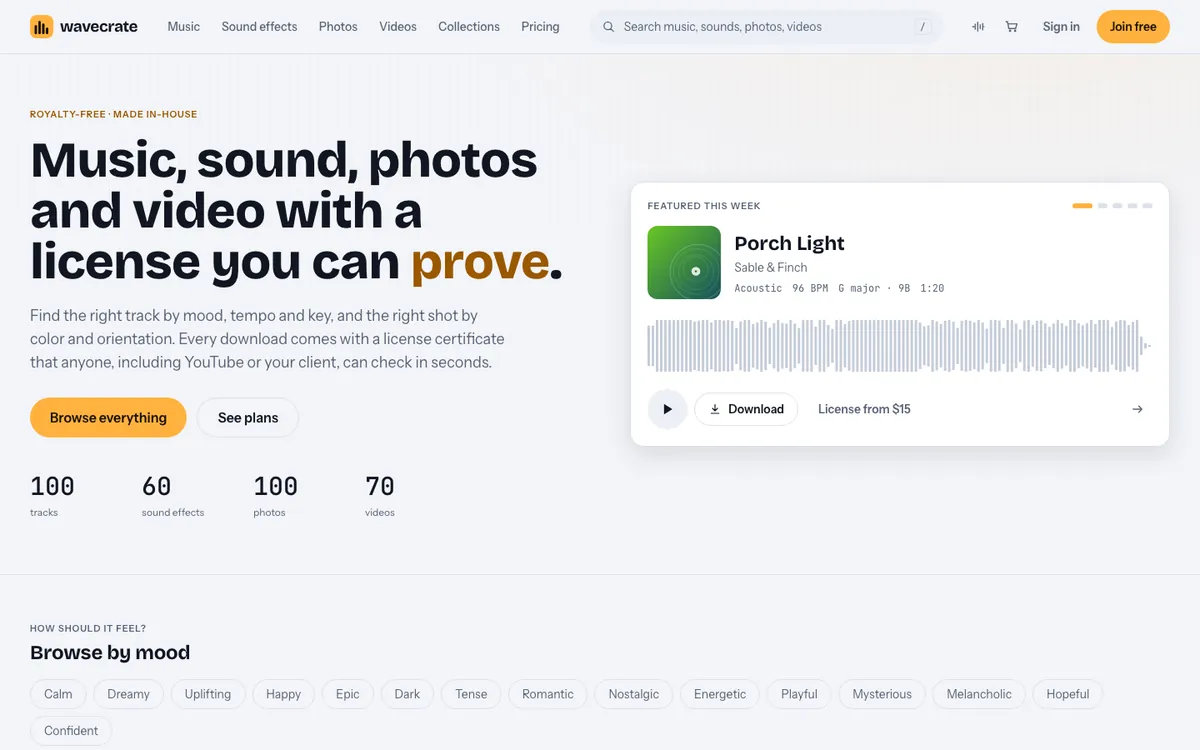
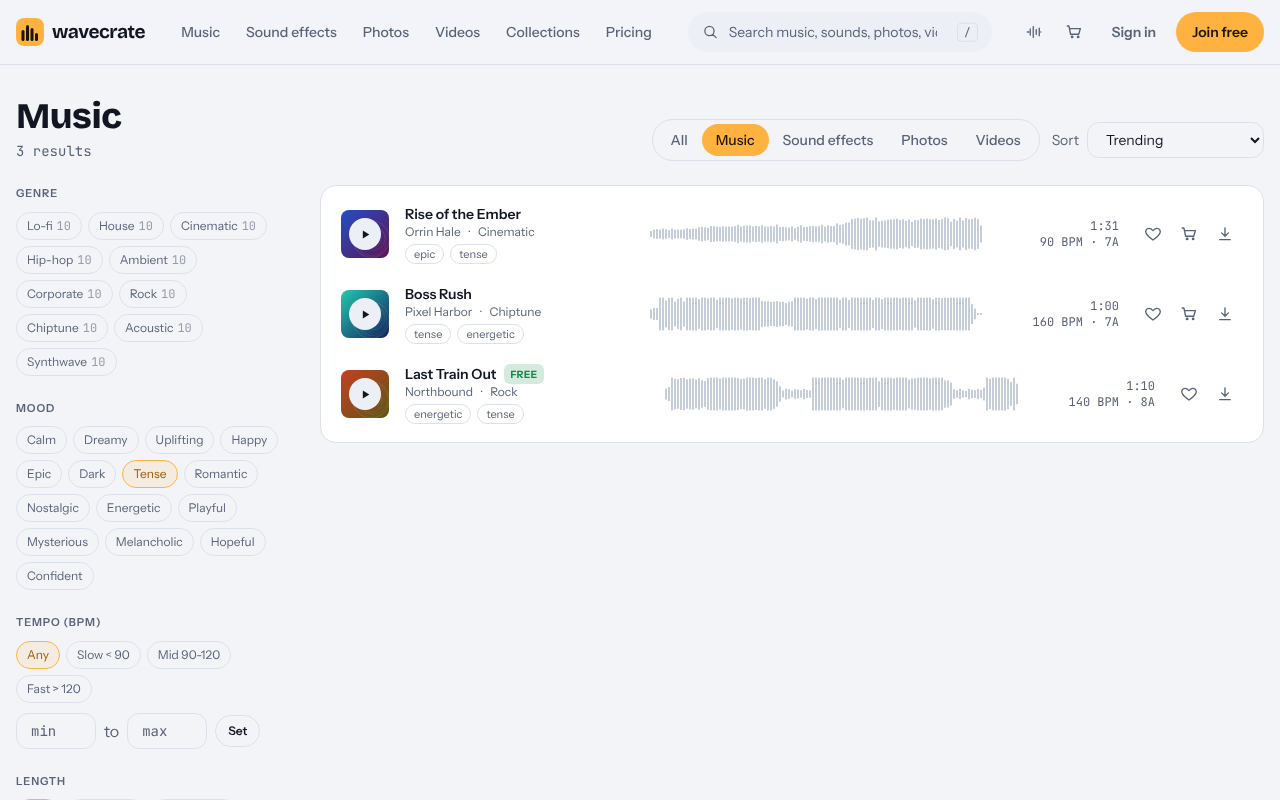
The catalog is small here, so it is better to know it before you plan. On 20 October 2026 the Tense mood filter on music returned three tracks, the Mysterious filter returned one, and a search for the word "mystery" returned nothing.
- Rise of the Ember (Cinematic, Premium): strings, low brass and timpani building toward a big finish, 90 BPM in D minor, with the energy marked Intense.
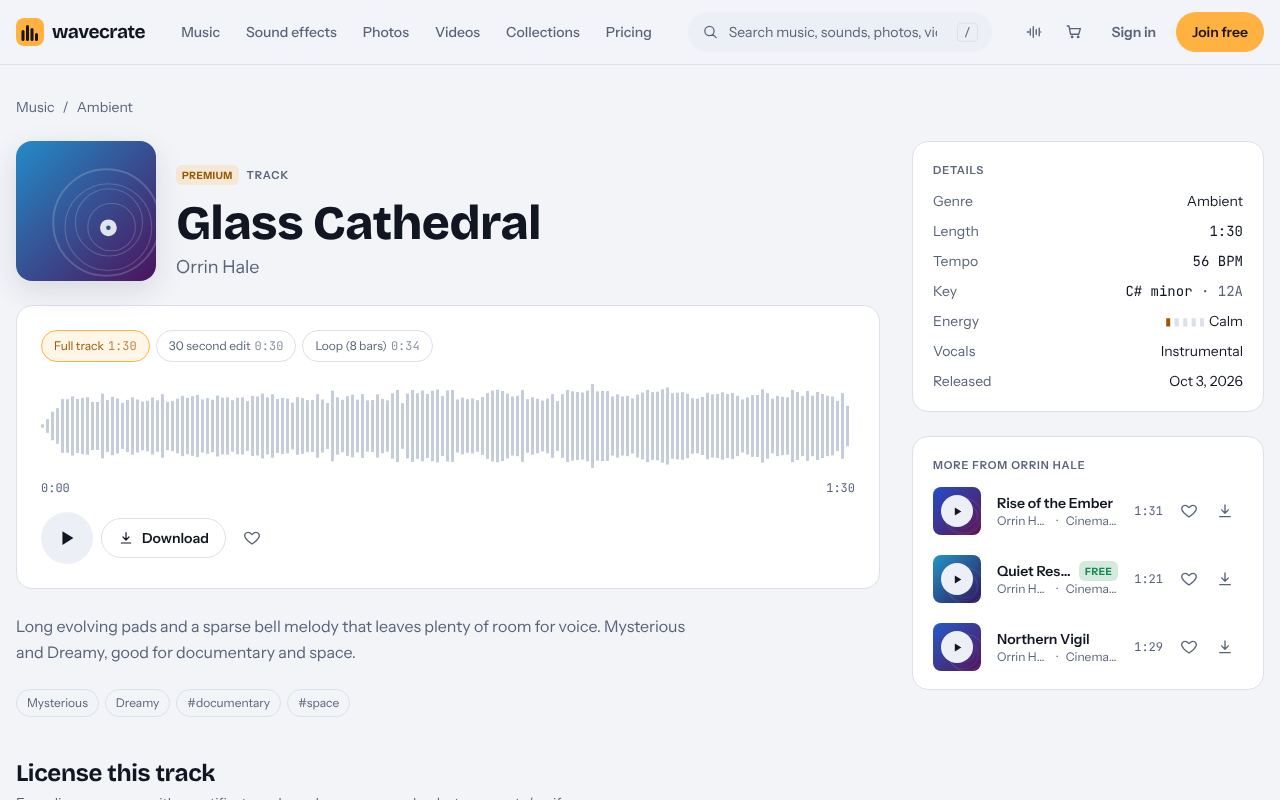
- Glass Cathedral (Ambient, Premium): long evolving pads and a sparse bell melody that "leaves plenty of room for voice", 56 BPM in C# minor, marked Calm and tagged Mysterious and Dreamy.
- Last Train Out (Rock, Free): driving power chords and live-feel drums, 140 BPM, tagged Energetic and Tense.
- Boss Rush (Chiptune, 160 BPM) is tagged Tense too, but it is a game track, so it suits a podcast about games more than a quiet case file.
So the honest picture is one bed for a quiet case (Glass Cathedral), one big cue for a reveal (Rise of the Ember) and one hard track for a chase (Last Train Out). The rest of the effect comes from sound effects and from how you mix, which is most of this guide.
Map the beats before you open the library
Do not start with music. Start with the script and mark where the story turns. A 30 minute episode might run like this:
- Cold open, 0:00 to 2:00: one strange fact, told plainly.
- Setup, 2:00 to 9:00: who, where, and what everyone believed.
- The doubt, 9:00 to 17:00: a detail that does not fit.
- The witness, 17:00 to 24:00: a story that changes.
- The reveal, 24:00 to 28:00: what happened.
- The open end, 28:00 to 30:00: what is still unanswered.
Next to each beat, write one word: curious, uneasy, suspicious, afraid, stunned, unresolved. That list is your brief. You are not looking for "scary music". You are looking for six shades of unease, and most of them need less sound than you expect.
Pick a tense underscore for a mystery podcast episode by key, tempo and energy
Wavecrate's browse page filters music by tempo (Slow is under 90 BPM, Mid is 90 to 120, Fast is over 120), by energy from Calm to Intense, and by key. Three rules of thumb help.
- Slow reads as waiting. Fast reads as being chased. Keep most of the episode under 90 BPM, which is where Glass Cathedral (56 BPM) sits.
- Minor keys lean dark. Both Glass Cathedral (C# minor) and Rise of the Ember (D minor) are in minor keys, and every track page shows its key before you download.
- Calm energy is not calm mood. Glass Cathedral is marked Calm for energy and Mysterious for mood. That is the combination a quiet case file wants: little movement, with an odd color.
Rise of the Ember is marked Intense and described for trailer and action, so treat it as a short cue. Under twenty minutes of talking it would take over the room.
Layer a bed, a room and a few hits
One track rarely does the job alone. Build the underscore in three layers.
The bed. Glass Cathedral comes as a full track (1:30), a 30 second edit (0:30) and an 8 bar loop (0:34). The loop is the useful one: narration runs longer than any track, and a loop lets you hold the mood without the music building to an ending in the middle of a sentence.
The room. A low room tone gives the listener a place to be. The Ambience category holds ten sounds, among them Control Room sounds of 28, 29 and 32 seconds tagged Mysterious and Tense, and a Free Server Room sound tagged Calm and Mysterious. Pick one that fits the setting. A control room hum under a farmhouse story will confuse people.
The hits. For a beat that needs a push, use a short sound. Tension Riser (0:04) is a build sound, and Heartbeat Pulse (0:03) is described for heart and suspense moments; both are Premium. Reverse Swell, Long, Warm (0:03) is a reversed chord that swells into a hard stop, tagged Dreamy and Mysterious, and it was marked Free on the day of writing.
A worked example: one episode, six cues
Here is the beat map from earlier with one choice per beat. The plan uses only what the catalog holds.
- Cold open: the Server Room tone alone, very low, then silence for a breath before your show title.
- Setup: the Glass Cathedral loop, mixed so low you notice it only when it stops.
- The doubt: keep the bed, add Heartbeat Pulse once, on the sentence that names the odd detail.
- The witness: pull the music to almost nothing. Voices carry the tension here. Let one Reverse Swell fall when the story changes.
- The reveal: Tension Riser into Rise of the Ember, then a two second drop to near silence on the key line.
- The open end: return to the Glass Cathedral loop and fade it out without resolving.
The silence in step five matters. A cue followed by a beat of quiet lands harder than a cue followed by more music.
Mix the underscore under the voice
Mixing decides whether it works. A few habits that hold up:
- Voice first. Set the narration level, then bring the music up until you can barely follow it unless you listen for it. Then lower it a little more.
- Dip around words. Lower the music when someone speaks and let it rise in the gaps, by hand with volume automation rather than a heavy compressor.
- Make room. A voice lives in the middle of the frequency range. Gently cut that range in the music so the two do not fight.
- Prefer sparse tracks. Glass Cathedral's sparse bell melody is a good example of music that leaves space for a voice.
- Fade, do not cut. A hard start sounds like an edit; a long fade sounds like atmosphere.
- Check on a phone speaker and earbuds. Low hits that feel great on headphones can swallow speech on a phone.
Common mistakes are too much music (when something plays under every sentence, nothing stands out), a sting on every clue, and spending your loudest cue too early.
Which license your mystery podcast needs
You do not own a track after you download it; you license it, and Wavecrate keeps the copyright. The pricing page sets the rules for music and sounds, and the three uses below show where the lines fall. Paid licenses are not on sale yet (Wavecrate says purchases open soon), so the prices below are the listed prices for when sales open, while items marked Free, like Last Train Out, can already be downloaded with a free account.
- Your own show, with credit: Last Train Out was marked Free on 20 October 2026. The Free license covers podcasts, with credit text required in the description and 3 free downloads a month on a free account. The same goes for Reverse Swell, Long, Warm. Glass Cathedral and Rise of the Ember are Premium, so they have no Free license.
- A show that promotes your business: the Free license does not include "Your own business and brand content". That starts at Standard, with no credit line. Standard is listed at $15 for a track, and sounds list their own prices on the item page (Tension Riser, $3). Pro is listed at $99 a year or $12 month to month, is not on sale yet, and includes Standard licenses for the whole catalog.
- Client work or a paid ad: Extended covers paid advertising, client work and TV, radio and cinema. A sponsor read is a case the pages do not describe, so treat anything the cards do not name as not covered.
Read the item page on the day you download, since some items have moved between Free and Premium. When someone asks to see your license, paste the code from your certificate into your show notes; the verify page checks it with no account. See the pricing page for the full table.
Frequently asked questions
Can I use Wavecrate music in a podcast?
Yes. The Free license covers podcasts on items marked Free, with a credit line in your description. Standard removes the credit line and adds your own business and brand content.
Does the catalog have mystery music?
Only a little. On 20 October 2026 the Mysterious mood returned one track, Glass Cathedral, and the Tense mood returned three. A search for "mystery" returned nothing.
Should I use the loop or the full track?
Use the loop under long stretches of narration so the music never reaches an ending too early. Use the full track or the 30 second edit where you want a clear start and finish.
Do I own a track after I download it?
No. You get a license to use it, and Wavecrate keeps the copyright.
Get started
Browse Wavecrate: you can join free and download items marked Free now, paid licenses are not on sale yet (purchases open soon), and every download comes with a license certificate and a code anyone can check on its verify page.
Write your beat map first, then browse with it in hand: filter music by mood and slow tempo, add a room tone and a hit or two, and test the mix under your real narration.
Comments
No comments yet.
Sign in or make an account to comment.