TESCREAL: what the term means and why it is debated
TESCREAL is a word coined in 2023 by the computer scientist Timnit Gebru and the philosopher Émile P. Torres. It bundles seven ideologies into one acronym and argues they work as a single movement that shapes how people talk about AI and the future. The term is used as a criticism, and it is itself criticized. This post explains what each letter stands for, what Gebru and Torres argue, how the term frames the debate about AI risk, and what its critics say, with no verdict. Every claim comes from Wikipedia's TESCREAL article.
What TESCREAL stands for
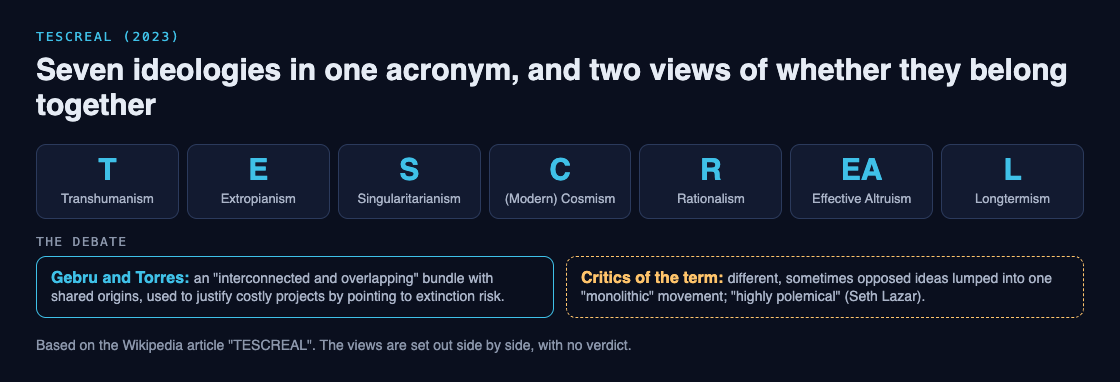
The acronym has seven parts:
- T for transhumanism.
- E for extropianism.
- S for singularitarianism.
- C for (modern) cosmism.
- R for rationalism, meaning the ideology of the rationalist community.
- EA for effective altruism.
- L for longtermism.
Some of these have their own posts here. The singularity idea is explained in technological singularity: what it means, and longtermism in longtermism and AI.
Where the term came from
Gebru and Torres first used the word in 2023, in a draft of a paper titled "The TESCREAL bundle: Eugenics and the promise of utopia through artificial general intelligence". The journal First Monday published the paper in April 2024, though the two had already made the term popular elsewhere.
In their account, the seven ideologies are a "bundle" of "interconnected and overlapping ideologies" with shared origins. They claim the bundle grew out of 20th-century eugenics. They use "TESCREAList" for people who, in their judgment, hold any or all of these views.
The argument behind it
Gebru and Torres argue that the bundle works as a movement that lets its backers use the threat of human extinction to justify expensive or harmful projects. They see it as widespread in the social and academic circles around AI in Silicon Valley. So the acronym is sometimes used to criticize a perceived belief system linked with big tech companies.
Other writers the article cites take similar lines:
- The science fiction author Charles Stross argued, using space colonization as his example, that these ideologies let the very rich pursue huge personal projects by saying that not doing them is an existential risk.
- The media scholar Ethan Zuckerman argues that weighing only the goals the movement values can justify projects with nearer harms, such as racial inequity, algorithmic bias and damage to the environment.
- Gebru, Torres and others have compared it to a secular religion, because of its parallels with Christian ideas about the end of the world.
How it frames the AI debate
This is where the term meets the ideas behind Contain ASI. According to Gebru and Torres, much of the talk about existential risk from artificial general intelligence happens among people they place in the bundle. They split those people into two camps:
- "AI accelerationists", who see AI as the only way to a utopian future where problems are solved.
- "AI doomers", who think AI is likely to be unaligned with human survival and likely to cause human extinction. Many of them, the article says, still see the development of such AI as inevitable, and argue that only building and aligning it first can avert the risk.
Gebru has called the clash between the two a "secular religion selling AGI enabled utopia and apocalypse". She and Torres argue that both camps use imagined AI futures, good or bad, to justify unlimited research, development and deregulation. They say this distracts from present harms: technology that may hurt society, falls hardest on minorities through algorithmic bias, and damages the environment.
For the arguments made by people who are worried about AI risk, in their own terms, see our post on existential risk from AI.
Criticism of the term
The term has drawn strong pushback:
- Too many things in one box. Writing in Asterisk, a magazine related to effective altruism, Ozy Brennan criticized treating different philosophies as one "monolithic" movement, and said thought experiments were taken out of context.
- Surprised members. The politics writer Danyl McLauchlan noted that while some in these groups want to engineer superhumans, others, like effective altruists who mostly want to help the poor, are astounded to be lumped into a malevolent eugenics conspiracy.
- Opposed ideas lumped together. Eli Sennesh and James Hughes argued, on the blog of the Institute for Ethics and Emerging Technologies, that the term groups philosophies whose core ideas exclude each other.
- Polemical. Seth Lazar, a philosopher of machine intelligence, said the term "is highly polemical, and ignores many other strands in the history of AI that do not meet that narrative". Torres replied that being polemical is "in the eye of the beholder".
A worked example: sort the seven ideas yourself
The core question about TESCREAL is whether its seven parts really belong together. You can test that in about 20 minutes.
- Write the seven names down the side of a page.
- Look each one up in its own Wikipedia article and write its central claim in one line, in your own words.
- Add two columns: "What does it say about AI?" and "What does it say about the far future?"
- Mark the overlaps. Where do two or more lines say the same thing? Where do they disagree?
- Decide what the grouping explains. Does treating them as one bundle help you understand the AI debate, or hide real differences? Note which reading the evidence in your table supports.
You may end up agreeing with Gebru and Torres on some links and with their critics on others. That is a fair result for a term this contested.
Exploring the debate in Contain ASI
Contain ASI does not take a side in this argument. It is a story strategy game for 1 to 4 players that runs in your browser and needs WebGL 2. Chapter 1, Before ASI, starts in January 2024 with four fictional AI labs in one race. As a researcher, research manager, CEO or government, you try for three years to keep every lab from crossing into recursive self-improvement before 2027.
The game says it is inspired by the AI 2027 scenario, and that all its labs, people and events are fictional. It is a story to think with, not a forecast of what real labs will do.
Frequently asked questions
What does TESCREAL stand for?
Transhumanism, extropianism, singularitarianism, (modern) cosmism, rationalism, effective altruism and longtermism.
Who coined the term TESCREAL?
The computer scientist Timnit Gebru and the philosopher Émile P. Torres, in 2023. Their paper on it was published in First Monday in April 2024.
Why is TESCREAL controversial?
Its authors use it to argue that these ideologies form one movement with troubling origins. Critics say it lumps together very different ideas and is "highly polemical".
What does TESCREAL have to do with AI?
Gebru and Torres argue that both AI accelerationists and AI doomers belong to the bundle, and that both use imagined AI futures to justify unlimited development while present harms are ignored.
Get started
Want to form your own view of the AI risk debate by playing it out? Open Contain ASI in your browser and start a campaign as a researcher, research manager, CEO or government.
Comments
No comments yet.
Sign in or make an account to comment.