The Age of Spiritual Machines by Ray Kurzweil explained
The Age of Spiritual Machines is a 1999 book by the inventor and futurist Ray Kurzweil about artificial intelligence and the future of humanity. Its subtitle sums up the claim: When Computers Exceed Human Intelligence. Kurzweil argues that machines will reach human-level intelligence, will appear to have free will and even spiritual experiences, and will eventually merge with us. This post explains the book's ideas, its year-by-year forecasts and the debate it started about whether a machine can be conscious, with no verdict. The claims come from Wikipedia's The Age of Spiritual Machines article.
What The Age of Spiritual Machines argues
The book was first published on 1 January 1999 and drew attention from The New York Times, The New York Review of Books and The Atlantic. By then Kurzweil had already started four technology companies. He later expanded the same ideas in The Singularity Is Near.
His starting point is evolution. He believes it shows that humans will one day build machines more intelligent than themselves. He even says evolution has an "intelligence quotient" just above zero, because it works so slowly; humans are far smarter than evolution, and our creations will in turn be smarter than us.
Three ingredients of AI
Kurzweil's law of accelerating returns explains, in his view, why important events come faster and faster, and why computing power grows exponentially. But he says computing power is only one ingredient of AI. The others are the ability to acquire knowledge automatically, and methods such as recursion, neural networks and genetic algorithms. He defines intelligence as the "ability to use optimally limited resources" to reach goals.
Machines that seem conscious and spiritual
The title comes from the book's boldest claim. Kurzweil defines a spiritual experience as "a feeling of transcending one's everyday physical and mortal bounds to sense a deeper reality". He expects machines to "claim to be conscious, and thus to be spiritual", and says they "will appear to have their own free will".
Behind this is his view of what a person is. Through thought experiments about brain implants and brain scanning, he concludes that we are not a particular set of atoms but a pattern, which could exist in different forms at different times. That is why he thinks a scanned brain could be "uploaded", and why he writes that after that "we will be software, not hardware".
He admits he has not solved how consciousness arises from matter. He also concedes that early AI research made wild claims that did not come true.
The year-by-year forecasts
The book has a dense chapter of forecasts for each of four years. Here is a sample, with dollar figures in 1999 dollars:
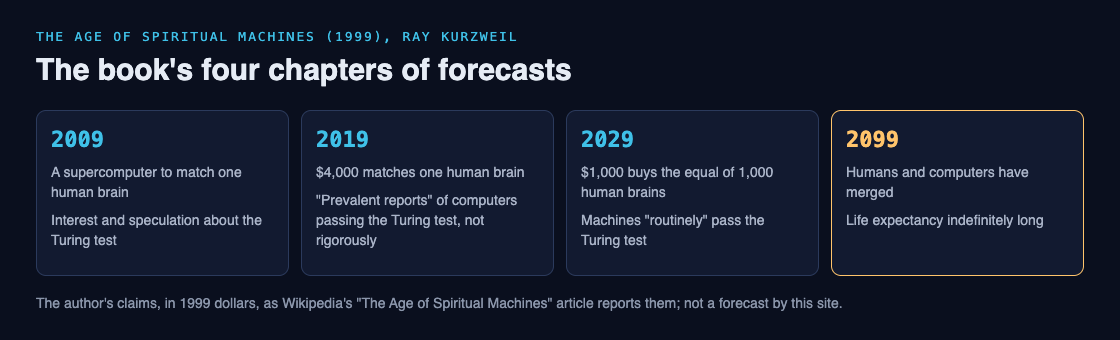
- 2009: it takes a supercomputer to match the power of one human brain; there is interest and speculation about the Turing test.
- 2019: $4,000 matches one human brain; there are "prevalent reports" of computers passing the Turing test, though not rigorously; life expectancy rises to over one hundred.
- 2029: $1,000 buys the equivalent of 1,000 human brains; machines "routinely" pass the Turing test, though people still argue about how machine and human intelligence compare; life expectancy reaches 120.
- 2099: humans and computers have merged, and life expectancy is indefinitely long.
Kurzweil also expected a new Luddite movement as intelligent machines take jobs, with a net gain of new and better jobs.
Molly
Running through the book are dialogues with a character later revealed as a young woman named Molly. She stands in for the reader, asking questions and pushing back. In the forecast chapters she seems to live in the year being described, while Kurzweil stays in the present and questions her.
What Kurzweil says about the risks
The book is mostly hopeful, but it does name dangers. Kurzweil admits that nanotechnology carries a big risk: a self-replicating substance, free of the limits on living things, could grow out of control and consume everything. His answer is that we already live with technologies that pose grave risks, such as nuclear power and weapons, and have kept them relatively safe, so he thinks we can probably do the same.
Not everyone shares that confidence about AI. Our post on existential risk from AI sets out the arguments on both sides.
The consciousness debate: Searle and McGinn
The book's sharpest critics were philosophers who doubt that computing alone can make a mind.
Kurzweil uses the chess computer that beat the world chess champion in 1997 as an early example of machine intelligence. John Searle, a philosophy professor at the University of California, Berkeley, reviewed the book in The New York Review of Books. He argued that while the champion was "quite literally, playing chess", the computer was doing "nothing remotely like it", only manipulating "a bunch of meaningless symbols". He added that a computer can simulate digestion but cannot digest a pizza, and said more computing power "moves us not one bit closer to creating a conscious machine".
Colin McGinn, writing in The New York Times, said machines might one day behave like humans, but we could never know if they have an "inner subjective experience". If they do not, he argued, uploading a person would let their mind "evaporate into thin air".
How reviewers saw it
McGinn still called the book "detailed, thoughtful, clearly explained and attractively written". Diane Proudfoot, a philosophy professor at the University of Canterbury, wrote in Science that its history was inaccurate and its philosophy flawed, giving "little confidence in his imaginings about the future". Chet Raymo, a physics professor at Stonehill College, wrote that "Ray Kurzweil has a better record than most at foreseeing the digital future". The book even inspired a 2000 concept album by the Canadian rock band Our Lady Peace.
A worked example: walk through the Chess Room
Searle's argument is easiest to judge if you play it out yourself. It is a version of his famous Chinese room.
- Picture the room. A man sits inside. Symbols come in; he handles them and passes symbols out. He does not know they are chess moves.
- Look at the result. Outside the room, those symbols win chess games.
- Ask Searle's question. Does the man understand chess? Searle says no, and so, he argues, neither does a computer.
- Ask Kurzweil's question. Does any single neuron in a chess player's brain understand chess? Kurzweil says no, yet together they produce a mind that does.
Where you land depends on whether you think understanding can come from many parts that each understand nothing. The same question comes up whenever people ask whether a machine truly understands what it does.
Exploring the idea in Contain ASI
Contain ASI is a story strategy game for 1 to 4 players that runs in your browser and needs WebGL 2. Chapter 1, Before ASI, starts in January 2024 with four fictional AI labs in one race. As a researcher, research manager, CEO or government, you try for three years to keep every lab from crossing into recursive self-improvement before 2027.
It is a game, not a forecast: the page says all its labs, people and events are fictional, and it does not mention Kurzweil. Whether or not machines could ever be conscious, the game asks a more practical question: can anyone slow a race to build them?
Frequently asked questions
What is The Age of Spiritual Machines about?
It is Ray Kurzweil's 1999 book arguing that computers will exceed human intelligence, appear to have free will and spiritual experiences, and eventually merge with humans.
What did Kurzweil forecast for 2029 in the book?
That $1,000 would buy the computing equivalent of 1,000 human brains, in 1999 dollars, and that machines would routinely pass the Turing test.
What is Searle's Chess Room argument?
A version of his Chinese room: a man in a room handles symbols that are meaningless to him, and his actions win chess games outside without him understanding chess. Searle says a computer is like the man.
How is it different from The Singularity Is Near?
The Age of Spiritual Machines came first, in 1999; Kurzweil expanded its ideas in The Singularity Is Near, his 2005 book.
Get started
Want to see whether a race toward smarter machines can be slowed? Open Contain ASI in your browser and start a campaign as a researcher, research manager, CEO or government.
Comments
No comments yet.
Sign in or make an account to comment.