The Singularity Is Near by Ray Kurzweil: the main ideas
The Singularity Is Near is a 2005 book by the inventor and futurist Ray Kurzweil about artificial intelligence and the future of humanity. It argues that technology grows exponentially, that machines will reach and pass human intelligence, and that humans and machines will merge in an event Kurzweil calls the Singularity, which he dates to 2045. This post explains the book's main ideas, its dated claims and what its critics say, with no verdict. The claims come from Wikipedia's The Singularity Is Near article.
What The Singularity Is Near is about
The full title is The Singularity Is Near: When Humans Transcend Biology. It builds on two of Kurzweil's earlier books, The Age of Intelligent Machines (1990) and The Age of Spiritual Machines (1999). A sequel, The Singularity Is Nearer, came out on 25 June 2024.
Kurzweil takes the term "the singularity" from Vernor Vinge, who made it popular in a 1993 essay, and traces the idea back to John von Neumann in the 1950s and I. J. Good in the 1960s. Our post on the technological singularity covers the general idea; this post is about Kurzweil's version.
In the book, the Singularity is the point after which machine intelligence becomes vastly more powerful than all human intelligence combined, and the point at which human and machine intelligence merge.
The law of accelerating returns
The book's engine is what Kurzweil calls the law of accelerating returns: the idea that technologies such as computers, genetics, nanotechnology, robotics and AI improve exponentially.
His reasoning is positive feedback. The results of one stage are used to build the next, so progress speeds up. Exponential growth is deceptive: it looks nearly flat for a long time, then hits what he calls "the knee in the curve" and shoots almost straight up.
Six epochs and many S-curves
Kurzweil describes the history of evolution in six epochs. Four have happened: Physics and Chemistry, Biology and DNA, Brains, and Technology. The fifth, The Merger of Human Technology with Human Intelligence, is the Singularity. The sixth is The Universe Wakes Up.
He also says the smooth curve is really a chain of smaller S-curves. Each method grows slowly, then fast, then levels off, and a new one takes over. When vacuum tubes stopped getting faster, for example, transistors carried on the growth.
Computers, brains and strong AI
Kurzweil argues that raw computing power is one bottleneck on the way to the Singularity. He settles on an estimate of about 10 to the 16th power calculations per second for the human brain, and writes that one thousand dollars will buy that much computing "by around 2020". He expects nanotubes to be the most likely next step once integrated circuits stop improving.
But he says computing power alone will not create AI. The best path, in his view, is to first understand human intelligence: image the brain in ever finer detail, then model it, from synapses up to whole regions. He also describes "uploading" a specific person's brain, and says the technology for that will exist by 2040, though he expects most people to change gradually through neural implants.
He names three revolutions: genetics, nanotechnology and robotics. The robotics revolution, he says, is really the arrival of strong AI, which the article defines as machines with human-level intelligence or greater. He calls it "comparable in importance to the development of biology itself".
What Kurzweil says about the risks
The book is mostly optimistic, but it does discuss danger. Kurzweil concedes that every technology can be misused, from viruses and nanobots to out-of-control AI machines.
His answer is defense: invest in defensive technologies, watch for dangerous pathogens, and accept limited moratoriums on certain technologies. For AI, he says the best defense is to strengthen the "values of liberty, tolerance, and respect for knowledge and diversity" in society, because "the nonbiological intelligence will be embedded in our society and will reflect our values".
It differs from the containment and control ideas in our post on AI containment. One reviewer, below, noted that the book looks more at good outcomes than at risks.
The dated claims, up to 2045
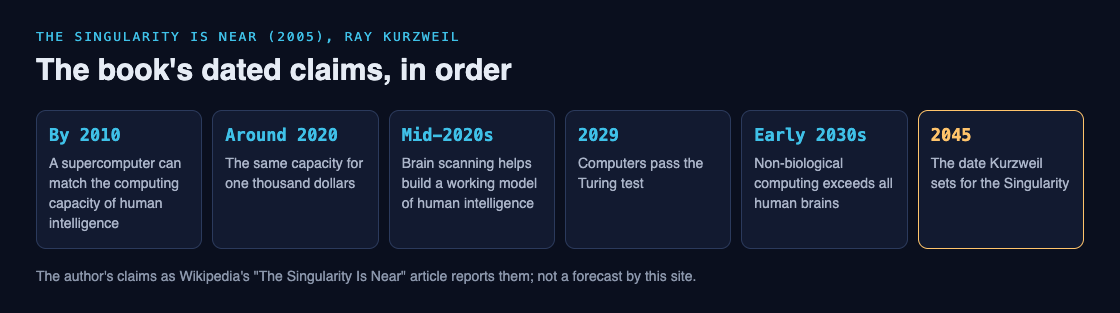
The book does not give a full timeline, but it makes several dated claims:
- By 2010, a supercomputer can match the computing capacity of human intelligence.
- By around 2020, the same capacity costs one thousand dollars.
- By the mid-2020s, brain scanning helps build a working model of human intelligence.
- By 2029, computers pass the Turing test.
- By the early 2030s, non-biological computing exceeds the capacity of all living human brains.
- In 2045, the Singularity. He writes that he sets that date for it, calling it "a profound and disruptive transformation in human capability".
How fast such a change would happen is its own debate; our post on hard takeoff vs soft takeoff sets out both sides.
What critics and reviewers say
The main objection is what critics call the "exponential growth fallacy". After the 1969 moon landing, a straight-line extrapolation would have meant lunar bases and crewed missions to distant planets; instead, exploration stalled. Paul Davies wrote that "the key point about exponential growth is that it never lasts". Theodore Modis said "nothing in nature follows a pure exponential" and argued that an S-shaped logistic curve, which rises and then flattens for good, fits real growth better.
Others question the book's religious overtones; John Gray said "the Singularity echoes apocalyptic myths". The neuroscientist David J. Linden wrote that "Kurzweil is conflating biological data collection with biological insight": data may grow exponentially while understanding grows slowly.
Reviews were split. Davies, in Nature, called it a "breathless romp across the outer reaches of technological possibility" that "needs to be taken with a huge dose of salt". Anthony Doerr, in The Boston Globe, called it "surprisingly elaborate, smart, and persuasive". Janet Maslin, in The New York Times, found it "startling in scope and bravado" but said "much of his thinking tends to be pie in the sky", and that he focuses more on optimistic outcomes than on the risks.
A worked example: is it an exponential or an S-curve?
The whole debate turns on one question: is a trend exponential, or an S-curve that only looks exponential so far? You can practise on any trend you follow.
- Find the feedback. Does each step make the next one easier, as Kurzweil argues for computing? If yes, growth can speed up.
- Find the limit. What resource could run out, as Davies warns? If there is a hard limit, Modis's flattening S-curve is more likely.
- Look for a replacement. If the current method stalls, is a new one ready, as transistors were for vacuum tubes? Kurzweil's case depends on the answer being yes, again and again.
Now try it on AI. Step 1 is the idea behind the intelligence explosion. Steps 2 and 3 are where most of the disagreement lies.
Exploring the idea in Contain ASI
Contain ASI is a story strategy game for 1 to 4 players that runs in your browser and needs WebGL 2. Chapter 1, Before ASI, starts in January 2024 with four fictional AI labs in one race. As a researcher, research manager, CEO or government, you try for three years to keep every lab from crossing into recursive self-improvement before 2027.
It is a game, not a forecast: the page says all its labs, people and events are fictional, and it does not mention Kurzweil. Where Kurzweil welcomes the moment machines pass us, the game asks you to try to hold that moment back.
Frequently asked questions
What is The Singularity Is Near about?
It is Ray Kurzweil's 2005 book arguing that technology grows exponentially, that machines will reach and pass human intelligence, and that humans and machines will merge in the Singularity.
What year does Kurzweil give for the Singularity?
- He also says computers will pass the Turing test by 2029.
What is the law of accelerating returns?
It is Kurzweil's name for the idea that technologies improve exponentially, because each stage of progress is used to build the next.
Is there a sequel to The Singularity Is Near?
Yes. The Singularity Is Nearer was released on 25 June 2024.
Get started
Want to try holding back the moment machines pass us? Open Contain ASI in your browser and start a campaign as a researcher, research manager, CEO or government.
Comments
No comments yet.
Sign in or make an account to comment.