The Wright Brothers' First Flight: What Happened in 1903
The Wright brothers' first flight: what happened in 1903 is a short story with a lot packed into it. On the morning of 17 December 1903, Orville and Wilbur Wright made four powered flights on a cold, windy beach in North Carolina. The longest lasted 59 seconds. It was enough to show that a heavier-than-air machine could take off under its own power and be flown by a pilot.
The short answer: the Wright brothers' first flight, what happened in 1903
The flights took place at Kill Devil Hills, about four miles south of the town of Kitty Hawk on the Outer Banks. The wind averaged more than 20 miles an hour, so the brothers laid their launching rail on level ground, pointing into the wind. The wind, not a slope, gave the machine the air speed it needed to leave the rail.
Here is the day, flight by flight:
- Flight one: Orville, 120 feet in 12 seconds.
- Flight two: Wilbur, about 175 feet in 12 seconds.
- Flight three: Orville, about 200 feet in 15 seconds.
- Flight four: Wilbur, 852 feet over the ground in 59 seconds.
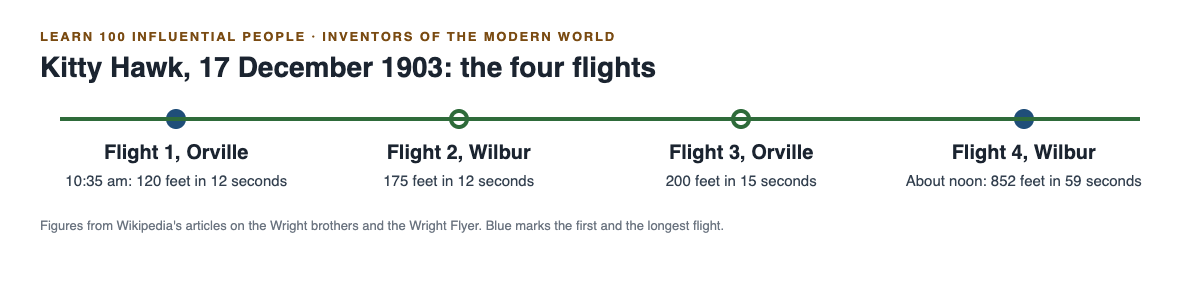
The four flights of 17 December 1903, in order.
The distances look tiny today. The first flight was shorter than the wingspan of a Boeing 747. The point was the kind of flight: the machine took off under its own power, flew under the pilot's control and came down on ground as high as where it started.
Before the flight: how Wilbur and Orville prepared
The brothers ran a bicycle repair and sales shop in Dayton, Ohio, which they had opened in December 1892. Years of work with bicycles and other machines gave them the mechanical skills they needed. They were not funded by a big backer.
When they wanted numbers for wing lift, they tested the published figures themselves. They rigged a freely turning bicycle wheel on a bicycle to compare wings. Then they built a six-foot wind tunnel in their shop and, between October and December 1901, tested dozens of miniature wings. Their method was to measure, build, test and fix.
The Wright Flyer and how it was controlled
The 1903 Wright Flyer was a biplane with a wingspan of about 40 feet. It had its small horizontal wing, the elevator, at the front instead of the back. Spruce, a light wood, was their preferred building material.
Control as well as lift
The brothers' key idea was to let the pilot control the machine on three axes, not only to get it off the ground.
- Roll: the wing tips were twisted, a method called wing warping, by a cradle the pilot moved with his hips.
- Pitch: the front elevator raised or lowered the nose.
- Yaw: a rudder turned the machine left or right.
An engine and propellers built for the job
The brothers could not find a suitable engine to buy. Charlie Taylor, who worked for them, built a light gasoline engine from scratch, with about 12 horsepower. Chains like bicycle chains drove two propellers, each about eight and a half feet long. The brothers based the propeller shape on the wing data from their wind tunnel, treating each blade as a wing that turns.
The failed try on 14 December
The Flyer did not fly on the first try. On 14 December the brothers, helped by men from the nearby life-saving station, moved it to the slope of a sand dune for a downhill start. They tossed a coin to see who would pilot, and Wilbur won.
The Flyer left the rail, but Wilbur pulled up too sharply, the machine stalled and it came down after about 105 feet and three and a half seconds. Damage was small, though repairs took three days. That is why the successful flights came on the 17th, and why Orville took the first one: Wilbur had already had his chance.
The four flights at Kitty Hawk, one by one
Flight one: Orville
Orville flew first at 10:35 in the morning, into a freezing headwind that gusted to 27 miles an hour. He covered 120 feet in 12 seconds, a ground speed of under 7 miles an hour, because the wind was doing much of the work. A camera the brothers had set up in advance caught the machine just off the rail.
Flights two and three
Wilbur flew next and went about 175 feet in 12 seconds. Orville then flew about 200 feet in 15 seconds. The flights reached about ten feet of altitude and were essentially straight; the brothers did not try to turn. Each landing was bumpy.
Flight four: the long one
Around noon, Wilbur started the fourth and last flight. Orville later wrote that the machine pitched up and down at first, then settled, then began pitching again and struck the ground. The flight lasted 59 seconds and covered 852 feet over the ground, which was about half a mile through the moving air.
The landing broke the frame that held the front elevator. The brothers hoped to repair it and even to fly four miles to Kitty Hawk village. Minutes later a powerful gust flipped the parked Flyer over several times, and it was damaged beyond a quick repair. It never flew again.
The famous photograph and the witnesses
The picture most people know shows the Flyer just off the rail on its first flight. John T. Daniels, one of five people who watched that morning, took it with Orville's pre-positioned camera. The other four were Adam Etheridge and Will Dough of the same life-saving crew, a local businessman, W. C. Brinkley, and a teenager, Johnny Moore.
On who flew first, the record is clear: it was Orville, though Wilbur had won the coin toss three days earlier. The two took turns all day, and each flew twice.
What happened after 1903
At first the news travelled badly. The brothers sent their father a telegram asking him to tell the press. The Dayton Journal refused to print the story, saying the flights were too short to be important.
The brothers kept working. In 1904 they built a second machine, the Wright Flyer II, and flew it from Huffman Prairie, a cow pasture about eight miles north-east of Dayton, to avoid the cost of travelling to the Outer Banks.
Wider attention came in 1908. On 8 August Wilbur began public demonstrations near Le Mans, France, facing doubt from the French flying community and scorn from some newspapers. In the United States, Orville flew for the Army at Fort Myer, Virginia. On 17 September a propeller split in flight and the machine crashed. Lieutenant Thomas Selfridge, an official observer riding with him, died that evening, and Orville was badly hurt. Wilbur died of typhoid fever on 30 May 1912, aged 45.
What the story shows about careful testing
The story is not about luck. It is about small steps, each with a test.
- Check the numbers you are given. The brothers tested lift data themselves, first on a bicycle and then in a wind tunnel.
- Build what you cannot buy. The engine and the propeller design came from their own work.
- Control matters as much as power. Their three-axis control let a pilot steer the machine, not only lift it.
- Expect a failed try. The 14 December stall cost three days, and the repair made the 17th possible.
Frequently asked questions
When was the Wright brothers' first flight?
It was on 17 December 1903, at Kill Devil Hills near Kitty Hawk, North Carolina. They made four flights that day, starting at 10:35 in the morning.
Who flew first, Orville or Wilbur?
Orville made the first flight, which lasted 12 seconds. Wilbur had won a coin toss for the first try on 14 December, but that attempt stalled, so Orville took the first chance on the 17th.
How long was the longest flight that day?
The fourth flight, flown by Wilbur, was the longest. It lasted 59 seconds and covered 852 feet over the ground.
What happened to the 1903 Flyer after the flights?
A powerful gust flipped it over after the fourth flight and it never flew again. The brothers shipped the wreck home to Dayton, and Orville restored it years later.
Get started
The Wright brothers are in the Inventors of the Modern World course of Learn 100 Influential People, next to Cai Lun, Gutenberg, Watt, Edison, Tesla, Bell and Ford. The site is a web app of short hands-on lessons, with questions that check what you learned. The about page says more about how it works.

The home page of Learn 100 Influential People, where the lessons start.
You sign in with your email and an emailed code. Start Learn 100 Influential People and work through the people who shaped history, one short lesson at a time.
Comments
No comments yet.
Sign in or make an account to comment.