Things I Can't Control: How to Let Go and Focus
When you search for things I can't control, you are usually stuck in worry, and the fix is not to care less about everything. It is to sort what is yours to act on from what is not, then put your effort in the first pile. The Stoics built a whole practice around this one move, and you can start it today with a pen and five minutes.
How to Find Your Meaning is a free web app of short hands-on lessons on Stoic philosophy, healthy habits and the story of who you are. You sign in with your email and an emailed code, and the lessons on acceptance are the first place to practise this sorting.
Things I can't control: why they feel so heavy
Worry has a pattern. You replay a meeting, rehearse an argument that may never happen, or refresh a message thread waiting for an answer. Your mind is working hard on something your hands cannot touch.
That is the weight. Effort goes in, nothing comes out, and the loop starts again. It feels like responsibility, but it is closer to spinning a wheel with no road under it.
Two things make it worse:
- Blur. You treat "what I do" and "what happens" as one thing. If the result goes badly, you feel you failed at everything.
- Urgency. A thing feels important, so you assume you must be able to fix it. Importance and control are different questions.
The way out starts by pulling those two apart.
What Epictetus taught about what is up to us
Epictetus opens his Enchiridion with the idea that some things are in our control and others are not. In our control, in the translation by Elizabeth Carter, are opinion, pursuit, desire, aversion and, in a word, whatever are our own actions. Not in our control are body, property, reputation, command and whatever is not our own action.
Epictetus spent part of his life as a slave before he taught, so he was not writing from a comfortable chair. His point was practical. If you pin your peace on things that can be taken, you will be anxious. If you pin it on your own judgements and actions, no one can take them.
He did not invent the idea. Earlier Stoics such as Zeno and Chrysippus had already shaped the school he inherited, and the app's course The Painted Porch: How Stoicism Began traces that history, and the lesson Epictetus: From Slavery to Teacher covers his own story. Epictetus is simply the teacher who put this idea first and made it plain.
A second idea sits beside it: it is not things themselves that disturb us, but our judgements about them. The event is one thing. The story you attach to the event is another. You often cannot change the event. You can examine the story.
In the app, the course Philosophy Is Core: Acceptance walks through this in three lessons: What Is Up to Us, Not Things but Judgements, and Accepting What Happens. Each lesson takes about nine minutes and includes a hands-on activity.
Everyday examples: work, health, and other people
Work
You hand in a proposal. Whether it is chosen is not fully up to you. The care you put into it, the time you started, and how you respond to feedback are up to you. If you spend the week imagining the decision, you lose the week.
Health
You can choose when you go to bed, whether you walk today, and what you eat. You cannot choose to never get sick or to control every test result. For anything about your own body, ask a doctor about your case. The Stoic part is narrow: put effort into the habits you can keep, and meet the rest with a steady mind.
Other people
You cannot make someone like you, forgive you or change. You can be honest, kind and clear. You can decide what you will do if they do not respond. That last part is the one most people skip.
How to sort what you can and can't control
Try this on paper. It takes about five minutes.
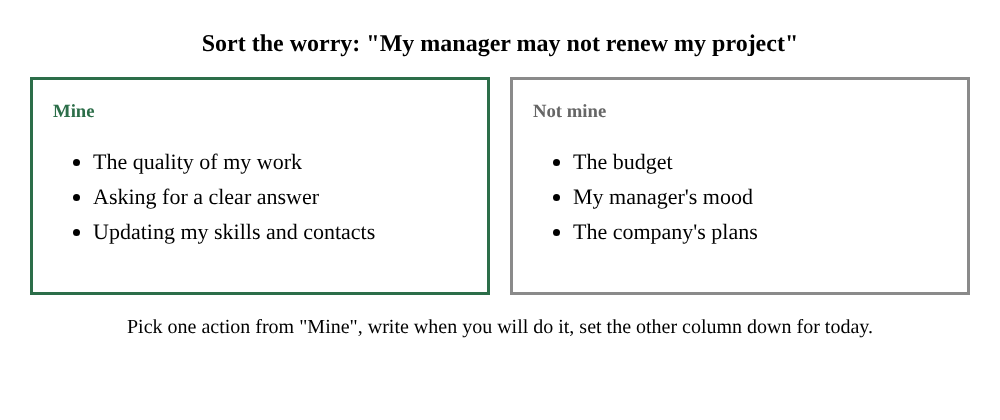
- Name the worry in one sentence. Example: "My manager may not renew my project."
- Draw two columns. Label them "Mine" and "Not mine."
- List the parts. Not mine: the budget, the manager's mood, the company's plans. Mine: the quality of my work, whether I ask for a clear answer, whether I update my skills or my contacts.
- Check each item with a test. Ask: "If I did exactly the right thing, could someone else still change the result?" If yes, the result is not yours. The action is.
- Pick one action from the "Mine" column. Write when you will do it.
- Cross out the other column for today. You are not ignoring it. You are setting it down.
Some items will sit in the middle. Your reputation is partly shaped by your behaviour and partly by what others choose to think. Sort the behaviour into "Mine" and the opinion into "Not mine."
What to do when you can't control the outcome
This is the hard case. You have done your part and the result is still open, or it went the wrong way.
Three moves help.
- Aim at the effort, not the prize. Think of an archer. The archer can control the aim and the release. Wind and movement decide the rest. Judge yourself on the shot.
- See trouble coming. The Stoic exercise of imagining what could go wrong is not gloom. It lets you decide in advance how you would respond. The app covers this in Seeing Trouble Coming, in the course Stoic Exercises.
- Zoom out. The lesson The View from Above asks you to look at your problem from a great height, as one small thing among many lives. The point is proportion, not dismissal.
For loss and grief, the lessons On the Shortness of Life and Grief and Consolation draw on Seneca. They do not tell you to feel nothing. They give you old, tested ways to carry what you cannot change.
Common mistakes that turn acceptance into giving up
Acceptance is easy to misread. Watch for these.
- "Nothing matters, so why try." The Stoics did not say that. The effort is yours and it matters. Only the outcome is held loosely.
- Using it to avoid hard talks. "I can't control how they react" is true. It is not a reason to stay silent. Say the honest thing, then let their reaction be theirs.
- Suppressing feeling. You can feel angry or sad and still choose your next action. Accepting what happened is not pretending you are fine.
- Sorting once and stopping. The line moves. A situation that was out of reach last month may have an action in it today.
- Calling everything "not mine." If your list has no items in "Mine," look again. There is almost always a next step, even a small one.
Using what you control to find your meaning
Once you stop spending energy on the wrong pile, you have more to give the right one. The right one is your conduct: how you treat people, what you practise, what you choose to do with the day.
The Stoics named four virtues for this: wisdom, justice, courage and temperance. The lesson The Four Virtues in the app introduces them, and the daily Stoic practice puts one virtue in front of you each morning to practise.
The practice has three short steps, about ten minutes in all:
- Morning: a question for the day ahead and one of the four virtues to practise.
- During the day: a short passage from Epictetus, Marcus Aurelius or Seneca, and one thing to try.
- Evening: the three questions Seneca learned from Sextius. What bad habit did I cure today? What fault did I resist? In what way am I better?
That evening review is a quiet way to check the sorting. You are asking about your own actions, which is the one thing you can always answer. The app does not promise any result from this, and it does not tell you what your meaning is. It gives you a steady place to look. You can also keep notes on each day of the practice and on any lesson, all in one place.
You can read more about the app, its three parts and how the lessons are built on the about page.
Frequently asked questions
What does it mean to focus on what you can control?
It means putting your effort into your own choices, judgements and actions, and holding results loosely. You still plan and try hard. You just do not tie your peace to an outcome other people or events can change.
Is accepting what you can't control the same as giving up?
No. Acceptance is about the facts you cannot change. You keep acting on everything you can. Giving up drops the effort too, which the Stoics did not teach.
How do I stop worrying about things I can't control?
Write the worry down, split it into what is yours and what is not, and choose one action from the first list. Do the evening review to see what you did. This takes practice, and it will not remove every worry.
Where does the idea of what is up to us come from?
Epictetus opens the Enchiridion with a version of it, but he was not the first to teach it. Earlier Stoics such as Zeno and Chrysippus laid the ground, and Marcus Aurelius and Seneca return to the theme in their own writing.
Can this help with health or money worries?
It can help you sort the habits you control from the results you do not. For your own medical or financial case, ask a doctor or an adviser.
Get started
Open How to Find Your Meaning, sign in with your email and the code it sends you, and start with the course Philosophy Is Core: Acceptance. The lessons are free with an account. If you want it on your home screen, the get the app page shows how to get it.
Start How to Find Your Meaning: free, short hands-on lessons on Stoicism, healthy habits and your own meaning, with a daily Stoic practice to live it.
Comments
No comments yet.
Sign in or make an account to comment.