Thomas Edison and the light bulb: what he really invented
Thomas Edison and the light bulb is a story with a famous line and a better truth. The line says Edison invented the light bulb. The truth is that others made electric lamps before him, and that he built something they did not: a bulb that lasted, inside a system that could light whole streets. This post sorts out who did what, using historians' accounts, so you can tell the myth from the record.
Thomas Edison and the light bulb: the short answer
Edison did not invent the first light bulb, and he did not do the work alone. The historians Robert Friedel and Paul Israel, who listed the inventors of incandescent lamps before Edison and Joseph Swan, conclude that Edison's version was "the first practical implementation". An incandescent lamp gives light by heating a thin conductor until it glows.
They name four reasons his version pulled ahead of the others:
- an effective material for the glowing part;
- a better vacuum than other versions had;
- a high electrical resistance, which made it economical to send power from one central source;
- the other parts a large lighting system needs.
So "Edison made electric light practical" is a claim you can defend. "Edison invented the bulb" is not.
Who came before: Davy and Swan
In 1802 Humphry Davy passed current from a huge battery, 2,000 cells in the basement of the Royal Institution, through a thin strip of platinum and made it glow. It was not bright enough, and it did not last long enough, to be useful. Even so, it was the starting point for scores of experimenters over the next 75 years. Davy also showed the electric arc, a spark held between two pieces of charcoal.
The most serious rival was Joseph Swan, a British physicist and chemist. He began working with carbonized paper filaments in a glass bulb with the air pumped out in 1850, and by 1860 he had a working device. Its life was short, because the vacuum was poor and electricity was hard to supply. By the mid-1870s better pumps existed, and in 1878 Swan, with the vacuum-pump expert Charles Stearn, found a way of processing the bulb that avoided early blackening.
In early 1879 Swan's lamp worked in public, and about 700 people saw it on 3 February 1879. But it used a thick carbon rod from an arc lamp, so it needed very large conductors to carry the current, and it burned for about 40 hours. In 1881 the Savoy Theatre in London was lit entirely by Swan's lamps, the first theatre and public building in the world to be. Swan's bulb was practical enough to be in daily use in London that year.
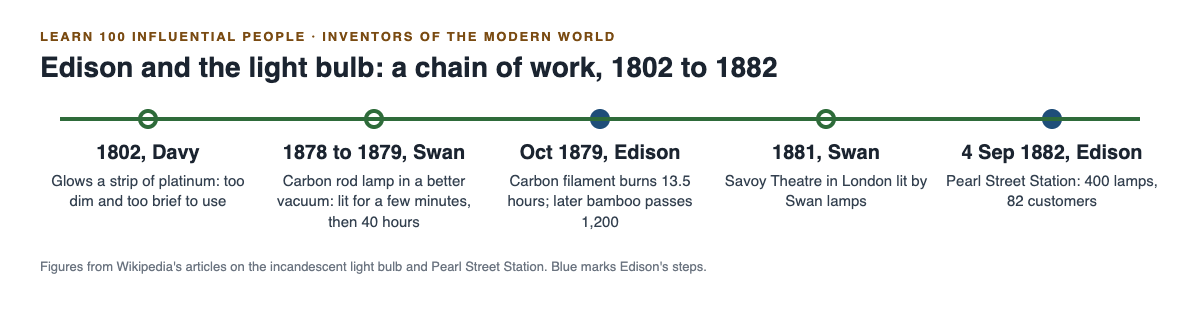
Electric light was a chain of work, not one moment.
What Edison added: a filament that lasts and a high resistance
Edison began serious work on a practical lamp in 1878 and filed his first patent application, "Improvement in Electric Lights", on 14 October 1878. After many experiments he went back to carbon. In October 1879 a carbon filament burned for 13.5 hours, and on 4 November 1879 he filed a US patent for a lamp with a carbon filament joined to platinum wires. The patent listed several ways to make the filament, including cotton and linen thread, wood splints and paper. His team later found that carbonized Japanese bamboo could last more than 1,200 hours.
The difference between Swan's rod and Edison's filament was resistance. A thin filament resists the current, so it glows with a small current. That means the wires that feed it can be thinner and cheaper. In 1889 a judge upheld Edison's claim to "a filament of carbon of high resistance", after a patent office ruling in 1883 had said his patents rested on the earlier work of William Sawyer.
More than a bulb: the system behind it
The historian Thomas Hughes argues that Edison's business success came from building a whole, linked system of electric lighting. The lamp, he says, was a small part of it, no more critical than the generator, the main and feeder wires and the way lamps were connected side by side. Other inventors with lamps and generators of similar skill are forgotten because they did not oversee a complete system.
Edison's team worked on the pieces a customer needs:
- a power company, the Edison Illuminating Company, founded on 17 December 1880;
- a three-wire wiring scheme, which let smaller wires carry the load and so cut the copper needed;
- a meter: a cell with zinc plates that were weighed every month to show how much current each customer had used.
On 4 September 1882 Pearl Street Station in New York City began generating power, with an initial load of 400 lamps for 82 customers at 110 volts of direct current. By 1884 it served 508 customers and 10,164 lamps. The system had a limit: his direct current plants could not serve customers more than about one mile away, while alternating current, helped by transformers, could travel far over thinner wires.
Menlo Park and who really did the work
Edison's laboratory at Menlo Park, New Jersey, built in 1876, is now considered the first industrial research laboratory. His staff were told to carry out his directions, and he drove them hard. His name is on 1,093 US patents, about one every 10 to 12 days of his adult life, and as head of the laboratory he was credited for inventions made in large part by the people working under him.
That is the honest way to read "Edison's bulb": a team effort, led and financed by Edison, built on earlier work. Other inventors improved the filament too. Alessandro Cruto showed thin carbon filaments in 1880, and Lewis Latimer patented a better way of making them in 1882. The same pattern of one name on top of many hands shows up in the Wright brothers' first flight, and in Gutenberg's printing press, which also built on older skills.
Why Edison got the credit
Three things put his name first.
- A working product. In 1880 the steamer Columbia became the first ship to use his lamps, and the Pearl Street customers followed.
- Patents. His US patents and the court rulings over them, from 1883 to 1889, kept his name in front of the public.
- Business deals. In Britain the Edison and Swan companies merged into one firm, called Ediswan. Edison was against it at first but was forced to cooperate, and in time he bought all of Swan's share.
One more story is worth leaving behind. In 1893 Heinrich Goebel claimed he had made a bulb with a bamboo filament in 1854. Judges in four courts doubted it, no final decision was reached, and research published in 2007 concluded the Goebel story is fictitious.
A worked example: test the claim in three questions
You can use the same three questions on any "X invented Y" claim. Here they are on this one.
- Did something like it exist before? Yes. Davy lit a platinum strip in 1802, and Swan showed carbon lamps in 1878 and 1879.
- What did X change? A carbon filament of high resistance, a better vacuum, and the parts of a lighting system, from the power station to the meter.
- Who else was working on it? Swan, Sawyer, Cruto, Latimer and Edison's own team at Menlo Park.
Now rewrite the claim to fit the answers: "Edison led the team that made electric light practical and sold it as a system." It is longer than the myth, but it is the one a historian would sign. Do the same for any name on a "most influential" list, as in who invented paper, where the answer also turns out to be a chain.
Frequently asked questions
Did Thomas Edison invent the light bulb?
Not first, and not alone. Davy lit a platinum strip in 1802, and Joseph Swan showed carbon lamps in 1878 and 1879. Edison's team made a long-lasting, practical bulb and built a lighting system around it.
Who invented the light bulb before Edison?
Humphry Davy made a strip of platinum glow in 1802, and Joseph Swan began on carbon filaments in 1850. Swan's lamps lit the Savoy Theatre in London in 1881.
What did Edison improve about the bulb?
He used a thin carbon filament of high resistance, a better vacuum, and a design that fit a central power supply. His team found that carbonized bamboo lasted more than 1,200 hours.
Why is Edison more famous than Joseph Swan?
Edison built and sold a complete system, held strong patents and drew press attention. Swan's claim was real too, and the two British companies merged into Ediswan.
Get started
Edison is one of the people in the Inventors of the Modern World course in Learn 100 Influential People, with Cai Lun, Gutenberg, Watt, Tesla, Bell, the Wright brothers and Ford. The lessons last about nine minutes, with hands-on activities and questions. They set out where researchers disagree and list their sources. You sign in with your email and an emailed code.
The home page of Learn 100 Influential People, where the lessons start.
Start Learn 100 Influential People: short hands-on lessons on the people who shaped history, with every side of the debate and the sources to read next.
Comments
No comments yet.
Sign in or make an account to comment.