Tim Berners-Lee: how the World Wide Web began
If you want to know how the World Wide Web began, the best place to look is Tim Berners-Lee's own record. In March 1989 a software engineer at CERN, the European particle physics laboratory in Geneva, wrote a short proposal about a very local problem: people kept losing track of information. Within two years his answer was running on the Internet for anyone to use. This post follows the story through his own pages, explains what the Web is and is not, and ends with a way to read his proposal yourself.
Who is Tim Berners-Lee?
Tim Berners-Lee is the computer scientist who, in the words of his own biography, "invented the World Wide Web while at CERN" in 1989. He wrote the first web server and the first web browser in 1990, and his specifications for URIs (web addresses), HTTP and HTML were refined as the Web spread.
His longer biography gives the background. He graduated from the Queen's College, Oxford, in 1976, where he built his first computer with a soldering iron, an M6800 processor and an old television. He then wrote software for telecoms and printing firms before coming to CERN.
Later honours followed: a knighthood in 2004 and, in 2017, the ACM Turing Award "for inventing the World Wide Web, the first web browser, and the fundamental protocols and algorithms allowing the Web to scale." In 1994 he founded the World Wide Web Consortium, W3C, which develops the standards the Web runs on.
Enquire: the 1980 program behind the idea
The Web did not start in 1989. In 1980, during a six-month stint as a consultant at CERN, Berners-Lee wrote a program for his own use called Enquire. His biography says it stored information "including using random associations", was never published, and "formed the conceptual basis" for the World Wide Web.
The key idea was the link. Instead of filing a note in one fixed place, you connect it to the other notes it relates to. In 1984 he returned to CERN on a fellowship, and the problem Enquire had touched turned out to be CERN's problem too.
The 1989 proposal: how the World Wide Web began on paper
In March 1989 he wrote "Information Management: A Proposal". His note on the page explains that it was "an attempt to persuade CERN management that a global hypertext system was in CERN's interests."
The problem was plain. CERN had thousands of people working on complex, changing projects, and people did not stay long. As the proposal puts it: "When two years is a typical length of stay, information is constantly being lost." And worse: "Often, the information has been recorded, it just cannot be found."
His answer was "a distributed hypertext system": documents on many computers, linked to each other, so you could follow a question like "Who wrote this code?" from one page to the next. He also saw past CERN. The proposal calls CERN "a model in miniature of the rest of world in a few years time."
The idea did not have its famous name yet. He notes that the only name he had for it then was "Mesh". He chose "World Wide Web" in 1990, while writing the code.
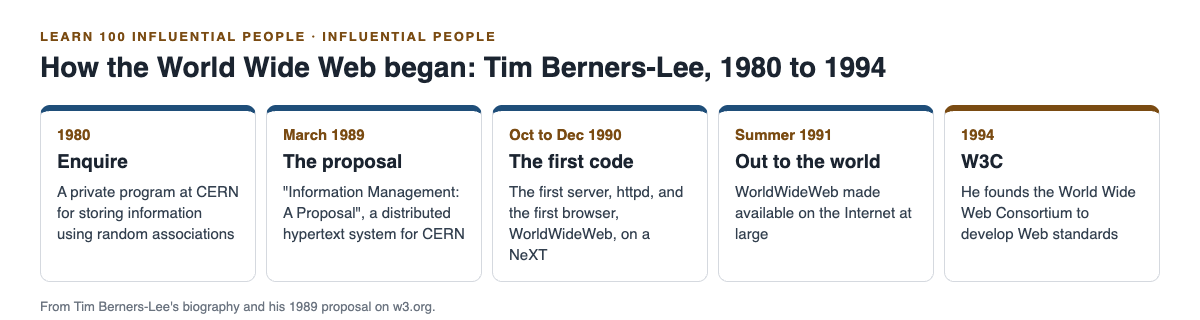
Five dates from Berners-Lee's own biography and proposal.
1990 to 1991: the first browser, server and web page
The longer biography gives the dates. Work started in October 1990. He wrote the first web server, called httpd, and the first browser, called WorldWideWeb, which could also edit pages and ran on a NeXT computer. The program was made available inside CERN in December 1990 and "on the Internet at large in the summer of 1991."
His press questions page says the first web page served over HTTP, at the end of 1990, was the project's own home page, later known as info.cern.ch/hypertext/WWW/TheProject.html. You can still open it. Its first line describes the Web as an initiative "aiming to give universal access to a large universe of documents."
He did not do it all alone. On the same page he credits Mike Sendall, who let him start the project, and Robert Cailliau, another CERN engineer, who was the first convert and put huge effort into promoting it. From 1991 to 1993, his biography says, he kept refining the design with feedback from users across the Internet.
The Web is not the Internet
This is the most common mix-up, and Berners-Lee answers it himself in his frequently asked questions. He did not invent the Internet. It already existed, and had for about fifteen years, when he invented the Web. For the Internet itself he points to Vint Cerf and Bob Kahn, who defined the Internet Protocol.
In his explanation, the Internet is a network of networks: computers and cables that pass small packets of data to the right place. Many programs use it. Email was around long before the Web. The Web is one service that runs on top of the Internet: pages with addresses, linked to each other, that any browser can fetch.
Keeping the two apart is a good test of any source. A book or video that says Berners-Lee "invented the Internet" has the story wrong.
Why he made the Web open
Berners-Lee did not keep the Web as his own product. Asked about this in the same FAQ, he says making it an open system was necessary for it to be universal: had the technology been proprietary and under his control, it would probably not have taken off.
Others built on it quickly. His FAQ describes how Marc Andreessen and Eric Bina at NCSA wrote their own browser, Mosaic, from scratch. In 1994 he founded W3C so that the Web's standards would be agreed in the open.
His own view of the Web today is more mixed. His biography describes his work on Solid, which "aims to give people control and agency over their data", and his 2025 book, This is for Everyone. Whether the Web he built has kept its promise is a debate he still takes part in.
Worked example: read the 1989 proposal in 20 minutes
Here is a way to meet Berners-Lee through his own words, using the steps from our guide to how to analyze a primary source.
- Source it (3 minutes). Open the 1989 proposal. Note who wrote it, when (March 1989, with a date added in May 1990) and for whom: CERN's management.
- Find the problem (5 minutes). Read the section "Losing Information at CERN". Copy one sentence that states the problem in your own notes.
- Find the answer (7 minutes). Read on to "Linked information systems". Write one sentence on what he proposed, in your own words.
- Check it (5 minutes). Compare the proposal with the first web page at info.cern.ch. What from 1989 is already there in 1990, and what is new, such as the name?
Then place him among the other people who changed how we store and share knowledge: Gutenberg's printing press, Ada Lovelace's notes and Alan Turing's contributions.
Frequently asked questions
When did the World Wide Web begin?
Berners-Lee proposed it at CERN in March 1989, wrote the first server and browser from October 1990, and made it available on the Internet in the summer of 1991.
Did Tim Berners-Lee invent the Internet?
No. He says himself that the Internet already existed and points to Vint Cerf and Bob Kahn; he invented the Web, which runs on top of it.
What was the first website?
The first web page served over HTTP, at the end of 1990, was the project's home page at CERN, later known as info.cern.ch/hypertext/WWW/TheProject.html.
What did Berners-Lee first call the Web?
In his 1989 proposal the only name he had for it was "Mesh"; he chose "World Wide Web" in 1990 while writing the code.
Get started
Berners-Lee is the last name in a story that runs, as the site puts it, from Moses to the web. Learn 100 Influential People teaches the 100 people who most shaped human history in 15 courses and 46 lessons of about 9 minutes, with 272 questions to check what you learned. 38 cards set out where researchers disagree, and every lesson lists its sources. Sign in with your email and an emailed code, and read what the site is for.
Comments
No comments yet.
Sign in or make an account to comment.