Tower house castles: living in one tall tower
Tower house castles put a lord's home, stores and defence into one tall stone tower. Instead of a ring of walls around a wide bailey, you got height: storage at the bottom, the best rooms higher up, and battlements on top. This guide explains what tower house castles were, using four towers that English Heritage describes in detail, and gives you three questions to read any of them.
A note on words. "Tower house" is the search term most people use. English Heritage calls Belsay in Northumberland a "pele tower", which it defines as "a regional type of fortification built by rich families in the late Middle Ages to defend themselves." The other three towers below are described simply as towers. This post uses each source's own words.
What tower house castles were
A tower house was a tower that people lived in, not only fought from. It usually stood beside or inside other buildings: a hall, a courtyard, a wall. English Heritage's Longthorpe page makes the point that this idea was old. "The association of massive towers with ordinary 'low-rise' houses had 12th-century precedents and outlasted the Middle Ages."
So a tower house is less a fixed type than a habit. A family with money added a strong, tall building to its home. Why they did it varied, and the four towers below give four different reasons.
Longthorpe: a lawyer's status symbol
Longthorpe Tower was built by Robert Thorpe, a lawyer, between about 1290 and 1300. He attached it to a hall and cross-wing built about 1250 to 1270. English Heritage calls the result "as much a status symbol as a refuge": a tower 13 metres (40 feet) high, with battlements.
The page also says a tower like this was "an unusual feature in southern England." Its fame today comes from inside. The main first-floor room has wall paintings, found in 1945 under many coats of limewash and distemper.
Edlingham: comfort first, defence later
Edlingham in Northumberland began as a hall house, built about 1300 by Sir William Felton "at a time when Northumberland was relatively peaceful." Its ground floor, the undercroft, was "used for storage", and the lords' rooms were on the first floor.
About 1340 to 1350 his son, also William, built a solar tower "to improve domestic comfort." It is three storeys high, and "each floor contained a single chamber." The first-floor room has a double line of windows and the remains of an elaborate fireplace. Only then, "as the Anglo-Scottish wars continued", did he strengthen the defences with a gate tower and a stone curtain wall.
Nunney: a soldier's ideal
Nunney in Somerset was built by a knight, John de la Mare, under a royal licence of 1373. English Heritage says it was "built by a soldier returning from fighting abroad" and is "as much the realisation of an ideal as a stronghold intended for serious defence." The licence to crenellate post explains what that royal licence was.
The tower has a four-lobed plan and a moat around it. Inside were "a kitchen at ground floor level, a hall on the third floor and withdrawing chambers on the top floor", with a chapel opening off them in a corner tower. The castle kitchens post uses Nunney to show how far food had to climb.
Belsay: a pele tower on the border
Belsay sits in what English Heritage calls Northumberland's "border country." The Middleton family has lived there almost continuously since the 13th century, but the great fortified tower came later, in the late 14th century, "probably added to an existing manorial complex."
English Heritage gives two reasons at once. The tower "was both a statement of family pride and a response to the conflict and unrest in this border region between England and Scotland." Then the reasons faded. The union of the two kingdoms under James I in 1603 "brought relative peace to the border region", and on Christmas Day 1817 the family moved from the castle into a new hall nearby.
Worked example: read a tower house in three questions
Use these three questions on any tower house, at the site or on its history page.
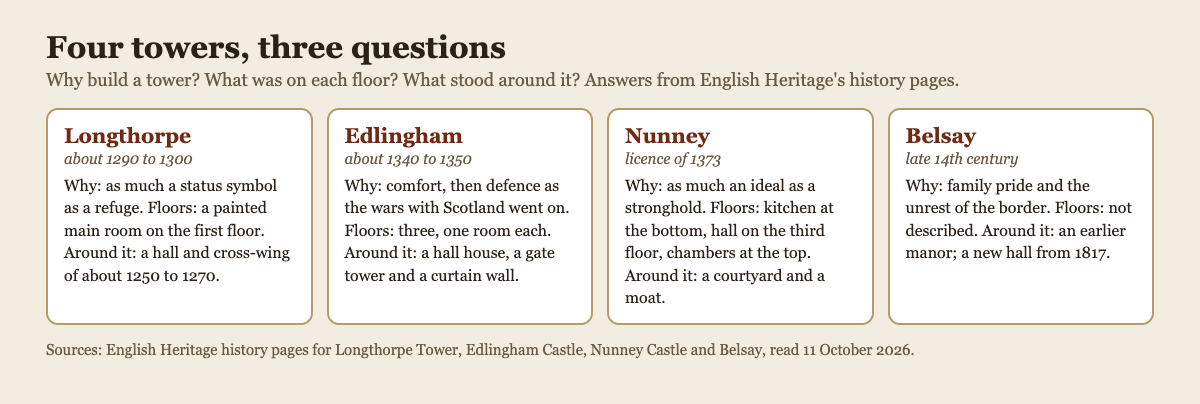
- Why build a tower? Look for the source's own reason. Longthorpe: status as much as refuge. Edlingham: comfort first. Nunney: an ideal as much as defence. Belsay: pride and the unrest of the border.
- What was on each floor? Edlingham: one chamber a floor, the best room on the first floor. Nunney: kitchen at the bottom, hall on the third floor, private rooms at the top. Longthorpe: the painted room on the first floor. Belsay's page does not say, so leave it blank.
- What stood around it? Longthorpe: an older hall and cross-wing. Edlingham: a hall house, then a gate tower and curtain wall. Nunney: a courtyard and a moat. Belsay: an older manor, and later a new hall.
Now compare the answers. None of the four sources says its tower was built for defence alone. That is the honest lesson of these four pages: a tower house was a home that could defend itself, built by families who also wanted to be seen. The castle keep post shows a bigger great tower read the same way.
Tower house castles and Two Towers
Two Towers is a free medieval tower defense game that plays in your browser, with no ads. Its title screen sets the task in one line: "Two towers. One gate. Hold it as long as you can."
The towers in the game are not homes. They are the two towers you choose to guard the gate, such as the Archer Tower ("Fast arrows"), the Trebuchet ("Stones on a crowd") or the Ballista ("Bolts through armor"), upgraded with the gold you win. One castle you can defend is the Old Keep, "Grey stone and slate, as it always stood." It is a game, not a history course, but it puts you in the spot every tower builder above planned for: what happens when someone comes to the gate.
Frequently asked questions
What is a tower house castle?
A tall stone tower that a family lived in, usually beside a hall or inside a courtyard. The best rooms were higher up, and it could be defended.
What is a pele tower?
English Heritage defines it as a regional type of fortification built by rich families in the late Middle Ages to defend themselves. Belsay in Northumberland is one of the best-surviving examples.
Were tower houses built only for defence?
Not in these four cases. English Heritage gives status, comfort or an ideal as a reason for each one, and puts defence beside it, not alone.
Where can you see a tower house in England?
English Heritage has a history page for each tower in this post: Longthorpe Tower (now managed by Nene Park Trust), Edlingham Castle, Nunney Castle and Belsay.
Get started
Pick one tower house near you and run the three questions on its history page. Then try holding a gate yourself: play Two Towers free in your browser and see how long your two towers last.
Comments
No comments yet.
Sign in or make an account to comment.