Transhumanism and AI: what transhumanists believe
Transhumanism is a movement that wants to use technology to take humans beyond their current natural limits, especially by extending life and improving thinking, health and well-being. Several of its ideas involve AI: superintelligence, the technological singularity and mind uploading. This post explains how transhumanism and AI connect, what named thinkers have said, and where the critics disagree. The claims come from Wikipedia's Transhumanism article.
What transhumanism is
Wikipedia calls transhumanism an intellectual and cultural movement. It advocates using existing, emerging and speculative technologies to enhance humans beyond current natural limitations. Its key areas are nanotechnology, biotechnology, information technology and cognitive science, often shortened to NBIC.
Transhumanists imagine that these technologies, combined, could one day let humans become "posthumans": beings whose capacities exceed those of present-day humans.
In 1990, Max More, a strategic philosopher, gave the definition that laid the foundation of modern transhumanism: "a class of philosophies that seek to guide us towards a posthuman condition".
Where the idea came from
The biologist Julian Huxley popularized the term "transhumanism" in a 1957 essay. He defined it as the idea that humanity can consciously transcend its limitations through reason, science and technology, while remaining fundamentally human.
In 1998, the philosophers Nick Bostrom and David Pearce founded the World Transhumanist Association, which changed its name to Humanity+ in 2008.
The movement has drawn both support and criticism from philosophical, religious, ethical and political perspectives. If you came here from the debate over the term TESCREAL, our post TESCREAL: what the term means and why it is debated covers that term. This post sticks to transhumanism itself.
How transhumanism and AI connect
Transhumanists support a group of technologies. The article lists several hypothetical future ones, including artificial intelligence, superintelligence, simulated reality, mind uploading and cryonics. Transhumanists believe humans can and should use these technologies to become more than human.
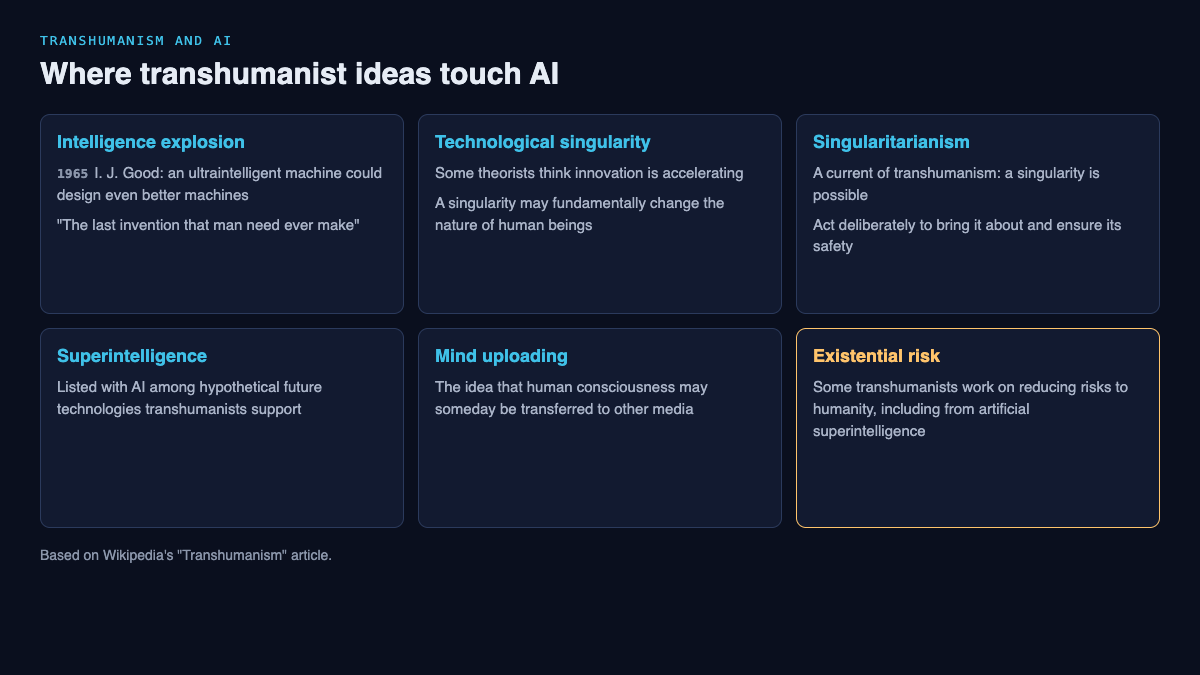
Six transhumanist ideas that touch AI, based on Wikipedia's Transhumanism article.
The intelligence explosion
In 1965, the British cryptologist I. J. Good first proposed the idea now called the technological singularity: the ultra-rapid arrival of superhuman intelligence. He wrote that an "ultraintelligent machine could design even better machines", which would cause an "intelligence explosion". In his words, "the first ultraintelligent machine is the last invention that man need ever make."
Computer scientist Marvin Minsky wrote on the relationship between human and artificial intelligence from the 1960s. Roboticist Hans Moravec proposed creating intelligent artificial beings, an idea that has influenced transhumanism.
The singularity
Some theorists think technological innovation is speeding up. They think the next 50 years may bring a technological singularity, which may fundamentally change the nature of human beings. Transhumanists who expect this change generally think it is desirable, though some worry about the dangers of very rapid change. Our post on the technological singularity explains the idea in more depth.
One current of the movement goes further. Singularitarianism holds that a technological singularity is possible, and calls for deliberate action to bring it about and keep it safe. Our post on singularitarianism covers it.
Mind uploading
Some transhumanists believe the human mind and computer hardware are compatible. If so, human consciousness may someday be transferred to other media. This is commonly known as mind uploading.
Neuroscientist Anders Sandberg has worked on scanning ultra-thin sections of the brain. The method is currently used on mice. The article calls it the first step towards hypothetically uploading a human brain onto a computer.
Existential risk: the worried side of the movement
Not all transhumanists are simply hopeful about AI. Some focus on reducing existential risks to humanity, including risks from artificial superintelligence, asteroid impacts, nuclear war and pandemics.
Nick Bostrom has written extensively on existential risks, including ones that emerging technologies could create. One solution he proposed is differential technological development. The idea is to slow down possibly harmful technologies while speeding up likely beneficial ones, especially those that protect against the harms of others. Our post on existential risk from AI sets out the main arguments on each side.
The physicist and transhumanist thinker Giulio Prisco writes that "cosmist religions based on science might be our best protection from reckless pursuit of superintelligence and other risky technologies."
Others push back from different sides. The British Astronomer Royal Martin Rees argues that advanced science and technology bring as much risk of disaster as opportunity for progress, though he does not call for a halt. Some precautionists believe AI and robotics may produce other forms of cognition that could threaten human life. In their 2021 book Calamity Theory, Joshua Schuster and Derek Woods argue that Bostrom's approach relies too much on fringe science and speculative technologies.
The debate around transhumanism
Criticism takes two main forms. Practical critics doubt the goals can be reached. Ethical critics object to the moral principles behind them. This post sets out each position and takes no side.
Doubts about feasibility
Philosopher Mary Midgley, in her 1992 book Science as Salvation, traced the idea of immortality by leaving the body behind, echoed in mind uploading, to a group of early 20th-century scientific thinkers. She called these ideas "quasi-scientific dreams and prophesies".
Public health professor Gregory Stock is generally sympathetic to transhumanism. But he is skeptical that turning humans into cyborgs is technically feasible or widely wanted. He says many people will be deeply integrated into systems of machines, but remain biological.
AI pioneer Joseph Weizenbaum criticizes the ideas of some colleagues, in particular Minsky and Moravec. In his view, devaluing the human organism enables divisive and undemocratic social policies.
Religious objections
Some Christian thinkers see mind uploading as a denigration of the human body. Other religious critics have faulted transhumanism for offering no eternal truths or relationship with the divine. On the other side, theologians Ronald Cole-Turner and Ted Peters hold that the doctrine of "co-creation" obligates people to use genetic engineering to improve human biology.
Eugenics and inequality
Some critics argue that transhumanism revives eugenic ideology under the banner of individual choice. The major transhumanist organizations strongly condemn the coercion of past eugenic policies and reject their racist and classist assumptions. Most transhumanist thinkers instead advocate a "new eugenics", a form of egalitarian liberal eugenics, and most who hold this view prefer the terms "germinal choice" or "reprogenetics" to "eugenics".
On inequality, environmental ethicist Bill McKibben suggests enhancement technologies would mostly reach people with more money, creating a "genetic divide". Political economist and philosopher Francis Fukuyama calls transhumanism the world's most dangerous idea, because he believes it may undermine the egalitarian ideals of democracy. Science journalist Ronald Bailey answers that political equality has never rested on the facts of human biology.
A worked example: sort the claims by what would test them
Transhumanist claims about AI mix different kinds of statement. Take the four claims below and put each in one of three boxes: testable now, testable only in the future, or a question of values.
- "Thin sections of the brain can be scanned." Testable now: the article says the method is already used on mice.
- "An ultraintelligent machine could design even better machines." Testable only in the future: the article lists superintelligence among hypothetical future technologies.
- "Human consciousness may someday be transferred to other media." Future, and you would also have to agree on what counts as success.
- "It is desirable for humans to enhance themselves beyond what is naturally human." Values: evidence can tell you what a technology does, not whether you should want it.
Use the boxes on any argument you hear. If one person argues from the future box and the other from the values box, more evidence will not settle it.
Contain ASI: a fictional race, not a transhumanist story
Contain ASI is a story strategy game for 1 to 4 players that runs in your browser and needs WebGL 2. Chapter 1, Before ASI, starts in January 2024 with four fictional AI labs in one race. As a researcher, research manager, CEO or government, you try for three years to keep every lab from crossing into recursive self-improvement before 2027.
It is a game, not a forecast. The page says it is inspired by the AI 2027 scenario and that all its labs, people and events are fictional. It does not mention transhumanism. But it puts you on the worried side of this post, trying to keep AI labs from crossing into recursive self-improvement.
Frequently asked questions
What do transhumanists believe about AI?
They count AI and superintelligence among the technologies humans should use to become more than human. Some also focus on reducing existential risks, including from artificial superintelligence.
Who coined the term transhumanism?
The biologist Julian Huxley popularized it in a 1957 essay. The article says the term itself derives from a 1940 paper by the Canadian philosopher W. D. Lighthall.
Is transhumanism the same as singularitarianism?
No. Singularitarianism is one current within transhumanism, based on the belief that a technological singularity is possible.
Do all transhumanists want to live forever?
No. In one survey of 818 transhumanists, 23.8% said they did not want immortality.
Get started
Want to feel what it is like to hold back a race toward recursive self-improvement? Open Contain ASI in your browser and start a campaign as a researcher, research manager, CEO or government.
Comments
No comments yet.
Sign in or make an account to comment.