Two Towers king stage: how to hold every fifth stage
The Two Towers king stage comes every fifth stage, and it is where most runs end. On stage 5, 10, 15 and every fifth stage after, a king leads the attack. The game calls him very strong, and he hurries the attackers around him. This guide explains what changes on a king stage, gives you a five-stage plan for your gold and your gate, and shows how to learn from a loss using the game's own words.
Everything here about the game comes from the text it shows you on twotowers.vlvd.net. Where the game gives no number, this guide gives none either.
What the Two Towers king stage is
Two Towers is a medieval tower defense game. Attackers march out of the woods toward your city gate, and your towers shoot them on the road. If the gate falls, the game is over. Every stage comes stronger, faster or in greater numbers than the last, and there is no final stage.
Most stages bring a mix of attackers: peasant levies, archers, knights, monks, cavalry, hounds and more. Every fifth stage adds one more: the king. The game describes him as very strong, and says he hurries those around him. That second part matters as much as the first. A king does not walk alone. The crowd near him moves faster, so it reaches the gate sooner and spends less time inside your towers' range.
So a king stage tests two things at once. Can your towers do enough damage to bring down one very strong attacker? And can your gate take the hits from everyone who arrives early because he hurried them?
The game's own tip, line by line
The game gives one line of advice for every kind of attacker. For the king it says:
A king leads every fifth stage: Reinforce the gate before it and save gold for Damage.
There are two instructions in that line, and the order is the point.
- Reinforce the gate before it. Open the gate's sheet between stages. Repair puts back what attackers broke (the sheet shows +25%) and is not offered when the game says "The gate is whole". Reinforce raises the gate's strength above that, and the button shows how much strength you get and what it costs in gold. Before a king stage, Reinforce is the one to want.
- Save gold for Damage. A very strong attacker needs a lot of hits. Damage upgrades make each hit count for more. The game's general tip says the same for every stage: "Spend your gold on Damage between stages, and Reinforce the gate."
If you have read our guide to when to repair and when to reinforce the gate, this is the same idea with a deadline. You know exactly when the hard stage comes, so you can plan for it.
A five-stage plan you can follow
Here is a plan for stages 1 to 5. It repeats for 6 to 10, 11 to 15, and so on. The game gives no gold prices for upgrades or for Reinforce, so the split between saving and spending is yours to tune.
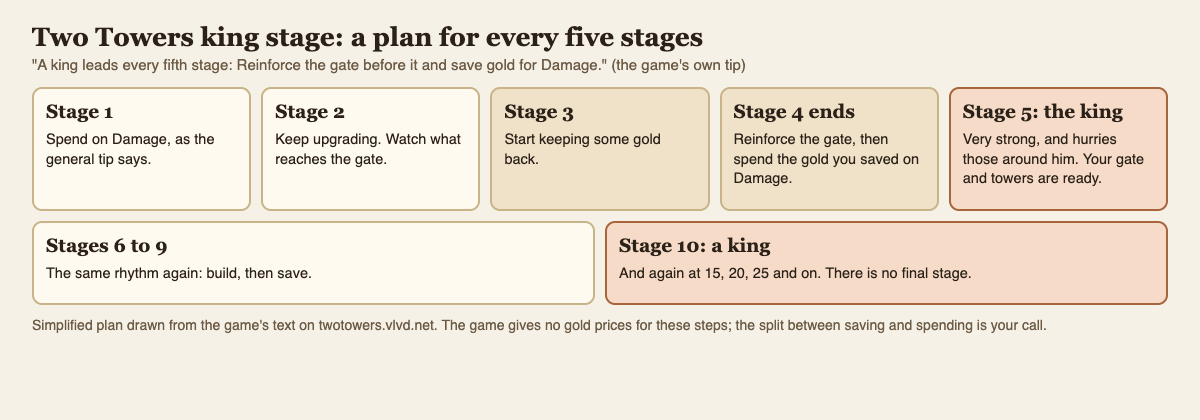
- Stages 1 and 2: build. Spend what you win on Damage for both gate towers, as the general tip says. Early attackers are weaker, so this is the easiest time to grow.
- Stage 3: start saving. Keep buying, but leave some gold unspent at the end of the stage. If you plan a hill tower, this is when 150 gold for the first one starts to compete with everything else.
- When the game says "Stage 4 held": prepare. Open the gate's sheet and Reinforce. Then tap each tower and spend the gold you saved on Damage.
- Before stage 5 starts: check. The game counts down ("Stage 5 begins in" and a number) and offers "Start the stage now". Do not press it until the gate and both towers are ready.
- Stage 5: watch, do not panic. Press Space to pause if you need to look at the field. Press F for double speed only once you trust your setup.
Then start again. Stages 6 to 9 rebuild your gold; stage 10 brings the next king. The game also rebuilds your towers stronger every five stages, through Ages from Timber to Legendary. It does not say whether that lands on the king stage itself, so watch your towers and see.
Which towers and upgrades answer the king's escort
The king hurries those around him, so the attackers near him are the ones to plan for. The game's tips say which towers answer each kind. A few matter most on a king stage:
- Monks heal those around them. The tip: "kill them first, with Archer Volley or a Ballista." A monk healing next to a king is the worst pairing on the road.
- Standard bearers lend armor to the attackers around them. The tip: "bring them down first with a Ballista."
- Knights have armor that turns arrows. "Ballista bolts and fire go straight through it."
- Cavalry already ride fast. "Fire rate and Archer Volley catch them before the gate." Hurried by a king, they arrive sooner still.
If your two gate towers are an Archer Tower and a Ballista, you have answers to all four. If you chose differently, our guide to which two towers to pick first walks through the pairs, and tower defense tips by attacker covers the rest of the list.
How to learn from a lost king stage
When the gate falls, the game tells you why. It shows a line like "The gate fell mostly to" an attacker, with the share of the damage that attacker did. Then it offers "Start again from stage 1".
Read that line before you start again. It turns a loss into a plan:
- If the king did most of the damage, you needed more Damage before stage 5, or more strength on the gate.
- If knights or a ram did most of it, your towers were not getting through armor. The tips point to Ballista bolts and fire.
- If archers or crossbowmen did most of it, they were shooting the gate from the road. The tips point to Range.
Then change one thing on the next run, not five. That is how you find out what actually worked.
When a real king led the siege
The game's king is a strong attacker on a road. In real medieval England, a king leading a siege meant something bigger: a royal army, and the cost of keeping it in the field.
English Heritage's ten things about sieges uses Kenilworth in 1266 as its example. About 1,200 rebels who wanted to curb Henry III's power held Kenilworth Castle, which had very strong defences. The siege began on 25 June and lasted 172 days. Feeding the king's army was so hard that at least 20 counties had to supply food, and the Sheriff of London even sent a whale.
The same page says royal armies often gave farmers no choice but to sell to the army at low prices, and that sieges were so expensive that the people inside were generally offered good terms of surrender. The terms could differ even within one war. In the English Civil War the garrison at Pendennis marched out with full honours of war, while the Royalists at Goodrich became prisoners and gave up their arms and property.
The lesson travels into the game in a loose way. A king's attack was the moment when everything was committed at once. Your job on a king stage is the defender's version: have the gate and the towers ready before it arrives. For how long real sieges dragged on, see how long a medieval siege lasted.
Frequently asked questions
How often does the king come in Two Towers?
Every fifth stage: stage 5, 10, 15, 20 and on. There is no final stage, so the king keeps coming as long as your gate holds.
What does the king do?
The game says he is very strong and hurries those around him. The attackers near him move faster, so they reach your gate sooner.
Should I spend gold on the gate or on towers before a king stage?
Both, in that order: the game's tip is to Reinforce the gate before the king and save gold for Damage. Saving a little from stages 3 and 4 makes room for both.
How do I know why I lost?
After the gate falls, the game shows which attacker did most of the damage, as a share of the total. Use that line to choose what to change on your next run.
Get started
Open Two Towers, pick your two gate towers, and play to stage 5 with the plan above. It is free and plays in your browser on a computer or a phone.
Comments
No comments yet.
Sign in or make an account to comment.