How long did a medieval siege last? Weeks, months, a year
How long did a medieval siege last? The honest answer is anywhere from a few weeks to more than a year. English Heritage's accounts of sieges in England include one that ended after six weeks, one that ran from October to December, one of 172 days and one that lasted from the spring of 1264 to July 1265. The length was rarely decided by the walls alone. It was decided by food, money and whether help was on the way.
This post sets out the real range, gives you four questions that tell you whether a siege will be short or long, and walks through one siege at Pevensey in Sussex as a worked example.
Why there is no single answer
A siege could end in three ways, as English Heritage's guide to medieval siege warfare puts it: the attackers broke in by assault, the defenders surrendered on agreed terms, or the attackers gave up and went home. Each of those can happen in the first week or the tenth month.
Sieges also cost a great deal. The same guide says they needed huge amounts of money, time and manpower, and that only the wealthy and powerful could keep an assault going for long. Sometimes it was easier and cheaper for the people inside to surrender and walk away than to risk their lives. So a short siege often means one side decided early that holding on was not worth it.
The slowest way to take a castle was blockade: stop anyone and anything going in or out, and wait. English Heritage calls it generally a last resort, because it could be lengthy and costly for both sides.
Sieges in England, from weeks to more than a year
Here are the sieges English Heritage describes, roughly from shortest to longest:
- Rochester, 1088: William Rufus took the castle back after a siege of several weeks, according to the history of Rochester Castle.
- Pevensey, 1088: the same king besieged Pevensey by land and sea. After six weeks food was running short and the rebels agreed a truce.
- Rochester, 1215: King John besieged the castle between October and December. Miners brought down one corner of the keep, and starvation soon forced the rebels to surrender.
- Kenilworth, 1266: the siege began on 25 June and lasted 172 days, almost six months. The garrison surrendered with food for two more days.
- Pevensey, 1264 to 1265: the castle's constable refused to surrender after the Battle of Lewes in May 1264. The castle held out, and the siege was lifted only in July 1265.
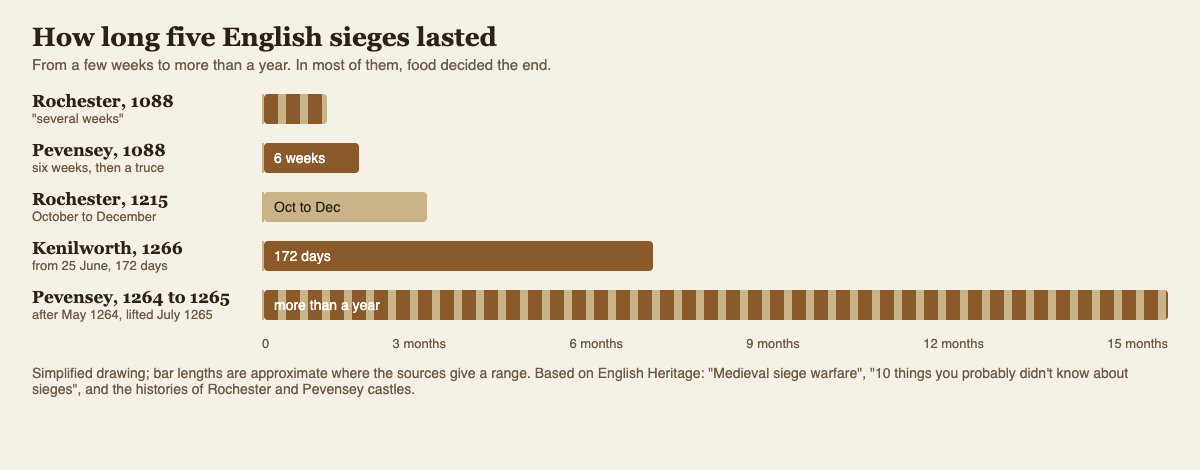
Notice something odd. English Heritage's 10 things about sieges calls Kenilworth the longest siege in medieval England, while its history of Pevensey gives that title to the 1264 to 1265 siege. Both are its own pages. One way to read it: Kenilworth was a hard, continuous assault with siege engines and towers, while Pevensey was a long stand-off in which the garrison still rode out to raid the countryside. Which one counts as "longest" depends on what you count as a siege. You can read both pages and decide.
Four questions that tell you how long a siege will last
When you read about any siege, ask these four questions. They predict the length better than the height of the walls.
- How much food is inside? Defenders who knew a siege was coming stockpiled food and water, and beer and wine in case the water was poisoned. Most castles had wells and cisterns for rain. Hunger ended more sieges than stones did.
- Is help coming? A garrison that expects a relief army holds on. A garrison that knows nobody is coming starts to think about terms.
- Can the attackers feed themselves? A besieging army had to eat too. At Kenilworth at least 20 counties sent food to the king's army, and the Sheriff of London even sent a whale.
- Can the walls be broken quickly? Miners, stone throwers and siege towers could shorten a siege. Strong walls, water defences or a garrison with its own siege engines made it longer.
Worked example: Pevensey, 1088
Pevensey Castle stands inside a Roman fort on the Sussex coast, where William the Conqueror landed in 1066. In 1088, the year after he died, his sons were at war. Robert was Duke of Normandy, William Rufus was King of England, and some barons wanted Robert on the English throne. The Count of Mortain and his brother Odo, Bishop of Bayeux, held Pevensey for Robert, as the history of Pevensey Castle tells it.
Now run the four questions.
- Food: this was the weak point. The king besieged the castle by land and sea, so supplies could not come in by boat either. After six weeks, food was running short.
- Help: the rebels were waiting for Robert to cross from Normandy. He did not come, and the page says there was no prospect of reinforcements.
- The attackers: the king led the siege himself, close to London, with ships to close the sea. He could afford to wait.
- The walls: strong. The page says the castle's defences resisted every assault.
Three of the four answers pointed to a short siege, even though the walls held. So after six weeks the rebels agreed a truce. The ending was gentle by the standards of the time: the Count of Mortain was allowed to keep Pevensey.
The same castle shows how much the answers matter. In 1147 King Stephen blockaded Pevensey until the people inside were starved into submission. In 1264 the garrison had a different answer to the food question: it rode out to raid the countryside, so in September local knights were called in to stop them. That siege lasted into July 1265, and the castle held out.
So how long did a medieval siege last?
For the English sieges above, the answer runs from several weeks to more than a year, with hunger setting the clock in most of them. A few things are worth keeping in mind:
- Short sieges were often decided by talk, not force. Surrender on terms was normal, and English Heritage notes that the elite on the losing side could usually expect reasonable treatment.
- Long sieges were expensive for the attacker too. Feeding an army for months drew on whole counties.
- Medieval records are patchy. Dates like "October to December" or "several weeks" are the best reading of the evidence, not a stopwatch.
Some places were besieged again and again. Carlisle, on the border with Scotland, was besieged ten times, more than any other place in the British Isles. For more on how defenders held out, read how castles defended against a siege, and for the 172 days at Kenilworth, the post on what a siege tower was follows that siege step by step.
A siege with no final stage in Two Towers
Two Towers is a free tower defense game that plays in your browser, on a computer or a phone. Its siege never ends: there is no final stage, and every stage comes stronger, faster or in greater numbers than the last. The game marks each stage you hold, and its messages tell you what is coming, such as "The enemy grows stronger" or "The enemy marches faster".
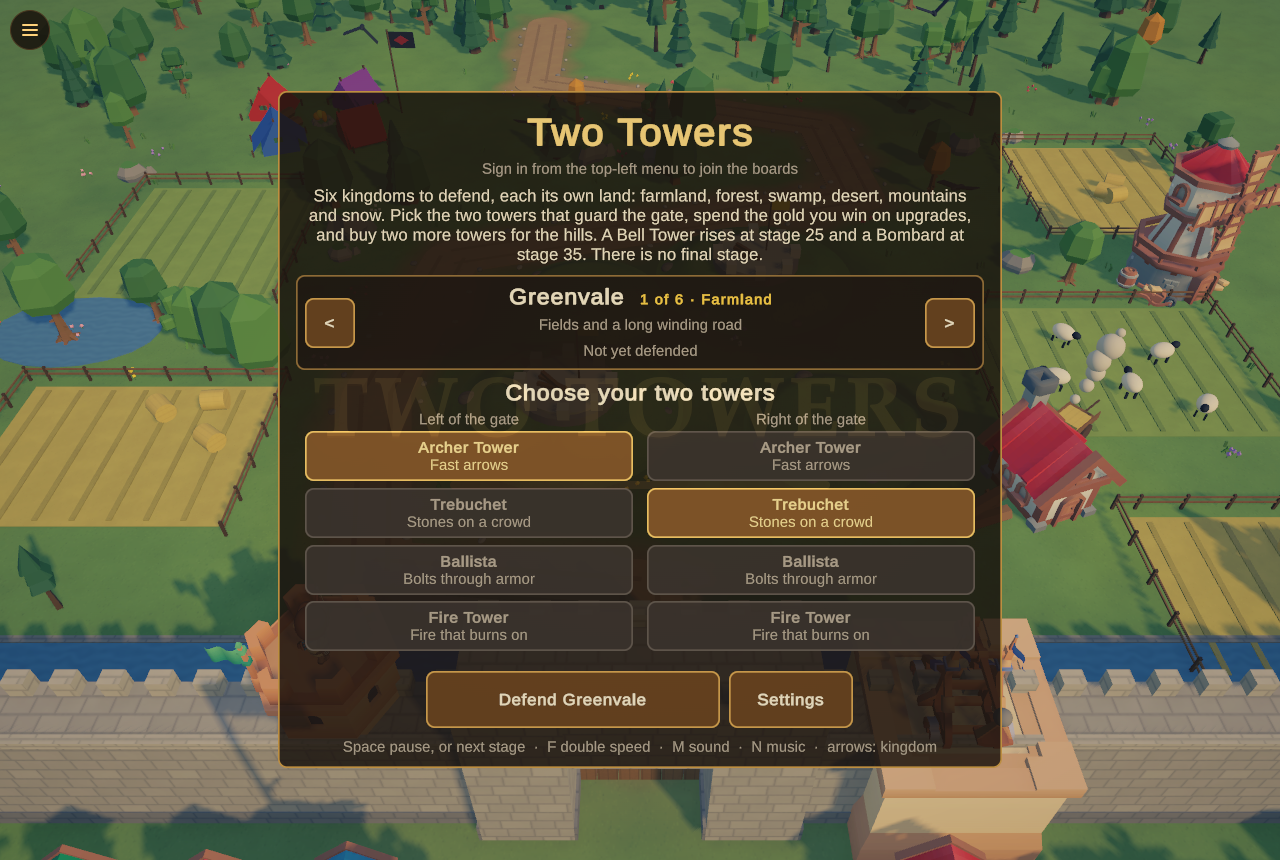
The real sieges above were won by whoever lasted longer, and the game works the same way. The game's text for the gate says "Repair what the attackers broke, or reinforce it." Its own tip is to spend your gold on Damage between stages and reinforce the gate, and a king leads every fifth stage, so the game tells you to reinforce the gate before it and save gold for Damage. You are the garrison, and you are planning for a long siege.
The game is not a history lesson. Its towers and attackers are named for real siege warfare, and the history in this post comes from English Heritage.
Frequently asked questions
What was the longest siege in medieval England?
English Heritage gives two answers on two of its pages: Kenilworth in 1266, at 172 days, and Pevensey, besieged from 1264 until July 1265. Kenilworth was a continuous assault, while Pevensey was a long stand-off.
Why did most medieval sieges end?
In the English examples above, hunger mattered most, together with whether a relief army was coming. Many sieges ended with surrender on agreed terms rather than a final assault.
How long could a castle hold out?
As long as its food and water lasted and its people were willing to stay. Defenders stockpiled food, kept wells and cisterns, and stored timber, stone and earth to repair breaches.
Was starving a castle out common?
It happened, as at Pevensey in 1147, but English Heritage calls blockade a last resort because it was slow and costly for both sides.
Get started
Play Two Towers: it is free and plays in your browser on a computer or a phone. Pick your two towers, keep the gate repaired, and see how many stages your siege lasts.
Comments
No comments yet.
Sign in or make an account to comment.