Tynemouth Castle: a coal port the Royalists held
Tynemouth Castle sits on a cliff at the mouth of the river Tyne, and for most of its life it was not a castle at all. It began as a monastery. English Heritage says the priory "was protected like a castle by walls, towers and a gatehouse", and that after the monks were thrown out it became a coastal fortress that stayed one until 1956. This post follows that headland through six changes, one of which was a Civil War fight over coal, and ends with what a tower defense player can take from it.
What Tynemouth Castle was: a priory behind a wall
The headland has held people for over 2,000 years, but the story that matters here starts with the monks. A monastery re-founded in 1083 became a priory in 1090, when the Earl of Northumbria gave the headland to the abbey of St Albans. Its rich lands, English Heritage says, brought in rents, produce and resources "including coal", and the money paid for a church and chapels.
The first sign of a fortress comes early. In the reign of William II (1087 to 1100), the rebel Robert de Mowbray took refuge in the "stronghold" at Tynemouth. English Heritage calls this the first evidence that the priory was also a fortification, "a character that endured throughout its history".
A wall, a siege and a gatehouse
War in Scotland and border raids gave the priory a reason to build. In 1296 Edward I granted leave for Tynemouth to be properly fortified, and a high perimeter wall with towers let soldiers defend the priory in times of war and lawlessness. After the Scottish victory at Bannockburn in 1314, Robert the Bruce attacked the priory. An 80-strong garrison defended it successfully.
In 1390 renewed war with Scotland led Richard II to give a large sum to repair the defences, and more money came from John of Gaunt and Henry Percy. Some of it went into the great gatehouse, which English Heritage calls "a large and sophisticated defensive structure as strong as that in any castle". The gatehouse and sections of the wall still stand. If you have read the post on why a gatehouse was a castle's strongest part, this is the same idea on a cliff top: put the strongest building where the way in is.
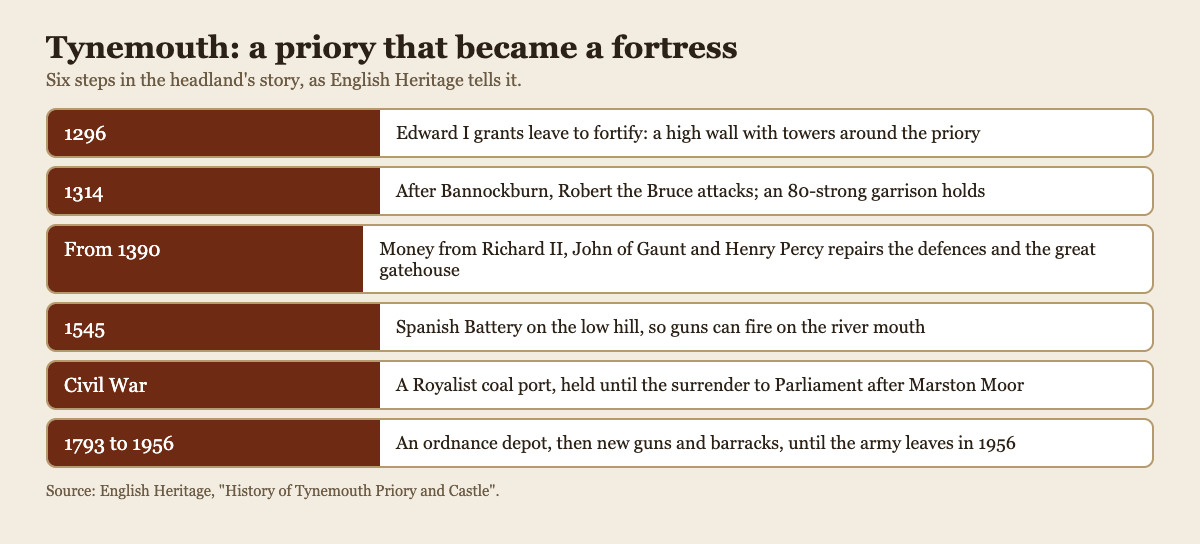
Six steps in the headland's story, from English Heritage's history page.
The Tudor fix: guns that could not see the river
The priory was closed in January 1539, when Henry VIII dissolved the monasteries. A few years later he wanted the headland as a supply base for his war in Scotland. In 1544 the Earl of Hertford gathered a fleet at Tynemouth to carry soldiers north, and Edinburgh was sacked and burnt.
That use showed a weakness. English Heritage says guns on the headland "did not command the river mouth, because of a low hill in between". In 1545 a military engineer, Sir Richard Lee, and an Italian expert, Gian Tommaso Scala, drew up a new line of defences that took in the low hill, so guns there could fire directly on the river mouth. The hill became Spanish Battery. By July 1545, 1,000 workmen had almost finished the work, and 400 of them were to form a temporary garrison because regular soldiers were scarce.
The finished defences departed from the plan, but English Heritage says they "achieved the intended purpose". A governor with a small garrison now guarded the Tyne and Newcastle, whose economic value kept the place important.
Tynemouth Castle in the Civil War: a coal port held for the king
Coal is why the Civil War reached Tynemouth. English Heritage says Newcastle and Tynemouth were among only a few important ports controlled by the Royalist side, and that they were "crucial in denying vital supplies of coal to their Parliamentary opponents". Tynemouth Castle and Spanish Battery were heavily fortified, and their guns controlled the river.
It did not last. English Heritage dates the Royalist hold on the river to July 1644, when Newcastle and Tynemouth were surrendered to Parliament after the Battle of Marston Moor, "when the Royalist cause in the North collapsed". Notice what kind of fight this was. The castle was held for its position, and what it guarded was a trade, not a throne. For the other castles of the war, and what happened to each one's walls, see Civil War castle sieges.
After the war: a governor's house and a lighthouse
Tynemouth stayed a garrison after the Restoration of Charles II. New barracks were built in the old priory's outer court, and the governor, Colonel Edward Villiers, built himself a house using stone and lead from demolished priory buildings. The church was used to store gunpowder. The house had servants' quarters, stables, a brewhouse, barns and stores, there was a separate house for the master gunner, and the gatehouse held the soldiers. A lighthouse stood near the cliff edge by 1677.
The role shrank when Clifford's Fort was built on the riverside in 1672, then grew again from 1793, when an ordnance depot was made inside the walls to supply the troops of Durham and Northumberland. From 1859 the headland got 20 guns, and by 1905 concrete emplacements held two 6-inch, one 9.2-inch and two 12-pounder guns. The army left in 1956.
A worked example: read Tynemouth's page in five questions
You can do this with any castle's history page. Take Tynemouth's and ask five questions, in order.
- What was it first? A monastery, then a priory under St Albans.
- When did it first fight? In William II's reign, when a rebel took refuge in its "stronghold".
- When did the walls come? 1296, with the king's grant, and the gatehouse after 1390.
- What did its guns need? A hill between them and the river had to be built over, so Spanish Battery came in 1545.
- Who held it, and why? Royalists, for a coal port, until the surrender after Marston Moor.
Five answers, five dates, and you can tell the whole story in one breath: a priory, a wall, a gatehouse, a battery, a port.
In Two Towers: put the guns where they can see
The Tudor lesson is a plain one: a defence is only as good as what it can reach. In Two Towers, a free medieval tower defense game that plays in your browser, the title screen sets the aim: "Two towers. One gate. Hold it as long as you can." Every stage comes stronger, faster or in greater numbers than the last, and there is no final stage. You pick one of four towers for each side of the gate: Archer Tower, Trebuchet, Ballista or Fire Tower.
Then you can buy a tower for West Hill or East Hill with gold: 150 for the first and 300 for the second, any of the four kinds. That is in-game gold, never money. Between attacks you can also repair or reinforce the gate. Tynemouth's builders spent on a hill and a gatehouse for the same two reasons you do: to see the attackers early, and to make the gate last.
Frequently asked questions
Was Tynemouth Castle a real castle?
English Heritage calls the site "Tynemouth Priory and Castle". The priory was protected like a castle by walls, towers and a gatehouse, and after 1539 the headland became a coastal fortress.
Why did the Royalists hold Tynemouth?
English Heritage says Newcastle and Tynemouth were among the few important ports the Royalists controlled, and holding them denied coal to their Parliamentary opponents.
What was Spanish Battery?
It was the low hill that the 1545 line of defences ran south to include, so that guns could fire directly on the river mouth. English Heritage says it was allegedly named after Henry VIII's Spanish mercenaries.
When did the army leave Tynemouth?
In 1956, after which most of the military buildings were cleared to show the priory and castle remains.
Get started
Read Tynemouth's history page with the five questions above, then try holding a gate yourself: Play Two Towers, choose your two towers, and see how many stages you last.
Comments
No comments yet.
Sign in or make an account to comment.