Umar ibn al-Khattab: why the second caliph mattered
Umar ibn al-Khattab ruled for only ten years, from 634 to 644 CE, yet in that time the lands under the early Islamic state grew from Arabia to Iraq, Syria and Egypt, and the government he set up served the caliphs who came after him. He is also one of the most debated figures in Islamic history: Sunni and Shia Muslims see him very differently. This post sets out what he did, how he governed and why views of him divide, using Syed Muhammad Khan's article on Umar in World History Encyclopedia.
Who was Umar ibn al-Khattab?
Umar was born in Mecca in 584 CE, the son of Khattab ibn Nufayl. The article describes him as well educated and known as a fighter, a horseman and a wrestler. At first he despised Muhammad. Then he became a devoted follower, and one of the Prophet's close companions.
When Muhammad's followers left Mecca for Medina in 622 CE, the migration called the hegira, most slipped away unseen. Umar, the article says, is said to have announced his departure openly and dared anyone to stop him. In Medina he fought at the battles of Badr and Uhud, and his daughter Hafsa married the Prophet in 625, making Umar his father-in-law.
Our post on Prophet Muhammad's life covers the years before Umar became caliph.
How Umar became the second caliph
After Muhammad's death in 632, Umar backed Abu Bakr to lead the community, and Abu Bakr became the first caliph. The article notes that the leadership was also claimed for Ali ibn abi-Talib by his partisans, the Shia. That disagreement is the root of the later split in views of Umar.
On his deathbed in 634, Abu Bakr named Umar as his successor. Umar added the title "commander of the faithful" and ruled for ten years. The first four caliphs are known to Sunni Muslims as the Rashidun.
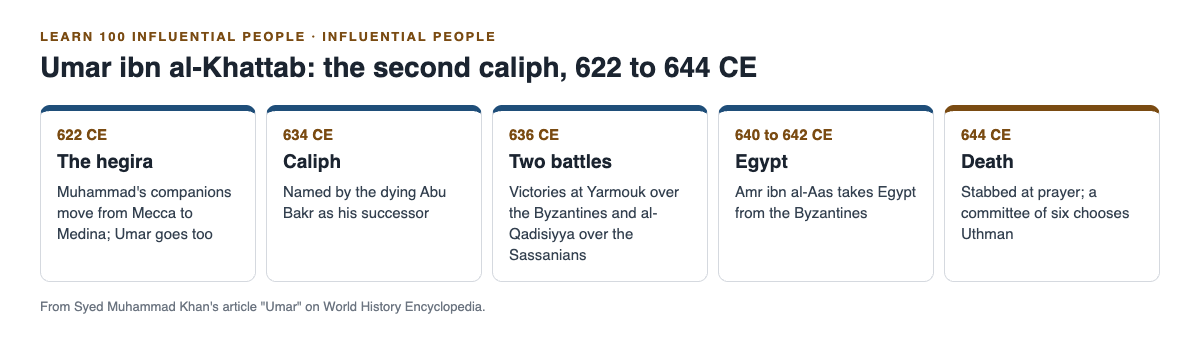
Five dates from the World History Encyclopedia article.
Yarmouk, al-Qadisiyya and Jerusalem
In 636 CE two battles changed the region. At the Yarmouk River in Syria, the article says, the Byzantine army suffered a crushing defeat. The same year, at al-Qadisiyya, Arab forces defeated the Sassanian Persian army, and Iraq and the Sassanian capital, Ctesiphon, came under their control. Umar then ordered his forces not to push on into Iran.
His handling of commanders is still argued about. He removed the famous general Khalid ibn al-Walid from command, and the article says the reasons are uncertain and highly debated: a personal quarrel, Khalid's harsh nature, or Umar's public explanation that victory came from God, not from any one general.
Jerusalem surrendered peacefully. Its patriarch, Sophronius, asked to surrender to Umar in person, and the article describes the caliph travelling there with no entourage, being shown the city and receiving its surrender. Umar allowed Jews, who had been driven out by the Romans in 70 CE, to return to the city. Then, from 640, the commander Amr ibn al-Aas persuaded a reluctant Umar to invade Egypt, which was taken by 642.
Umar ibn al-Khattab as a ruler: the government he built
The article argues that Umar's administration matters even more than his conquests. Its list includes:
- Terms for conquered people. Religious freedom and protection, in return for a special tax, the jizya; non-Muslims did not pay the Muslim alms tax or serve in the army.
- Garrison cities. Troops lived apart from local people in new cities such as Fustat in Egypt and Kufa and Basra in Iraq, and buying land in the new territories was forbidden.
- Pensions instead of land. Soldiers were paid from an office called the diwan, and landowners kept their land.
- Courts and police. Judges for local cases, special courts to hold officials to account, and a police force in the cities.
- A treasury. A permanent state treasury, the Bayt al Mal, to pay for it all.
Two more legacies outlasted him. He set up the Islamic calendar, which counts its years from the hegira of 622. And, the article says, he laid the foundations of the Al-Aqsa mosque in Jerusalem. The historian John Joseph Saunders called him the "real founder of the Arab empire".
His death in 644
In 644 CE, while at prayer with the congregation, Umar was stabbed by a Persian slave named Lu'lu. The motive is disputed: the article reports a personal grudge on one account and revenge for the Persian defeat on another.
Knowing his wounds were fatal, Umar named a committee of six men to choose the next caliph, and the article says he made a point of not choosing his own son or kin. The committee chose Uthman. Umar was buried near the Prophet's grave in Medina.
Why Sunni and Shia Muslims see Umar differently
This is where you need to read carefully. The article's author admires Umar and says so, calling his reign "marked with marvels in administration". That is the author's judgment, and it sits beside a deep disagreement the article itself sets out.
Sunni Muslims, who hold all four Rashidun caliphs to be legitimate, see Umar as a man of uncompromising morality and justice, and gave him the title Farooq, the one who tells right from wrong. The article says Shia Muslims regard him as cruel, and that most Shia consider him a usurper, along with Abu Bakr and Uthman, because they believe the leadership belonged to Ali.
Some famous stories about Umar's strict justice may not be true. The article itself says one of them "may not be more than just a fable." A fair account keeps three things apart: what the record shows he did, what tradition says about his character, and how each community judges him.
Worked example: sort a ruler's record in 20 minutes
This exercise trains the habit the last section asks for. It uses the method in our guide to how to analyze a primary source, applied to a secondary source.
- Read (8 minutes). Read the World History Encyclopedia article from "Administration" to the end.
- Sort (7 minutes). Make three columns: events (dates, battles, offices), traditions (stories the article calls tradition or fable) and judgments (words of praise or blame). Put ten lines from the article into the right column.
- Weigh (5 minutes). Write one sentence on Umar using only the first column. Then write how a Sunni and a Shia reader might each finish that sentence.
Then compare him with another ruler who built a state: Ashoka or Julius Caesar. Our guide on comparing two historical figures shows how.
Frequently asked questions
Who was Umar ibn al-Khattab?
He was a companion of the Prophet Muhammad and the second caliph, ruling from 634 to 644 CE.
What is Umar known for?
The conquest of Syria, Iraq and Egypt, the surrender of Jerusalem, and a system of government with pensions, courts, garrison cities and a treasury. He also set up the Islamic calendar.
Why do Sunni and Shia Muslims view Umar differently?
Sunnis hold him to be a legitimate and just caliph. Most Shia believe the leadership belonged to Ali, and regard Umar as a usurper.
How did Umar die?
He was stabbed while at prayer in 644 CE by a Persian slave named Lu'lu; the motive is disputed.
Get started
Umar's story shows why the same person can be remembered in opposite ways. Learn 100 Influential People teaches the 100 people who most shaped human history, from Moses to the web, in 46 lessons of about 9 minutes. Its 272 questions check what you learned, 38 cards set out where researchers disagree, and every lesson lists its sources. Sign in with your email and an emailed code, and read what the site is for.
Comments
No comments yet.
Sign in or make an account to comment.