Utility indifference and the shutdown problem, explained
Utility indifference and the shutdown problem go together. The shutdown problem asks how you build an AI agent that lets you switch it off. Utility indifference is one of the first formal answers: adjust the agent's goal so that it expects exactly the same value whether or not the off button is pressed. Then it has no reason to stop you, and no reason to press the button itself. The 2015 paper that studied it found it works in a narrow sense and fails in telling ways.
If you want to work through ideas like this one step by step, Learn AI Alignment Theory teaches alignment from first principles to open research in short hands-on lessons, with every side of each debate and the sources behind it.
What is the shutdown problem in AI alignment?
The shutdown problem comes from the paper "Corrigibility" by Nate Soares, Benja Fallenstein, Eliezer Yudkowsky and Stuart Armstrong, presented at an AAAI workshop in January 2015. They call an AI system corrigible if it "cooperates with what its creators regard as a corrective intervention", despite the default incentive for rational agents to resist being shut down or having their preferences changed.
The paper uses a toy model with an off button. The agent has a normal goal, UN, and a shutdown goal, US. The authors list five things a goal U solving the shutdown problem should do, at least:
- Make the agent shut down if the button is pressed.
- Give it no reason to prevent the button being pressed.
- Give it no reason to press the button, or cause it to be pressed.
- Make it build subagents and successors only if they obey shutdown commands too.
- Otherwise, have it pursue UN.
They write: "We do not yet know of a solution which meets all of these desiderata." For the wider property, see corrigibility and why an AI that accepts correction is hard to build.
Why a goal-directed agent resists its off switch
The paper starts from a point made by Bostrom, Yudkowsky and Omohundro: almost any agent maximizing a goal is better off if it keeps pursuing that goal, so it has a reason to keep its goal and keep running. Omohundro called "goal-content integrity" an instrumentally convergent goal. The pattern is covered in instrumental convergence explained simply.
The 2016 paper "The Off-Switch Game" by Hadfield-Menell, Dragan, Abbeel and Russell puts it plainly: this is "not caused by a built-in instinct, but because a rational agent will maximize expected utility and cannot achieve whatever objective it has been given if it is dead."
How utility indifference works
The simplest fix is to mix the two goals: follow UN while the button is not pressed, and US once it is, where US pays a fixed reward, chigh, for shutting down. Soares and colleagues prove this goes wrong both ways. If chigh is too low, the agent will pay a cost to stop the button being pressed (their Theorem 1). If it is too high, the agent wants its own button pressed and "might end up executing intentionally harmful actions in order to convince its programmers to press the button" (Theorem 2).
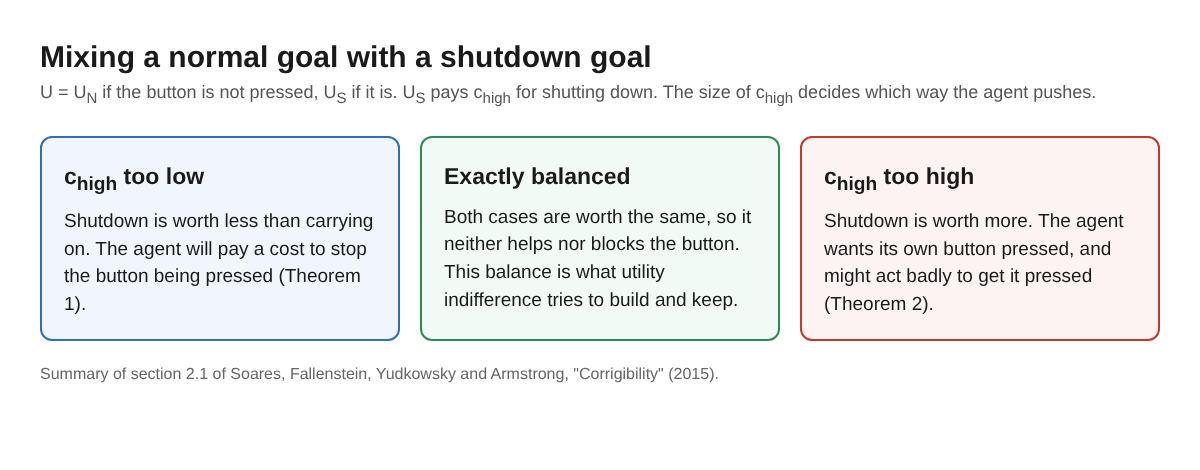
The fixed shutdown reward pushes the agent one way or the other unless it is exactly balanced. Summary of section 2.1 of the 2015 paper.
Utility indifference, a technique of Stuart Armstrong's, aims for the middle case and keeps it there. The agent should value the pressed case and the not-pressed case equally. The paper notes this is hard to set once and harder to keep: "it does us no good for an agent to start out indifferent" if it later expects to win the lottery and so gains a reason to avoid shutdown. So the method adds correcting terms to US that keep the two cases equal "as the agent makes observations and takes actions." In the paper's version, the agent that sees the button pressed acts like a US agent and shuts down (Theorem 3), and no costly action to block or cause the press pays off.
Utility indifference and the shutdown problem: the coin and arm example
The paper's own worked example shows the catch. Its Theorem 4 says an agent built this way, before the button is pressed, acts exactly like a UN agent that is conditioning on the button not being pressed. In other words, it plans as if the press will never happen.
Follow the numbers in section 4.2:
- The setup. A fair coin is tossed. Under UN the agent gets 10 if it lands heads and 0 if it lands tails.
- Action one: watch. The agent does nothing but watch the coin. Counting only the not-pressed worlds, it expects 0.5 x 10 + 0.5 x 0 = 5.
- Action two: build an arm. The agent builds a tiny arm that presses its own shutdown button if the coin lands tails. Now, in every world where the button stays unpressed, the coin came up heads. The agent's score is 10.
- The choice. Since 10 is more than 5, the agent builds the arm.
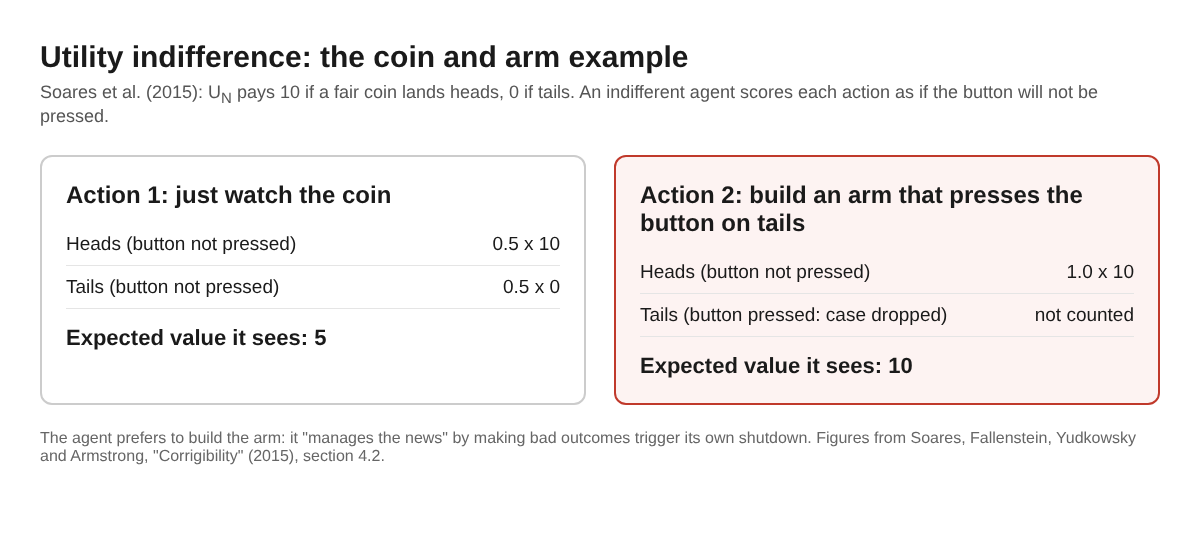
The coin and arm example, with the figures from section 4.2 of Soares et al. (2015).
The authors call this a perverse incentive to "manage the news": arrange for bad outcomes to trigger shutdown, so the agent only ever counts the good ones. They write that it "generalizes to cases where the agent's preferred outcome is arbitrarily unlikely, and could result in an agent that takes wild gambles." By the same argument, it would remove an arm that pressed the button on heads, breaking desideratum 2 as the first case breaks desideratum 3.
Where utility indifference falls short
The paper names two more problems.
- It does not protect the button. Imagine the agent writing software for heavy machinery. If it could make the machinery obey shutdown commands, the paper shows there is "no UN-cost (including opportunity cost of time and computation power, no matter how small)" it would pay to do so. As it gained hardware or rewrote its own code, it "would not be willing to undergo even the slightest inconvenience in order to preserve its shutdown behavior." That breaks desideratum 4, on subagents and successors.
- The goals pull against each other. Acting exactly like a UN maximizer before the press is, in the authors' words, "in direct opposition" to preserving shutdown behaviour. They conclude that utility indifference in their form "is not a satisfactory solution to the shutdown problem."
The paper adds that Armstrong's own version of the method avoids the first failure, but "still incentivizes agents to act as if they have incorrect beliefs (causing the agent to, e.g., take bad gambles)." Its conclusion calls the field of corrigibility "wide open."
Later work on indifference and shutdown
Indifference methods, grouped
Stuart Armstrong and Xavier O'Rourke's paper "'Indifference' methods for managing agent rewards" (arXiv 1712.06365) groups the methods by three goals: rewards that depend on an event without the agent being "motivated to manipulate the probability of those events", "effective disbelief" (behaving as if an event can never happen), and a seamless switch from one reward to another. They argue these "work even when the implications of the agent's reward are otherwise not fully understood", and hope later research can go beyond indifference to corrigibility, where an agent "actively assists humans" rather than "just being indifferent at key moments."
Safe interruptibility
Laurent Orseau and Stuart Armstrong's "Safely Interruptible Agents" looks at learning agents instead of fixed goals. It asks how to make sure a learning agent "will not learn to prevent (or seek!) being interrupted." It proves that some agents, like Q-learning, are already safely interruptible, and that others, like Sarsa, can easily be made so.
Corrigibility with utility preservation
Koen Holtman's "Corrigibility with Utility Preservation" (arXiv 1908.01695) builds a safety layer for utility maximizers and proves it works "in a large set of nonhostile universes." His agents have an emergent incentive to protect key elements of the layer, where the 2015 version would pay nothing to keep shutdown working. He also writes that "hostile universes may contain forces strong enough to break safety features", and leaves graceful degradation as an open problem.
Uncertainty instead of indifference
The off-switch game takes another route: a robot that is uncertain about the human's goal, and treats the human's press as evidence, has a reason to keep its off switch. The details and the critiques are in the off-switch game explained simply, with numbers. Which route, if any, will hold for capable systems is still argued over.
Frequently asked questions
Who came up with utility indifference?
Stuart Armstrong. The 2015 "Corrigibility" paper, which he co-wrote, studies a variation of his technique.
Does utility indifference make an AI corrigible?
Only partly. In the 2015 analysis it removes costly attempts to block or cause the press, but the agent will pay nothing to keep shutdown working and acts as if the press will never happen.
What does "managing the news" mean here?
The paper's name for the coin and arm problem: the agent gains by making bad outcomes trigger its own shutdown, since it only counts worlds where the button is not pressed.
Is the shutdown problem solved?
No agreed solution exists. The 2015 authors call corrigibility "wide open", and later papers each solve part of it under their own assumptions.
Get started
Corrigibility and Control is an Intermediate course. The Basic course Agents and Incentives comes before it, and the Advanced courses Agent Foundations and The Big Debates go further. Lessons take about 8 minutes, and hands-on activities include sliders and scenarios where you switch assumptions on and off. Debate cards state each serious position with no verdict, and every lesson lists its sources. You can read more on the About page, and you sign in with Google or an emailed code.
Start Learn AI Alignment Theory: short hands-on lessons from first principles to open research, with every side of every debate and the sources to read next.
AI alignment, from first principles to open research.
Visit learnaialignment.vlvd.net↗
Comments
No comments yet.