Watching a newsreel or film clip as a historical source: 4 steps
Watching a newsreel or film clip as a historical source takes four steps: meet the clip, observe its parts, make sense of why it exists, and use it as evidence next to other sources. Moving pictures feel like a direct view of the past. They are not. Someone chose what to film, what to cut and what to say over the pictures. The National Archives teaches the same four steps for video as for photographs, posters and sound recordings, and this guide shows how to use them.
If you have read our guides to analyzing a written document, analyzing a sound recording and analyzing a historical photograph, much of this will look familiar. Film adds one twist: it joins picture, sound and editing, so there are more choices to question.
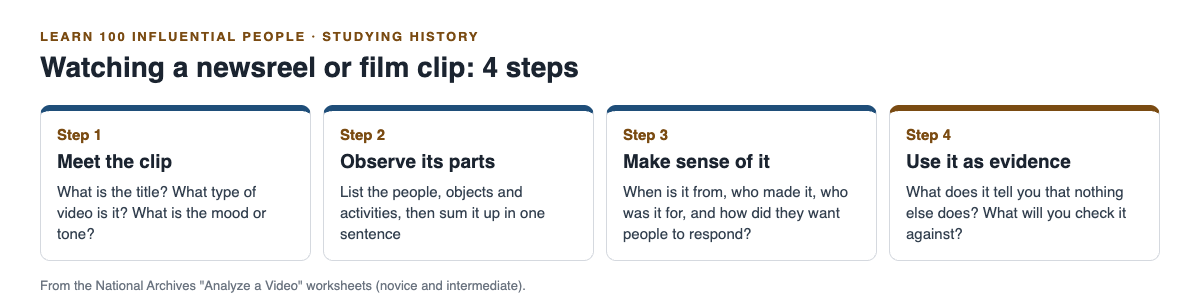
The four steps, in the order the worksheets use them.
Watching a newsreel or film clip as a historical source: what the worksheets ask
The National Archives publishes worksheets for each kind of source, in a novice and an intermediate version. Its materials are in the public domain, and its Analyze a Video worksheet for younger students and its intermediate version follow one pattern: meet it, observe its parts, try to make sense of it, use it as historical evidence.
The intermediate worksheet asks you to name the type of video: animation, propaganda, promotional, training film, combat film, newsreel, news report, informational, documentary, entertainment, commercial or other. It also asks which elements are present, such as music, narration, background noise, special effects, dramatizations, color or black and white. Those two lists are a useful reminder that a clip is built from parts, and each part was a choice.
Step 1: Meet the clip
Before you judge anything, say what you have. Is there a title, and what does it promise? What type of video is it? What is the mood or tone? Does it show people, activities, places, or all three?
Write the answers down, even if they feel obvious. A title such as "The King Visits His Armies" tells you something about how the makers wanted the footage understood before a single shot plays.
Step 2: Observe its parts
Watch the clip at least twice. The first time, just follow it. The second time, list what you see and hear without explaining it: the people, the objects, the activities, and then the elements, such as narration, music or silence. Finish with one sentence that sums it up.
Keep what you observe apart from what the clip says. "A narrator says the crowd is cheering" is a claim. "I can see a crowd and I can hear applause" is an observation. The worksheets keep these in separate steps for a reason.
Step 3: Try to make sense of it
Now ask the questions that make it evidence. When is it from, and what was happening then? Who made it, and who was it meant for? How did the maker want the audience to respond, and what in the clip or in what you know about the maker points to that answer?
This is where a newsreel or a documentary stops being a window and becomes a document. Someone paid for it, someone approved it, and someone expected an audience to feel something.
Step 4: Use it as historical evidence
The last step asks what you learned from the clip that you might not learn anywhere else, and which other evidence you will use to understand the event. No single clip settles a question. Check it against letters, diaries, official records, newspaper reports and the work of historians, as in our guide to primary and secondary sources.
Then write a short conclusion in three parts: what the clip reliably shows, what it shows about its makers and their aims, and what it cannot tell you.
A worked example: The Battle of the Somme (1916)
The Battle of the Somme is a British film from 1916, so it is a good test of the four steps. The details below come from the Wikipedia article on the film, which draws on the history of how it was made and shown. Treat that article as a secondary source and check it against the film's archive record if you cite it in an essay.
Step 1: Meet it. It is a black-and-white silent film in five parts, with intertitles that summarize each part. It runs 77 minutes. The first part shows preparations: troops marching, munitions piled up, guns firing. Later parts show the attack of 1 July 1916, the wounded and the ruined villages. It was made with the War Office and then released to the public as a cinema feature, so the worksheet's type list does not give one clean label; that is worth noting in step 1.
Step 2: Observe its parts. Two cameramen, Geoffrey Malins and John McDowell, shot it between 26 June and 7 to 9 July 1916. There is no recorded sound, so any music or noise came from the cinema. A musical medley of classical, folk and popular pieces was published so that musicians in cinemas could play along. A British officer who watched it in France noted that it did not record the sound of rifles and machine-guns, though real artillery fired nearby while he watched.
Step 3: Make sense of it. The British Topical Committee for War Films, which represented newsreel producers and was supported by the War Office, sent the cameramen to France. The War Office wanted images that supported the war effort and raised morale, and much of the footage was censored from the public version. General Henry Rawlinson, who saw a rough cut, said that "some of it is very good but it cut out many of the horrors in dead and wounded". Some of what looks like battle was staged. Footage of troops advancing was shot between 12 and 19 July at a mortar school near St Pol, away from the front, for the camera.
The release shows the intended audience. The first screening was on 10 August 1916 at the Scala Theatre, for journalists, officials and people from the cinema trade. A letter from David Lloyd George was read out first. It told the audience to see that the film reached everyone, and it called this their duty. On 21 August the film opened in 34 London cinemas, and a leaflet reportedly told filmgoers that it was not entertainment but an official film.
Step 4: Use it as evidence. Here the clip meets other voices, and they do not agree. The Times reported that crowded audiences were interested and thrilled to have the realities of war brought before them. Hensley Henson, the Dean of Durham, protested against an entertainment that wounded the heart and violated the sanctity of bereavement. By October the film had been booked by more than two thousand cinemas in Britain. That makes it strong evidence of what the authorities chose to show the home front, and of how audiences reacted. It is weaker evidence of what a soldier at the front lived through, and some of its battle scenes were arranged. In 2005 UNESCO added it to its Memory of the World Register, and described it as the first feature-length documentary record of combat produced anywhere in the world.
A fair conclusion is limited and specific: the film reliably shows the look of the preparations and the aftermath, it shows a government shaping a message in 1916, and it cannot tell you what the battle felt like or how many scenes were set up.
Common mistakes when using film as evidence
- Treating the narration or the intertitles as neutral labels. They are part of the argument.
- Ignoring what is missing. A frame shows one angle, and a cut shows one order. The Somme footage was cut because the War Office wanted a certain picture.
- Trusting a scene because it looks real. Some of the best-known scenes were staged for the camera.
- Stopping at one source. With no comparison, you only have the makers' version.
Frequently asked questions
Can I trust a newsreel as evidence?
You can trust it as evidence of what was filmed and how it was presented, once you know who made it and why. You should not treat it as a complete or neutral account of an event.
How is analyzing video different from analyzing a photograph?
The National Archives uses the same four steps for both. Video adds narration, music, background noise and editing, so the worksheet asks about those elements as well as the people, places and activities.
What if I cannot find out who made the clip?
Write that down. Your conclusion about its purpose will be weaker, so lean harder on step 4 and compare the clip with sources whose makers you know.
Can a clip be staged and still be useful?
Yes. A staged scene still shows what the makers wanted viewers to believe. It tells you less about the event and more about the people who made the film.
Get started
Clips are easier to read when you already know the people and the debates behind them. Learn 100 Influential People teaches the 100 people who most shaped human history, from Moses to the web, in 46 lessons of about 9 minutes. 38 cards set out where researchers disagree, and every lesson lists its sources. Sign in with your email and an emailed code, and read what the site is for.
Comments
No comments yet.
Sign in or make an account to comment.