What Are Destructible Walls in Games? A Simple Guide
If you have ever shot a hole in a wall to reach an enemy, you already know the answer to what are destructible walls in games? They are parts of the level that you can damage or remove while you play. A wall that breaks changes the map, and a changed map changes your choices. This guide explains how they work, why they matter, and how a small browser tank game stores and breaks its walls.
What are destructible walls in games?
A destructible wall is any piece of the level that reacts to damage. Some walls vanish after one hit. Some crumble a piece at a time, so the shape of the hole depends on where you shot.
The opposite is a solid wall. It blocks you no matter what you throw at it. Most games mix the two. In most games that have breakable terrain, only part of the world can be destroyed, as the Wikipedia article on destructible environments notes.
That mix is the whole design. Once you can tell which walls break and which do not, you start reading the map as a set of choices instead of a fixed maze.
A short history of breakable terrain
Breakable cover is an old idea. In Space Invaders (1978), you could take cover behind objects that could be destroyed. The Worms series, starting in 1995, went further: its terrain can be blown away completely.
3D games took the idea into walls and doors. In Red Faction (2001), you can blow up a door instead of opening it, or dig into a wall for cover. Even there, the team cut back the destruction during development because of technical limits.
Games use breakable terrain for a few reasons. It can show off the graphics. It can show how strong your weapon is. Or it can ask you to use that power to solve a problem or find a new path. The last one is the reason that matters most to you as a player.
How destructible walls work behind the scenes
Under the art, a game keeps a simple record of what is solid. When a shot hits a wall, the game checks that record, marks some of it as empty, and draws the screen again.
Here is a concrete case. Tank City Reboot is an original game inspired by the 8-bit tank classics of the Family Computer, set inside a computer. Its field is 208 by 208 pixels. Each map is laid out as 13 by 13 tiles of 16 pixels. But the walls are not stored as whole tiles. They are stored as 52 by 52 small bits, each 4 by 4 pixels.
That is why a wall can break a piece at a time. A hit does not remove a tile. It clears a few bits and leaves the rest standing.
Every shot goes through the same check, yours and the enemy's. So the enemy chips walls just like you do.
A worked example: digging through one firewall tile
Let us follow the code for one wall. You only need these facts:
- A firewall tile is 16 pixels across and 16 pixels deep.
- A shot that touches firewall clears it across a 16 pixel path, 4 pixels deep.
- A fully powered shot clears 8 pixels deep, and it breaks silicon too.
- Your cannon is fully powered after three Overclock power-ups, and it drops back to normal when you lose a life.
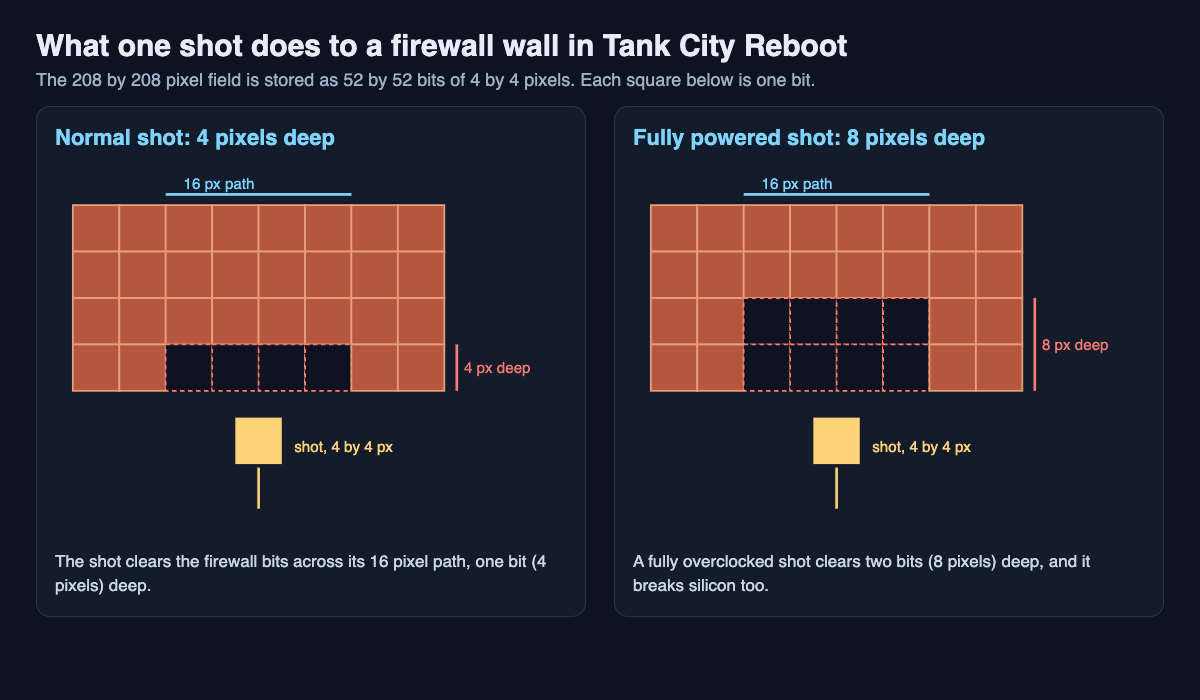
Now do the sums. Your tank faces a solid firewall tile and fires straight at it. The first shot clears a strip 16 pixels wide and 4 pixels deep. The second shot flies into that dent and clears the next 4 pixels. After four shots, 4 times 4 is 16, so you have dug all the way through.
The 16 pixel path matches the tile width. So a straight line of shots carves a channel one tile wide, not a thin crack.
With a fully powered cannon, each shot clears 8 pixels. Two shots do the same job. Those two saved shots are time you can spend on enemies.
The catch is the reset. Lose a life and your Overclock level goes back to 0. The wall that took two shots now takes four, and silicon stops your shots again. How hard a wall is depends on how well you are playing.
Why breakable walls change your choices
A breakable wall turns cover into a resource. Every shot you fire at a wall is a shot you did not fire at an enemy. Every hole you open is a hole an enemy can use too.
That gives you questions to answer:
- Do I open a shortcut, or keep this wall as cover?
- Do I leave the wall in front of the thing I am protecting alone?
- Which walls can I break now, and which need a stronger shot?
Enemies make the map change on its own, too. In Tank City Reboot, malware heads mostly for the CPU core, sometimes for you, and sometimes anywhere. Their shots chip firewall, so you will see routes open that you did not make.
The wall types in Tank City Reboot
Each wall type is named for a real computer idea, and each one treats shots and tanks differently.
- Firewall breaks under fire, a block at a time.
- Silicon stops every shot until your cannon is fully overclocked.
- Coolant blocks tanks, but shots fly over it.
- Encrypted zones hide any tank inside them.
Only firewall, silicon, the CPU core and the map edge stop a shot. That one rule tells you a lot about where you can attack from.
The CPU core sits at the bottom middle inside its own firewall, and a shot that reaches the core ends the game. The Firewall rebuild power-up turns that wall to silicon for fifteen seconds. It flickers back to firewall in its last 3 seconds, which is your cue to get back on defense. The guide to every power-up covers the rest.
Walls in Tank City Zero Day
The second game, Tank City Zero Day, adds more ways to change walls:
- Firewall breaks from any angle. A shot flying at an angle breaks a 12 pixel patch where it lands.
- The Pipelining upgrade gives faster shots that break deeper. At level 2 they also break silicon.
- With Load balancer, shots bounce off silicon and the arena edge. Firewall still breaks and stops the shot.
- Ransomware shots turn firewall into silicon instead of breaking it. The enemy hardens the map against you.
- Hot patch builds the wall around the core as silicon at the start of every wave.
- The zero-day boss of every fifth wave breaks through any wall.
Each Zero Day arena is freshly generated. The game checks that every enemy gate and your start can reach the core by going around silicon and coolant. Firewall counts as open in that check, since any tank can shoot through it. If the check fails, the arena is drawn again. Breakable walls are treated as paths that cost time, not as dead ends.
Frequently asked questions
Are destructible walls the same as destructible environments?
Destructible walls are one part of a destructible environment. An environment can also include terrain, buildings and other structures. Walls matter most in a top-down game because they control where you can move and shoot.
Why can't every wall be destroyed in most games?
If every wall broke, levels would lose their shape and you would lose your goals. Solid walls keep routes and cover in place, so the breakable ones mean something.
How many shots does it take to break a firewall tile in Tank City Reboot?
Four normal shots, since each clears 4 pixels of a 16 pixel tile. A fully powered shot clears 8 pixels, so two are enough.
Can enemies break walls too?
Yes. Enemy shots go through the same wall check as yours, so they chip firewall, including the wall around the CPU core. In Zero Day, ransomware shots do the opposite and turn firewall into silicon.
Get started
The best way to learn breakable walls is to shoot some. Start on stage 1, FIREWALL, which is mostly firewall with a few silicon blocks. Try three things in one run:
- Count the shots it takes to dig through one firewall tile.
- Collect Overclocks and notice the moment silicon starts to break.
- Guard the firewall around the CPU core, and grab Firewall rebuild when it drops.
Move with the arrow keys or WASD and fire with Space. In Zero Day, dash with Shift.
Play Tank City Reboot: it is free, plays in your browser on a computer or a phone, and needs no account.
Comments
No comments yet.
Sign in or make an account to comment.