What Are Hit Points in Video Games? HP Explained Simply
If you have ever watched a bar shrink above a monster's head, you have already met the answer to what are hit points in video games? Hit points, or HP, are a number that tracks how much damage something can take before it is destroyed. Each hit lowers the number. When it reaches zero, that character, tank or wall is gone. This guide explains how that number works, why designers rely on it, and how you can see it at work in a free browser tank game.
What are hit points in video games? The short answer
Hit points are a counter. A thing in the game starts with some amount, say 3. Every time it takes damage, the game subtracts from that amount. At zero, the game runs whatever "destroyed" means: an explosion, a lost life, a game over screen.
Health bars, armor and healing are all ways of showing that number or changing how fast it falls.
Where hit points came from
The idea is older than video games. While Dave Arneson was building the tabletop game that became Dungeons & Dragons, the rules it grew from settled each fight with one roll of the dice: your character either killed the enemy or was killed. Players did not want to lose characters they had grown attached to, so Arneson borrowed a "hit point" rule from older naval war games. Each character has a number of hit points that drops with every blow, so it can survive several hits.
His own summary is the best design note on the subject: players "didn't care if they could kill a monster in one blow, but they didn't want the monster to kill them in one blow". Video games took the same counter, because it is simple to compute and simple for players to understand.
How HP works under the hood: damage, subtraction, and zero
Inside the game, each object stores a value for its current HP. When a shot or a sword touches it, the game runs a small rule. In plain words it looks like this:
- Something hits the target.
- The game works out how much damage the hit does.
- It subtracts that from the target's HP.
- It checks: is HP now zero or less? If yes, the target is destroyed.
Some games add randomness to step 2, so a hit does a little more or less damage each time; the tabletop original rolled dice for damage. Other games keep damage fixed, so you can count hits exactly and the same plan works every time.
Health bars, hearts, and numbers: ways games show hit points
The same counter can look very different on screen:
- A bar that shrinks as you take damage. Good for a quick read.
- Icons such as hearts or pips, one per point. Good when HP is small and every point matters.
- A number or a fraction, like 3 of 5. Exact, but you have to read it.
- Sound, such as a character's heartbeat.
- Nothing at all. Some games hide enemy HP and let you learn it by counting shots.
Whatever the display, the designer Scott Rogers put the rule plainly: "health should deplete in an obvious manner, because with every hit, a player is closer to losing their life". Lives are a close cousin. A life count is a second layer of HP on top of the first: lose all your health and you lose one life, lose all your lives and the game ends.
Healing, armor, and shields: how games change the HP math
Once you have a counter, designers can change it in a few standard ways.
- Healing adds points back.
- Armor reduces the damage each hit does, or in simple games just means more hits to destroy.
- Shields block hits before they reach HP at all. Some last a set time. Some stop one hit and then need to recharge.
- Invincibility windows make you immune for a short moment, often right after you get hit or while you dodge. The guide to invincibility frames covers this in detail.
- Max HP increases raise the ceiling, so you can hold more before you break.
Why designers use hit points instead of one-hit deaths
A one hit rule is simple, but it is harsh. HP gives designers more room:
- Forgiveness. You can make a mistake and keep going.
- Variety. Two enemies can look alike but take different numbers of hits, which forces you to change your plan.
- Tension. A boss with a big pool of HP turns a fight into a long struggle instead of one lucky shot.
Hit points in action: how tanks soak damage in Tank City Reboot
Tank City Reboot is a free site with two original tank games that play in your browser. Both are good places to see HP clearly, because every hit does the same damage and you can count every shot.
The first game: count to four
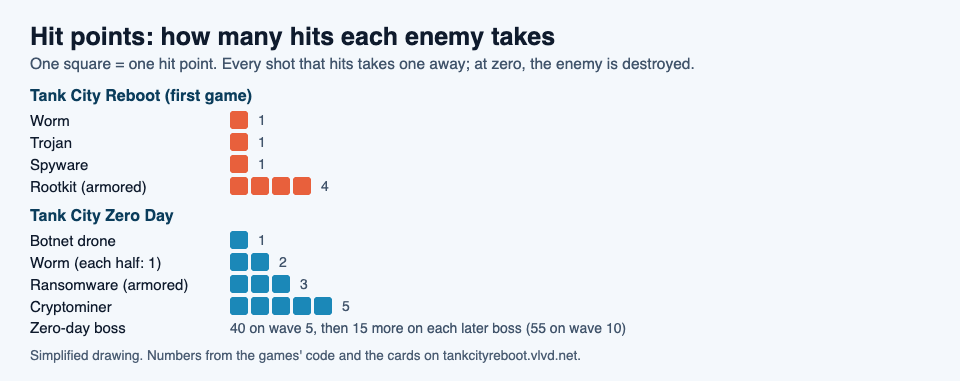
In the first game, your antivirus tank guards the CPU core while malware tanks roll in. The worm, trojan and spyware take one hit each. The rootkit is armored and takes four. That is a small HP pool, but it changes how you play. A rootkit heading for the core needs four clean shots, so you cannot ignore it while you chase a faster trojan.
There is a neat HP detail in power-up carriers. The 4th, 11th and 18th tank of each stage blink because they carry a power-up. The first hit on a carrier drops the power-up, even if the tank survives. So on an armored carrier, such as the 11th tank of stage 2, which is a rootkit, your first shot pays out right away and the next three finish the job.
Your own tank uses lives and shields. You start with 3 lives and earn one more the first time your score reaches 20,000 in a game. The Patch power-up gives a ten second shield, and each new tank of yours starts with a shield of about 4 seconds. That short shield is a classic invincibility window: it stops you from losing a second life the moment you respawn.
Tank City Zero Day: bigger pools, more math
The second game, Tank City Zero Day, gives enemies more HP and gives you tools to deal with it. Every shot that hits an enemy takes 1 hit point. Here is how many hits each threat needs:
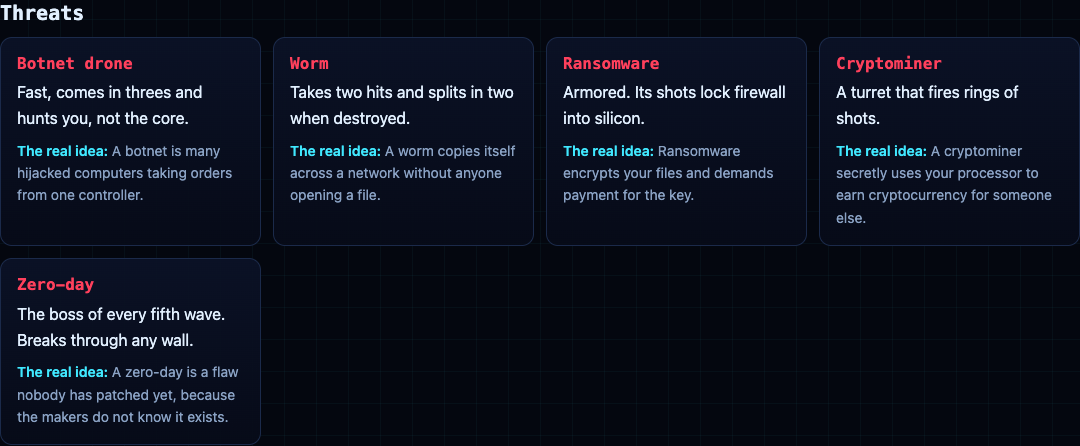
- Botnet drone: 1
- Worm: 2, and it splits into two halves that take 1 each
- Ransomware: 3
- Cryptominer: 5
- Zero-day boss: 40 on wave 5, and 15 more on each later boss, so 55 on wave 10
Try a worked example. On wave 10 the boss has 55 HP. Without upgrades, the wait between shots is 0.3 seconds. If every shot lands, that is 55 times 0.3, about 16.5 seconds of steady fire. Take the Cache upgrade three times and the wait drops to about 0.13 seconds, so the same 55 hits take roughly 7 seconds. Multithreading adds more shots per volley in a spread, so if more of each volley lands, the boss melts faster still. Damage over time matters as much as damage per shot.
The Encryption upgrade lets each shot pass through one more enemy per level. Against a line of drones with 1 HP each, one shot can clear two. Against a lone 5 HP cryptominer, it adds nothing. Knowing enemy HP tells you which upgrade fits the wave you are facing.
Your side of the HP sheet
In Zero Day you protect two counters. You start with 3 lives, and the CPU core has an integrity of 3. The run ends when the core's integrity or your last tank is gone. The RAID upgrade can be taken twice, each time raising core integrity by 1, up to 5, and repairing it fully. Two-factor gives one extra life.
Shields and dodges guard those counters. Sandbox gives a shield that stops one hit and recharges in 12 seconds, or 8 at level 2. Dash makes you immune for a fifth of a second and recharges in 1.5 seconds.
Core HP also pays out points. Clearing a wave adds a bonus of 250 times the wave number times the share of core integrity left. On wave 6 with a full core, that is 1,500 points. With one third of the core left, it is 500. Keeping HP high is not just about survival here; it is worth score.
Frequently asked questions
What does HP stand for in games?
HP stands for hit points. Some games say health points; either way it is the amount of damage something can take before it is destroyed.
Is HP the same as health?
In most games, yes. "Health" is the friendly word and "HP" is the number behind it. Lives are different: they are extra chances you get after your HP runs out.
What happens when hit points reach zero?
The object is destroyed. For an enemy that usually means it explodes and you score points. For you, it usually means losing a life, and if you have no lives left, the game ends.
How do invincibility frames protect your HP?
They are a short window where hits do not count, so your HP cannot drop. In Tank City Zero Day, a dash gives you a fifth of a second where enemy shots cannot touch you.
Get started
The best way to understand hit points is to count them yourself. Open the first game and see how fast you can put four shots into a rootkit before it reaches the core. Then try Zero Day and plan your upgrades around the boss's 40 HP on wave 5. Watch the core integrity number and see how much bonus you keep when it stays full.
Play Tank City Reboot: it is free, plays in your browser on a computer or a phone, and needs no account.
Comments
No comments yet.
Sign in or make an account to comment.