What did a castle constable do in a siege?
A castle constable was the person who ran a castle for its owner, and in a siege the constable was the one who had to decide whether to hold it or hand it over. English Heritage's description of Beeston Castle puts the job in one line: the constable "managed the castle on behalf of the lord or king". This post follows real constables through real sieges on English Heritage's pages: one who refused to surrender at Pevensey, one who wrote for help, and two who chose a side. Then it shows where constables lived, so you can find their rooms on a visit.
Castle constable: the person in charge when the lord was away
A king or a great lord could not live in every castle he held. Someone had to keep each one ready, and that was the constable. Beeston's inner gatehouse, English Heritage says, probably provided the constable's accommodation, and it was the most important building at the castle.
The office could be shared. At Dunstanburgh, English Heritage names a first constable, Robert of Binchester, appointed in March 1319, and later "joint constables" who held the post together. At Dover, from the 1260s the constable of the castle was also Lord Warden of the Cinque Ports, a royal officer who made sure the semi-independent Cinque Ports, a group of harbour towns, gave their service to the Crown. A constable could be a local manager or a figure of national weight.
In peacetime the job was upkeep, and it could go wrong. At Pevensey in 1306, the constable Roger de Levelande was accused of breaking up and selling the wooden bridge over the moat. The cost of repairs to the castle at that time was estimated at more than £1,000.
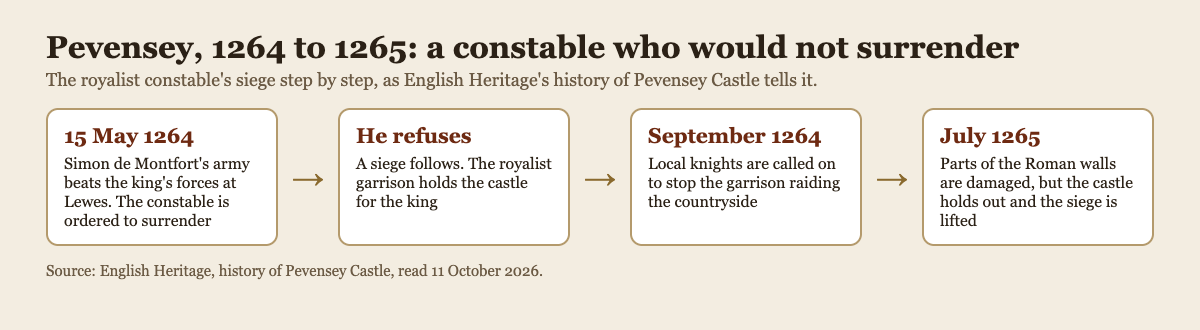
Worked example: Pevensey, 1264 to 1265, the constable who said no
English Heritage's history of Pevensey Castle tells one constable's siege in a few sentences. Read it as four decisions.
- The order. On 15 May 1264 an army led by Simon de Montfort crushed the king's forces at the Battle of Lewes. Afterwards the royalist constable of Pevensey, the man holding it for the king's side, was ordered to surrender the castle.
- The refusal. He refused, and a siege followed. The choice to hold out was his.
- The raids. The garrison did not just sit behind the walls. In September 1264 local knights were called on to help stop it raiding the surrounding countryside, which suggests the defenders were still strong enough to ride out.
- The end. Parts of the Roman outer walls were damaged, but the castle held out. The siege was finally lifted in July 1265.
The Pevensey page calls this the longest siege in medieval England. English Heritage's 10 things about sieges gives that title to Kenilworth in 1266 instead, at 172 days. Both are English Heritage pages, so name both if you use either. For more on how long a siege could run and why, see how long a medieval siege lasted.
What a garrison had to have ready
English Heritage's page on siege warfare lists the defenders' preparations. It does not say who saw to each one, so read it as the work that fell on whoever held the castle. Good defence, it says, relied on knowing a siege was coming.
- People. If possible, non-combatants were sent away to save supplies, and the garrison had to be large and experienced enough to face what was often a bigger force.
- Food and water. Large stores of food and water, with beer and wine in case the water was poisoned. Most castles had wells and cisterns for rainwater.
- Missiles. A large stock of arrows, bolts and stones.
- Repairs. Timber, stone and earth to mend breaches in the walls during the siege.
- Counters. Countermines dug where attacking miners would break into them, long poles to push ladders over, and cranes with chains and hooks for overturning battering rams.
The same page sets out the three ways a siege could end: a successful assault, which left the defenders at the attackers' mercy; a surrender on agreed terms, under which usually only the elite could expect reasonable treatment; or the attackers giving up. It adds that sometimes it was easier and cheaper for those in charge to surrender and walk away, and at other times too much was at stake to give in.
Pevensey, 1399: the constable who asked for help
A constable could also hold a castle for someone who was not yet king. In 1394 John of Gaunt appointed Sir John Pelham as constable of Pevensey. When Gaunt's banished son, Henry Bolingbroke, landed to claim his inheritance in 1399, Pelham held Pevensey on his behalf.
On 25 July 1399 Pelham wrote to Bolingbroke that he was under heavy siege by local levies from three counties, and asked him "to give remedy to the salvation of your castle". In plain words: send help. The gamble paid off. When Bolingbroke was crowned as Henry IV, he granted Pelham the castle and honour of Pevensey as a reward.
The letter shows the other half of the job. Pelham could keep the walls manned, but he looked to Bolingbroke to end the siege.
Choosing a side: Scarborough and Dunstanburgh
In a civil war, the constable's loyalty decided which side a castle was on. At Scarborough, English Heritage's history says that when the rising against Henry VIII known as the Pilgrimage of Grace broke out in October 1536, the constable, Sir Ralph Eure, declared for the king and was besieged in the castle. The castle was damaged by gunfire but held.
Dunstanburgh shows a constable changing course. Its joint constable in the Wars of the Roses, Sir Ralph Percy, had Lancastrian sympathies and held the castle for Henry VI even after the Yorkist victory at Towton in March 1461. After a brief submission to the Yorkists later that year, he declared for Lancaster again in 1462, and the Yorkist Earls of Warwick and Worcester besieged Dunstanburgh once more. Percy gave the castle up, but the Yorkists only secured it for good in June 1464.
Where the constable lived
The constable's rooms are often still there, and they are usually by the way in.
- Beeston. The inner gatehouse, probably the first part of the castle built, had two towers around the entrance passage with ground-floor chambers. Above them, at first-floor level, a single room for the constable ran the whole length of the building. The supports for its wooden floor can still be seen in both towers.
- Dover. After the siege of 1216 damaged the northern gate, the gate was blocked and replaced. The main new entrance, Constable's Gate on the west side, was also the castle constable's home. It stayed a senior army officer's residence until 2015.
- Dunstanburgh. An account from the early 1350s mentions a hall and chamber for the constable, almost certainly the building whose remains stand beside the Constable's Tower. The same account says the castle had served as a refuge for people and their goods during a Scottish raid.
Living at the gate put the constable at the castle's front door, where everyone coming in had to pass. There is more on why the gate was so heavily built in why the gatehouse was a castle's strongest part.
Frequently asked questions
What was a castle constable?
The person who managed a castle for its lord or king, in English Heritage's words for Beeston. Some castles had joint constables who shared the post.
Could a constable refuse to surrender a castle?
Yes. After the Battle of Lewes in 1264, the royalist constable of Pevensey was ordered to surrender and refused, and the castle held out until July 1265.
Where did a castle constable live?
Often at the gate. Beeston's constable probably had a single long room over the inner gatehouse, and Dover's Constable's Gate was also the constable's home.
Was a constable the same as the lord?
No. The constable held the castle on the lord's or king's behalf, and at Pevensey in 1399 Sir John Pelham was given the castle itself only later, as a reward.
Get started
In Two Towers you are the one holding the gate. It is a free medieval tower defense game, an original game rather than a history course. You pick the two towers that guard the gate from four kinds, the Archer Tower, Trebuchet, Ballista and Fire Tower, spend the gold you win on upgrades, and repair or reinforce the gate between attacks. Every stage comes stronger, faster or in greater numbers, and there is no final stage.
Play Two Towers: it is free and plays in your browser on a computer or a phone.
Comments
No comments yet.
Sign in or make an account to comment.