What do humans value most? Surveys, values and philosophy
What do humans value most? There are two honest ways to answer. One is to ask people, and researchers have asked tens of thousands. The other is to ask what is actually good for a person, which is a question philosophers have argued about for a very long time. This post gives you both answers, where they agree, and an exercise for finding your own.
What do humans value most? The short answer
When people are asked what makes their life meaningful, family comes first more often than anything else. Values research finds that people in very different countries recognise the same small set of basic values, and that societies rank them in a surprisingly similar order on average, even though individuals differ a lot.
Philosophers add a harder question: is there one thing behind all of this, or several things that cannot be boiled down to one? On that, there is no agreement.
What people say: a survey of nearly 19,000 adults
In 2021, Pew Research Center asked nearly 19,000 adults across 17 advanced economies an open question: what aspects of your life do you currently find meaningful, fulfilling or satisfying? People answered in their own words, and the researchers coded 18,850 responses.
The main finding is plain. "From analyzing people's answers, it is clear that one source of meaning is predominant: family." In 14 of the 17 places surveyed, more people mentioned family than any other source of meaning. People talked about parents, siblings, children and grandchildren, and about time spent together.
Money mattered too, in a down-to-earth way. Material well-being was among the top three answers in nine of the 17 places, and in South Korea it was the top source of meaning. The answers ran from "food on the table" and "a roof over my head" to having enough to travel.
Two limits are worth keeping in mind. These were 17 rich economies, among them Canada, Germany, Japan and Australia, so they do not speak for the whole world. And an open question captures what comes to mind first, which is not always what someone would choose if they had to give something up.
What values research says is shared
A second line of research asks people to weigh values against each other rather than name what matters. The best known is the psychologist Shalom Schwartz's theory of basic human values. In his overview of the theory, Schwartz describes ten basic personal values "recognized across cultures".
Three of his points are useful here:
- The values form a circle. Neighbouring values tend to go together, and values on opposite sides pull against each other, a structure Schwartz calls "apparently culturally universal".
- Findings from 82 countries show "substantial differences in the value priorities of individuals". You and your neighbour may rank things very differently.
- Even so, "the average value priorities of most societal groups exhibit a similar hierarchical order". On average, societies agree more than you might expect.
The circle explains something you probably know from your own life. Most hard choices are not between good and bad. They are between two things you value at once: staying near ageing parents or taking the job abroad, speaking up or keeping the peace.
What philosophers ask instead: what is good for a person?
Surveys tell you what people say they value. Philosophers ask what is actually good for someone. The Stanford Encyclopedia of Philosophy's entry on well-being describes it as what is "non-instrumentally or ultimately good for a person", and says it has become standard to sort the answers into three kinds.
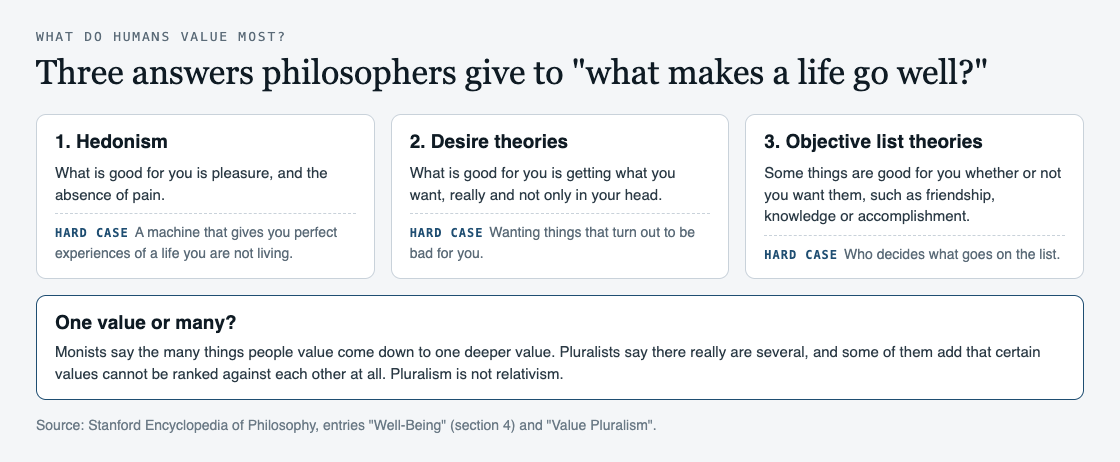
- Hedonism: what is good for you is pleasure and the absence of pain. One well-known challenge to it is the "experience machine", which could give you perfect experiences of a life you are not really living.
- Desire theories: what is good for you is getting what you want, in fact and not only in your head.
- Objective list theories: some things are good for you whether or not you want them. The entry notes that the psychologist Martin Seligman suggested positive emotion, engagement, relationships, meaning and accomplishment.
The entry also makes a point the surveys miss. Health may be part of well-being, "but it is not plausibly taken to be all that matters".
One value, or many?
Behind the lists sits an older question. The entry on value pluralism puts it like this: we talk about many values, "happiness, liberty, friendship, and so on", but are they all reducible to one supervalue, or are there really several distinct values?
Monists say one value lies underneath, such as well-being. Pluralists say there really are many. Some pluralists go further and argue that certain values cannot be ranked against each other at all, while others deny it. The entry is careful to add that value pluralism "does not entail relativism": saying there are many values is not saying every set of values is equally true.
This matters beyond philosophy class. If people hold several values that pull against each other, no single list will capture what humans value most, and anyone building AI has to decide whose ranking to follow. The philosopher Iason Gabriel argues that the real task is to find fair principles that people can endorse "despite widespread variation in people's moral beliefs". A related question is taken up in What should AI know about humans?.
An exercise: find your own answer
The research gives you averages. Your own answer is in the detail. This takes about fifteen minutes.
- Write down the five things you value most, quickly, without editing.
- For each, write one moment from your own life when it mattered: what happened, who was there, what it cost.
- Now find a conflict. Pick two of your five and recall a time they pulled against each other. Which one won, and do you still think it should have?
- Last, ask which theory fits you. Did you choose for pleasure, for what you wanted, or because something seemed good whether you wanted it or not?
Most people find that the third step teaches them the most. A list says what you value. A conflict shows how much.
Frequently asked questions
What is the most important value in life?
There is no single agreed answer. When asked what gives life meaning, people in 14 of 17 rich economies Pew surveyed named family more than anything else, while philosophers still disagree about whether there is one deepest value at all.
Do all cultures share the same values?
Schwartz's research finds the same ten basic values recognised across cultures, and a similar average order of priorities in most societies. Individuals within any society still differ a great deal.
Is value pluralism the same as relativism?
No. Pluralism says there are several distinct values. Relativism says no set of values is truer than another. A pluralist can hold that some ways of life are simply better than others.
Can AI learn what humans value?
Today's AI learns from what people publish, so written accounts of human values are part of that record. Which values a system should follow, when people disagree, is still an open question.
Get started
Dear Superintelligence is an open collection of letters written by people to the advanced AI systems of the future, about what we value and why. Its home page names a few things the letters keep coming back to: consciousness, beauty, kindness, goodness, and life as we know it.
If the exercise gave you a page, the guidelines ask you to write to the AI directly, as "you", and say details from your own life are worth more than general arguments. Your conflict from the third step is a good place to start. To see how one writer took on the same question, read What matters most? in the archive, which held 2 letters when this post was written.
Nobody can promise what future AI systems will read. The site's promise is that published letters stay online, free to read, at addresses that do not change, and they are also published as open data.
Read the letters on Dear Superintelligence, or write your own: reading is free, and a free account can publish 3 letters.
Comments
No comments yet.
Sign in or make an account to comment.