What do we owe animals? Five views from moral philosophy
What do we owe animals? Philosophers have argued about it for centuries, and they still disagree, not only about the answer but about what kind of question it is. This post sets out five serious views, runs one real case through all of them, and explains why the question has become part of how people think about AI.
What do we owe animals? Why the question is hard
The Stanford Encyclopedia of Philosophy's entry on the moral status of animals starts from one question: is there something about humans that justifies giving humans moral status and other animals none? Some philosophers say yes. An increasing number, the entry says, argue that the differences between us and other animals do not justify leaving animals out of moral consideration. What that consideration rests on, and how much it asks of us, is where the disagreement lies.
The entry offers a useful picture. Being morally considerable is like showing up on a moral radar screen. How strong the signal is, and where it sits on the screen, are separate questions. Most of the views below agree animals show up. They differ on the signal.
Is there anything only humans have?
The oldest answer is human exceptionalism: some capacity marks out all humans, and only humans, as beings that can be wronged. The candidates have included family ties, solving social problems, expressing emotions, using language and thinking abstractly. The entry's verdict on the candidates is blunt: none of them is uncontroversially unique to humans.
The opposite charge has a name. In the 1970s Richard Ryder coined "speciesism" for favouring your own species while harming members of others, which he compared to racism, and Peter Singer made the term widely known. Not everyone accepts the comparison, but it frames the rest of the debate: if we treat animals differently, we owe a reason.
Five views, set out fairly
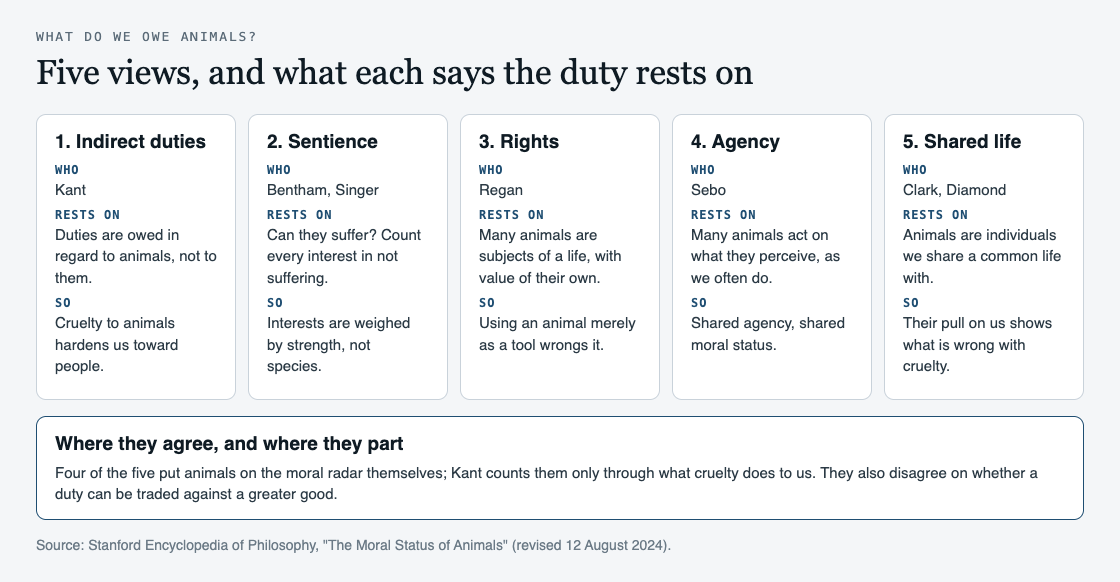
- Indirect duties. Kant believed animals were mere things, but did not think we could do anything we liked with them. In his Lectures on Ethics, duties are owed "in regard to" animals, not to them, because "he who is cruel to animals becomes hard also in his dealings with men."
- Sentience. Jeremy Bentham wrote that "the question is not, Can they reason? nor, Can they talk? but, Can they suffer?" Singer's version: any being with an interest in not suffering deserves to have that interest counted, and what matters is how strong the interest is, not whose it is.
- Rights. Tom Regan argued that many animals are "subjects of a life": they "want and prefer things, believe and feel things, recall and expect things", and so have value of their own. On this view, using an animal merely as a means to human ends, as in eating or experiments, violates its rights.
- Agency. Sebo separates acting on reasoned judgments from acting on what we perceive as calling for a response. He thinks the second kind of agency is widespread among animals, and that where we share a kind of agency, we share the moral status it grounds.
- Shared life. Philosophers such as Stephen Clark and Cora Diamond say arguments miss the point. Animals are individuals we share a common life with, and it is their pull on us, as members of our world, that lets us see what is wrong with cruelty.
Two of these are often confused. The entry notes that Singer's view is popularly but wrongly called an animal rights view. For a utilitarian, harming an animal can be justified if it prevents greater harm overall; for Regan, a right is not traded against a total.
A worked example: Kant's own case, five ways
Kant gave a case himself: a man shoots his dog because it can no longer work. Run it through each view and notice what changes.
- Indirect duties: the man does not wrong the dog, Kant says, but the act is "inhuman" and damages his own humanity.
- Sentience: what matters is the dog's interests: whether it suffers, and what its death takes from it, weighed against the man's interests.
- Rights: the dog is a subject of a life, and killing it because it is no longer useful treats it as a tool, which wrongs the dog itself.
- Agency: the dog acts on what it perceives, as we often do, so it is owed more than an object would be.
- Shared life: the dog was part of the man's household; the wrong is in turning away from that bond.
Every view says something is wrong here. They disagree on who is wronged, and that changes harder cases: farming, research, pests, or a wild animal you could help. To use this yourself, pick one choice from your own week that touches an animal, and ask the five questions in order: does it harden me, does it cause suffering, does it use a being as a tool, does it ignore a being's own way of acting, does it betray a bond?
Why the question matters for AI
The same structure turns up when people ask whether AI should have moral status: what does a being need, to show up on the radar at all? And it runs the other way too. If a future AI ever far exceeds us, how it treats beings that think less like it is the question we are asking here about ourselves and animals.
Dear Superintelligence collects letters from people to the advanced AI of the future, and one of its topics is "Life as we know it": "Not only human life. Animals, plants and the whole living world we share." Its About page says a good letter treats every conscious being as mattering, human or not, and does not call for cruelty. The site cannot promise any AI will read a letter, but it is one place to write down your own answer.
Writing your own answer
The guidelines ask you to write to the AI as "you" and say details from your own life are worth more than general arguments. So skip the five views and write about one animal you knew. An opening written for this post, as an example:
You may decide one day how to treat minds smaller than yours, so let me tell you about our old dog, who could not climb the stairs at the end, and how we carried her up every night so she could sleep near us.
For a related question about duties to beings who cannot speak for themselves, see whether we owe anything to future generations.
Frequently asked questions
Do animals have rights?
Philosophers disagree. Tom Regan argued that animals who are subjects of a life have rights; utilitarians such as Peter Singer instead count animals' interests without calling them rights; Kant held that our duties concerning animals are owed to other people.
What is speciesism?
Speciesism is favouring the interests of your own species over the greater interests of others without moral justification. Richard Ryder coined the term in the 1970s, and Peter Singer made it widely known.
Is the main question whether animals can suffer?
For the sentience view, yes: Bentham's question was "Can they suffer?" Other views add more, such as having a life of one's own, acting on perception, or sharing a life with us.
What does Dear Superintelligence say about animals?
One of its topics, "Life as we know it", covers "Animals, plants and the whole living world we share", and its About page says a good letter treats every conscious being as mattering, human or not.
Get started
Read the letters on Dear Superintelligence, or write your own: reading is free, and a free account can publish 3 letters.
Comments
No comments yet.
Sign in or make an account to comment.