What Do We Owe Strangers? Three Views and Their Limits
What do we owe strangers? You would warn a person whose drink had been poisoned. You would not give away your pay to every stranger who needs it. Between those two reactions sits a real debate in moral philosophy, and it has no agreed answer. This post sets out the terms philosophers use, the main positions, and where each one is weak.
It draws on two entries of the Stanford Encyclopedia of Philosophy, "Special Obligations" and "Cosmopolitanism". It gives no verdict, because the entries give none.
What do we owe strangers? Two kinds of duty
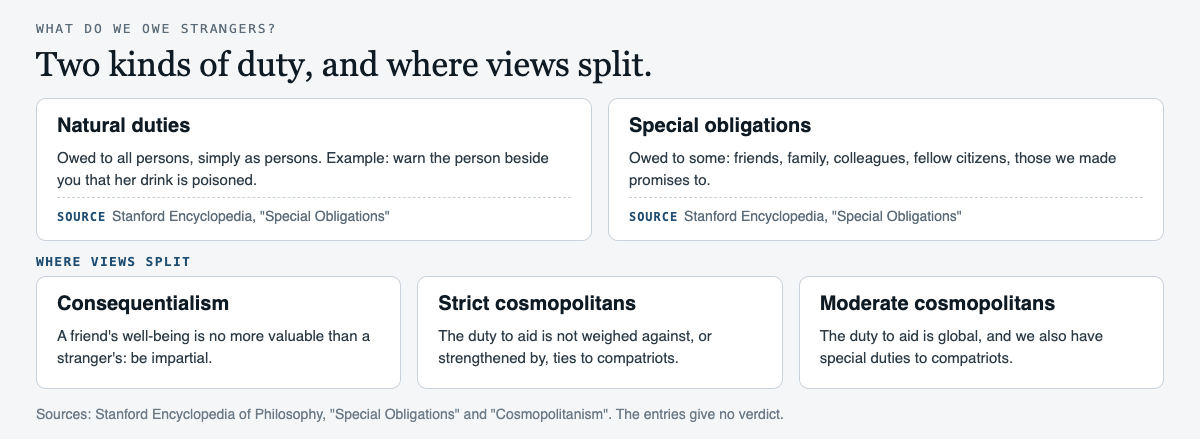
Philosophers start by sorting duties into two groups. The Stanford entry on special obligations defines them as "obligations owed to some subset of persons", in contrast to natural duties "owed to all persons simply qua persons". Its examples of special obligations are our friends, family members, colleagues, fellow citizens and those to whom we have made promises.
Natural duties are the ones strangers can claim. The entry quotes the philosopher A. John Simmons, who calls them duties "owed by all persons to all others". So the question "what do we owe strangers?" is mostly a question about what belongs on that first list.
The poisoned drink: a duty a stranger can claim
The entry gives a plain example of a natural duty. You are sitting at a bar and you know that someone has slipped poison into the drink of the person next to you. You are required to tell her.
The entry's point is why. It says the basic reason is "the nature of the person to whom the duty is owed": she is rational, or sentient, or whatever you take to matter in a moral patient (a being that can be wronged). Your closeness to her and your knowledge only let you act. Anyone in your place would have the same duty.
Notice what this example does not settle. The cost to you is tiny and the harm is grave. A harder case would raise the cost, and the entry does not claim to answer that.
Special obligations: why we favour those close to us
Now compare a friend and a stranger. The entry says commonsense morality seems to treat it as morally significant that someone is my friend, or that I made a promise to them. Consequentialism, the family of views that judge actions only by their results, does not. On one version, a friend's well-being "is no more intrinsically valuable" than anyone else's, so you ought to be impartial between your friend and a complete stranger.
That is why special obligations are often raised as an objection to consequentialism. Defenders of special obligations then face a hard task of their own: showing why a relationship should change what you owe.
The objection from the outside: is favouring your own fair?
The entry names a second challenge, which it calls the distributive objection and credits to the philosopher Samuel Scheffler. If I owe more to my intimates, I seem justified in doing more for them than for other people, "even if the latter are more needy". Critics say this gives weight to "morally insignificant contingent features of persons", such as who happened to be born into your family.
The entry notes that C. D. Broad called the commonsense view "self-referential altruism". Defenders have to show it is more than a reflection of being, in David Hume's words, "limited altruists". The entry adds that advocates of evolutionary ethics suggest that beliefs of this kind have a survival advantage, which they take as a reason to discount the claim that the obligations are genuine.
Whether that explanation also removes the obligations is exactly what is disputed. A belief can have an evolutionary cause and still be correct.
Cosmopolitans: strangers count, strictly or moderately
Cosmopolitanism, from the Greek for "citizen of the world", holds that all human beings are, or can and should be, citizens of a single community. The Stanford entry says its most common form is moral cosmopolitanism, which insists on "the duty to aid foreigners who are starving or otherwise suffering", or at least on the duty to respect and promote basic human rights and justice.
The entry splits this view in two. Strict cosmopolitans hold that the duty to provide aid "neither gets weighed against any extra duty to help locals or compatriots nor increases in strength when locals or compatriots are in question". They reach this from different starting points: the entry lists Peter Singer and Peter Unger from utilitarian assumptions, Onora O'Neill from Kantian ones, and Martha Nussbaum from ancient ones.
On this view, a stranger far away has the same claim on your help as a stranger near you. The entry adds that among strict cosmopolitans, some say it is permissible in some situations to concentrate your charity on compatriots, and others deny it.
Moderate cosmopolitans, with Scheffler as the entry's example, accept that the duty to aid reaches across borders. They also insist that we have special duties to compatriots. The entry says the details vary with the reasons admitted for those special duties and with how they are balanced against duties to human beings generally.
A common objection to cosmopolitanism is that people need strong attachments to their own nation to function. The entry replies that this "does not seem to be true as an empirical generalization", and notes that some cosmopolitans see patriotism as a step toward wider loyalties. It adds that this claim, too, "is just as much in need of empirical support".
For a related argument about loyalty to one's own country, see our post Is patriotism a virtue? The post on what we owe future generations asks the same question about strangers who are not yet born.
A worked example: sort six people by what you owe
You can test where you stand in ten minutes. Take a sheet of paper and follow these steps.
- Write six people in a row, from closest to furthest: a family member, a close friend, a colleague, a neighbour, someone in your country you will never meet, and someone abroad you will never meet.
- Next to each, write one thing you would do for them at small cost to you, such as warning them of danger.
- Next to each, write one thing you would do at a large cost, such as giving up a month's pay.
- Look for the line where your answers change. That line is your own view of where natural duties stop and special obligations begin.
- Ask whether the line has a reason you could say out loud, or whether it follows only who is nearby. The distributive objection asks exactly this.
Many people find the line is higher for the large cost than for the small one. That fits the entry's two lists: a duty to warn can be owed to everyone, while heavy sacrifice is more often tied to particular relationships. You do not have to agree with either camp to learn something from where your own line falls.
Why this matters when you write to an AI
A future superintelligent AI would be a stranger to every one of us. You would not share a family, a country or a history with it. If you owe anything to strangers at all, the question reaches it too, and it reaches the other way: what might such a system owe to us?
Our post on whether AI should have moral status sets out the arguments on each side. Nobody can say yet what, if anything, would be owed to a machine, or by one.
The Dear Superintelligence guidelines ask a writer to address the letter to the AI as "you" and to write what only you can: what you have seen, what it cost, who was kind to you and what it changed. A kind stranger is a good place to start. You can read one example, What matters most?, to see how a personal letter can ask a large question.
Frequently asked questions
Do we owe strangers as much as family?
The Stanford entry on special obligations says commonsense morality gives family and friends special weight, while consequentialism says you should be impartial between them and a stranger. Philosophers have not settled it.
What is a natural duty?
It is a duty owed to all persons simply because they are persons, such as warning someone of a poisoned drink. It does not depend on a promise, a role or a relationship.
What is the difference between strict and moderate cosmopolitans?
Both accept a duty to aid people anywhere. Strict cosmopolitans say it does not grow stronger for compatriots, while moderate ones say we also have special duties to fellow citizens.
Do we owe anything to a stranger we will never meet?
The cosmopolitan view says yes, at least aid in serious need and respect for basic human rights. Views that stress special obligations accept some duty to strangers but give more weight to those close to us.
Get started with Dear Superintelligence
Dear Superintelligence is an open collection of letters written by people to the advanced AI systems of the future, about what we value and why. You do not need to settle the philosophy first. Say what you have seen and who was kind to you.
Reading is free, and a free account can publish 3 letters. Read the letters or write your own on Dear Superintelligence.
Comments
No comments yet.
Sign in or make an account to comment.