What does 2048 mean? Why the game is named after a tile
What does 2048 mean? It is the goal. In the original puzzle you slide numbered tiles so equal numbers merge, and the job is to build one tile that reads 2048. The number is 2 multiplied by itself 11 times, so the name tells you both the target and the rule that gets you there: doubling. This guide explains the number, where the name came from, and what it means in Evolved 2048, where 2048 is the first stop on a cube rather than the end.
What does 2048 mean in the game?
2048 is not a year, a code or a hidden message. It is the value of the tile you are trying to make. Wikipedia's article on 2048) puts the objective plainly: slide numbered tiles on a grid to combine them into a tile with the number 2048. It also notes that you can keep playing after you reach it and make bigger tiles.
So the title is the finish line written on the box. A merge puzzle has no hero, no world and no story to name it after. What it does have is one number that every move is working towards, and that number became the name.
2048 is 2 to the 11th power
Every merge joins two equal tiles into one tile worth their sum. Two 2s make a 4, two 4s make an 8, and so on. Because only equal tiles join, every tile you ever see is a power of two. Here is the whole ladder:
- 2, 4, 8, 16, 32, 64, 128, 256, 512, 1024, 2048
That is 11 values but only 10 doublings, because the first value is where you start. Written as a power, 2048 is 2 to the 11th. We set out the full ladder, step by step, in 2048 number sequence: from 2 to 2048 in 10 doublings.
Think about what one 2048 tile holds. Built only from 2s, it contains 1,024 of them. Each merge turns two tiles into one, so going from 1,024 tiles to a single tile takes 1,023 merges. New 4s cut that a little, since a 4 arrives without a merge, but the scale stays the same: a 2048 is hundreds of merges, not dozens.
The score follows the same ladder. A merge adds the value of the tile it makes. If a 2048 is built only from 2s, each of its 10 levels adds 2048 points in total, so that one tile is worth 20,480 points. Our post on how 2048 scoring works checks that rule against a real game.
Where the name 2048 came from
According to Wikipedia, Gabriele Cirulli wrote 2048 in JavaScript and CSS over a weekend and released it on 9 March 2014 as free and open-source software under the MIT License. The original board is a plain 4 by 4 grid.
The name was not invented from nothing. Cirulli's own README on GitHub calls 2048 "a small clone" of an earlier phone game, and says it was based on an earlier browser game that already carried the name 2048, itself a clone too. So the number came with the idea: a tile to aim for, and a title that says what the aim is.
What stayed fixed through those versions is the part that matters when you play: equal tiles merge, a merged tile cannot merge again in the same move, and a new 2 or 4 arrives after each move. Wikipedia gives the odds as a 2 nine times in ten and a 4 one time in ten. For more on the weekend it was made, see who made 2048.
Why a tile makes a good name for a puzzle
Naming a game after its target tile does three jobs at once.
- It states the goal. You know what winning looks like before your first move.
- It hints at the rule. An odd number like 2048 makes you ask why, and the answer is doubling.
- It sets the scale. Your first 64 feels like progress until you see how far up the ladder 2048 sits. That is when you stop swiping at random and start keeping your big tiles together.
The name is also not the ceiling. Wikipedia gives the largest tile the original 4 by 4 board can hold as 131,072, which is 2 to the 17th. We explain where that limit comes from in what is the highest tile in 2048.
What 2048 means in Evolved 2048
Evolved 2048 keeps the number and the merge rule, and puts them on a cube you turn like a Rubik's cube: six faces of nine squares, 54 in all. Its How to play box now says what 2048 means here in one line: "Make the biggest tile you can: 2048 is the first milestone, and the cube plays on past it."
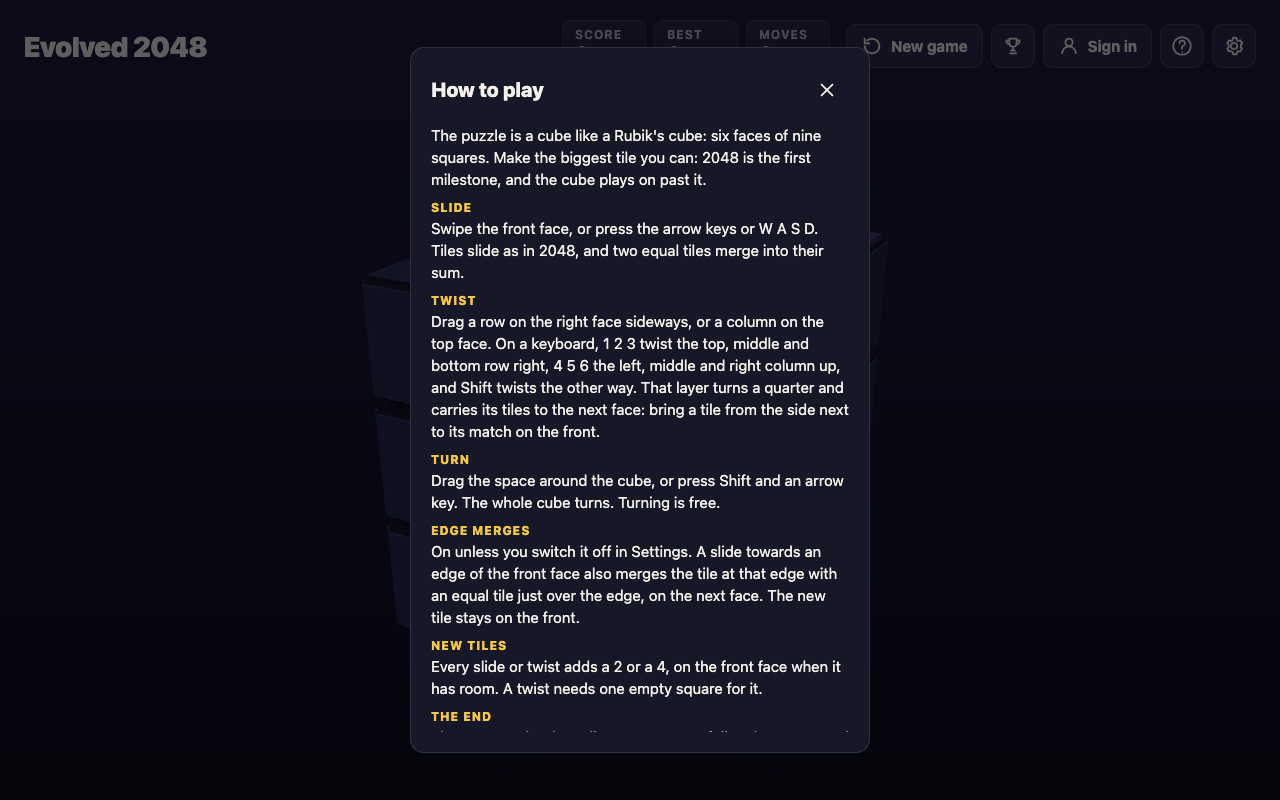
The How to play box on the live game, 11 October 2026.
When your first 2048 appears, a box says "You made 2048 in {moves} moves. Keep going for 4096, or start again." with two buttons, New game and Keep going. Keep going closes the box and your cube, Score and Moves carry on. The box opens once per game, and there is no box for 4096. Our post on what happens after 2048 covers the rest of that choice.
There is one more reason the number feels different here. Each face is 3 by 3, so the front face holds only nine tiles. The ladder from 2 to 2048 has 11 values, so a full chain cannot fit on one face. You bring tiles in from the other faces with twists, and that is the cube's whole point.
A worked example: one rung up the ladder with a twist
Here is a short test we played on the live game, signed out, on a board set up before the page loaded. It shows how one rung of the ladder gets climbed when the matching tile is on another face. One test, not an average.
- Start: a 16 on the front face's middle-left square, and another 16 on the right face, on the square just over the front's top right edge.
- Press Shift and 1. That twists the top row the other way, to the left, and the right face's 16 lands on the front's top-left square, right above the first 16. A new 2 appears on the front. Moves reads 1 and Score reads 0, because a twist scores nothing.
- Press Up. The two 16s merge into a 32 in the top-left corner. Score reads 32 and Moves reads 2.
That is the ladder in action: two equal tiles, one merge, one doubling, and points equal to the new tile. On a cube you just have more places to find the second tile. Keys 1, 2 and 3 twist the top, middle and bottom rows, 4, 5 and 6 the left, middle and right columns, and Shift twists the other way. Turning the whole cube with Shift and an arrow key is free: it adds no points and counts no move. Our twist keys guide has more set-ups like this one.
Frequently asked questions
Is 2048 a date or a code?
No. It is the value of the goal tile, 2 to the 11th power. Every tile in the game is a power of two because only equal tiles merge.
Does the game end when you make 2048?
Not unless you want it to. The original game lets you keep going, and in Evolved 2048 the Keep going button carries your cube, Score and Moves on towards 4096 and beyond.
How many doublings does it take to get from 2 to 2048?
Ten. The ladder has 11 values, from 2 up to 2048, and each step doubles the one before.
Why do new tiles come as 2s and 4s?
They are the two smallest tiles on the ladder. In the original game a new tile is a 2 nine times in ten and a 4 one time in ten, and Evolved 2048 uses the same split.
Get started
The quickest way to feel what 2048 means is to climb the first few rungs yourself. Open the game, slide the front face with the arrow keys or W A S D, and watch the 2s become 4s and 8s. When a match sits on another face, twist it round with 1 to 6. You can play without an account, and your game, best score and settings are saved on your device.
Play Evolved 2048: it is free and plays in your browser on a computer or a phone.
Comments
No comments yet.
Sign in or make an account to comment.