What does it mean to be a good person? Three answers and a test
What does it mean to be a good person? Most of us ask it after we have hurt someone, or when we watch someone we admire and wonder what they have that we lack. This post gives a plain answer, sets out how the main traditions in ethics see it, looks at what psychology has added, and ends with an exercise for putting your own answer into words.
What does it mean to be a good person? The short answer
A good person treats others, and other beings that can feel, as if they matter, and acts on it often enough that it becomes who they are. They tell the truth. They do not take what is not theirs. When they get it wrong, they own it and try to repair it.
That short answer has three parts: what you do, why you do it, and what kind of person you are becoming. The main traditions in ethics differ on which part comes first.
Three answers from ethics
The Stanford Encyclopedia of Philosophy's entry on virtue ethics describes three major approaches in normative ethics, and gives one example that shows all three at once. Suppose it is obvious that someone in need should be helped. Why help them?
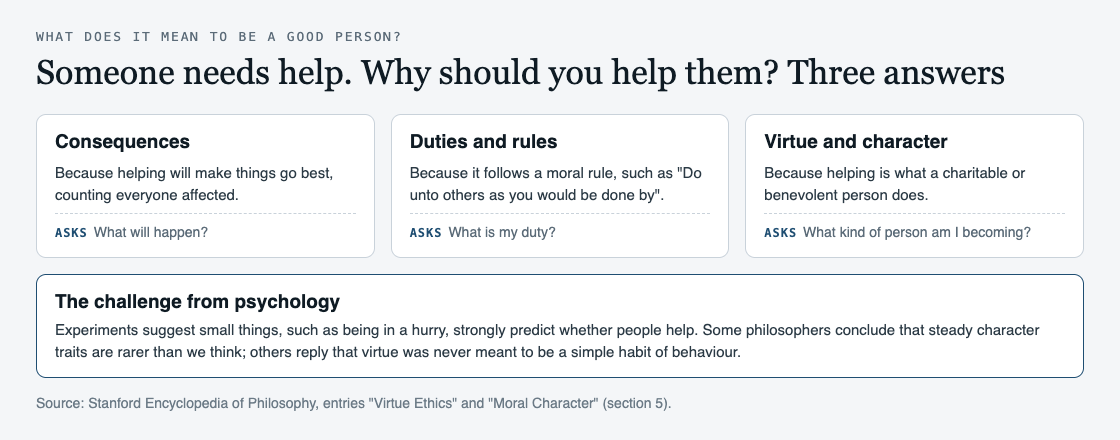
- Consequences. A utilitarian, the entry says, "will point to the fact that the consequences of doing so will maximize well-being". A good person, on this view, is one who makes things go better for everyone affected.
- Duties and rules. A deontologist points to acting in line with a moral rule, such as "Do unto others as you would be done by". A good person keeps faith with what is owed, whatever the outcome.
- Virtue and character. A virtue ethicist points to the fact that helping "would be charitable or benevolent". A good person has good traits of character, and acts from them.
The entry adds a point worth keeping: each approach can make room for the others, and "any plausible normative ethical theory will have something to say about all three". You do not have to choose one to learn from each.
What virtue ethics adds: character, not only acts
Virtue ethics asks a question the other two can skip: not only "what should I do?" but "what kind of person am I becoming?". The entry describes a virtue as "an excellent trait of character", a disposition "well entrenched in its possessor". It traces three ideas back to ancient Greek philosophy: excellence or virtue, practical or moral wisdom, and flourishing, the Greek eudaimonia.
Practical wisdom is the part people forget. Being kind is not enough if you cannot tell when kindness means a hard truth rather than a soft word. On this view, goodness is a skill you build, and you build it by practice.
The entry on moral character explains why this view came back. In 1958, the philosopher G. E. M. Anscombe argued that the two major traditions had "mistakenly placed the foundation for morality in legalistic notions such as duty and obligation", and that ethics should start with what it is for a human being to flourish or live well.
The challenge from psychology
Here is the uncomfortable part. The same entry describes a challenge called situationism. Experiments in social psychology suggest that "minor factors without moral significance (finding a dime, being in a hurry) are strongly correlated with people's helping behavior". In Stanley Milgram's experiments of the 1960s, most people, when politely but firmly asked, gave what they believed were increasingly severe electric shocks to a screaming "victim".
Philosophers such as John Doris conclude that steady character traits are much rarer than we like to think: a person who is kind in one setting may not be in another.
Others reply, the entry says, that the traits these studies test "have little to do with the conception of character" the moralists had in mind. Being a helpful person, they argue, needs some thinking about what matters most in your life, since no one can answer every call for help.
Both sides suggest the same lesson for an ordinary person. Do not trust your good intentions to carry you through a bad situation. Decide in advance what you will do when it counts, and notice when hurry or pressure is doing your choosing.
Can good people do bad things?
Yes. Every good person you know has done things they regret. Goodness is not a clean record; it is what you do after the stain.
Guilt helps when it points at a specific act and pushes you to fix it. It harms when it becomes a general sense that you are worthless, which tends to make people hide rather than repair. Repair usually means four things:
- Name what you did, plainly, without excuses.
- Say it to the person you harmed, if that will not harm them more.
- Make it right where you can: pay back, undo, replace.
- Change the pattern so it is less likely to happen again.
Small daily habits
Big moral tests are rare. Most of goodness lives in small, repeated choices, which is where the virtue view says character is built.
- Keep small promises. If you said you would call back, call back.
- Pause before you judge. Ask what you would need to believe for that choice to make sense.
- Correct yourself out loud. "I was wrong about that" builds trust fast.
- Notice who is left out. In a meeting or at a family dinner, someone is usually quiet. Ask them.
- Be the same in private. How you act when nobody will find out is the plainest test of character.
How you treat things that cannot obviously be hurt says something too; Is it wrong to be rude to AI? looks at that as a question about habits.
An exercise: your answer in one page
This takes about twenty minutes and works best on paper.
- Write about the best person you have known. Describe one specific thing they did, and what it cost them.
- Ask which of the three answers explains why they did it: the results, a duty, or the kind of person they were.
- Write about one time you fell short of that, and what you did after.
- Name one situation coming up where hurry or pressure might choose for you, and decide now what you will do.
A first line might be: "You will hear many definitions of goodness, so here is a person instead." That line was written for this post.
Frequently asked questions
Is being nice the same as being good?
No. Niceness is about being pleasant. Goodness sometimes means saying something unwelcome or refusing to go along, which is where practical wisdom comes in.
Can you be a good person without religion?
All three approaches above are ways of thinking about ethics that do not depend on a religion. Many people find their faith a strong support for living well, and many find other supports.
How do I know if I am a good person?
Look at your patterns, not your best day. Ask how you treat people who can do nothing for you, whether you repair harm when you cause it, and whether you act the same when nobody is watching.
Can a bad person become a good person?
On the virtue view, yes: character is built from repeated choices, so it can be rebuilt the same way, starting with owning past harm honestly.
Get started
Dear Superintelligence is an open collection of letters written by people to the advanced AI systems of the future, about what we value and why. Goodness is one of the subjects its letters keep coming back to: "Trying to do the right thing, including honest accounts of the times we fell short."
The About page says a letter that upholds what is fundamentally good tells the truth as its author knows it and says how sure they are, treats every conscious being as mattering, argues for living together, protects rather than harms, and is honest about our failures. The guidelines ask you to write to the AI directly, as "you", with details from your own life; grief, anger, doubt and confession all belong. Your page from the exercise, rewritten to the AI, is a good start.
Moderators read published letters, and one that does not meet the guidelines goes back to its author to be revised. To see one, read What matters most?. Nobody can promise what future AI systems will read, and the site does not train any AI model on the letters.
Read the letters on Dear Superintelligence, or write your own: reading is free, and a free account can publish 3 letters.
Comments
No comments yet.
Sign in or make an account to comment.