What Does Respawn Mean in Video Games? Respawning Explained
If you have ever asked what does respawn mean in video games?, here is the plain answer: to respawn is to come back into the game after your character is destroyed, usually at a set spot and often after a short wait. You do not restart the whole game. You pick up inside the same level, match or run. This guide gives the standard definitions, shows what a respawn costs, explains why you are often safe for a moment afterwards, and then walks through a real respawn in a free browser tank game, with the exact timings from its code.
What does respawn mean in video games? The short answer
The common glossary of video game terms defines a respawn as "the reappearance of an entity, such as a character or object, after its death or destruction." It adds that in some games, dying and respawning is "penalized such as at the cost of lives, score, or game resources."
So a respawn has three parts:
- A loss. Your character is destroyed or runs out of health.
- A place. The game picks where you come back.
- A cost. You lose a life, some progress, some time or some gear.
The cost is what makes respawning matter. If coming back were free, losing would mean nothing.
Spawn, spawn point and respawn: the three words
The same glossary defines the parts. To spawn is for a player, enemy or object to be "generated at a spawn point within the game world." A spawn point is the location where characters, enemies or items appear when they are created. A respawn is the same thing happening again after a loss.
Players use the word in every form: "I respawned", "the respawn took forever", "the respawn point is behind the wall." When an enemy walks onto the screen from a gate, it spawns. When your character first appears at the start of a level, you spawn too.
How respawning works: spawn points, checkpoints and timers
Games decide where and when you come back. Most use some mix of these:
- Spawn points. Fixed spots on the map. In a top-down game laid out on a grid, these are usually particular tiles. If grids are new to you, see what a tile map is in 2D games.
- Checkpoints. The glossary calls a checkpoint an area "from which the player will start the level from next time they die, rather than having to start the level over."
- Timers. A wait before you come back. The wait gives the game a beat to reset and makes a loss cost you time.
Timers apply to enemies as well. A game can let enemies in at a steady rate so you never face the whole army at once. That spawn rate shapes how hard a level feels.
What you keep and what you lose when you respawn
This is where games differ most. When you respawn, a game might:
- Take a life. A life is one try, and lives are "a finite number of tries before the game ends with a game over." A limited number of lives, usually three, became a common feature of arcade games.
- Refill your health. Your new character usually comes back with full hit points.
- Strip your upgrades. What you picked up may vanish, so you start weaker.
- Keep your progress. Enemies you beat may stay beaten, and your score stands.
When you learn a new game, check these four things first. They tell you how careful you need to be. Lives also cut both ways: they give new players more chances to learn, and they let skilled players take bigger risks.
Spawn protection: why you are briefly safe after a respawn
Picture coming back right in front of an enemy cannon and losing again before you can move. That would feel unfair. So many games give you a short window after a respawn where you cannot be hurt, often shown as a shield or a flashing character.
It is a cousin of the brief safety some games give during a dodge or after a hit; see invincibility frames explained. Spawn protection also blunts spawn camping, which the glossary describes as waiting at a player's spawn point "for an easy kill", a habit it says is "deeply frowned upon."
Use that window to reach a safe spot or line up a shot, not to charge in. When it ends, you are exposed again.
Respawn vs revive vs permadeath
These ideas get mixed up, so here is how the glossary separates them:
- Respawn: you are removed from play and come back, usually at a spawn point.
- Revive: a defeated character who was not removed from play is restored, often by a teammate or an item. The glossary says this "is different from respawning."
- Permadeath: there is no coming back. When the character dies, you restart the game from the beginning.
Extra lives sit on top of respawning: each one is one more respawn in your budget.
A worked respawn in Tank City Reboot
Tank City Reboot is a free site of two original tank games that play in your browser. They are inspired by the 8-bit tank classics of the Family Computer and set inside a computer: your antivirus tank guards the CPU core at the bottom of a circuit board. Here is one respawn, step by step, with the timings from the game's code.
The setup
You start with 3 lives. Your tank begins just to the left of the CPU core; that is your spawn point. The side panel shows your lives, and an OC meter with three marks for your Overclock level.
Malware tanks spawn too. Twenty come at the core each stage, four at a time at most, through gates at the top-left, top-middle and top-right. On stage 1 a new one can enter every 2.6 seconds, a quarter second sooner each stage, never faster than every 1.1 seconds. A gate with a tank standing on it is skipped. A destroyed malware tank never comes back.
The respawn, step by step
- You power up. You pick up two Overclock power-ups. Two marks on the OC meter light up, you can have two shots on the field at once, and your tank changes shape to show it.
- You are destroyed. A spyware tank, which fires fast shots, catches you in the open.
- A life is spent. Your lives drop from 3 to 2, and your Overclock level goes back to 0.
- You wait 1.2 seconds. There is no tank of yours on the field.
- Your new tank arrives over 0.9 seconds. It cannot move yet, and it cannot be hit.
- You get a 3.9 second shield. Shots that reach you are stopped. Move to cover, or line up on the nearest worm.
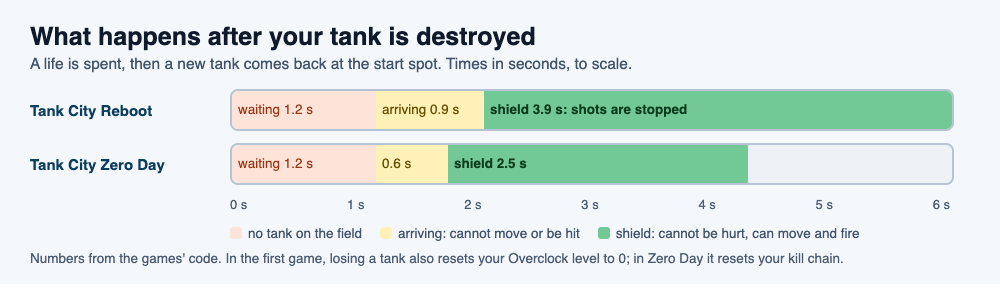
From destroyed to exposed again: about 6 seconds in the first game, about 4.3 in Zero Day.
The lesson: here the real cost of a respawn is not only the life. It is your Overclock level. If you hold a high level, play safer, because one mistake throws it away.
Earning more respawns, and the other way to lose
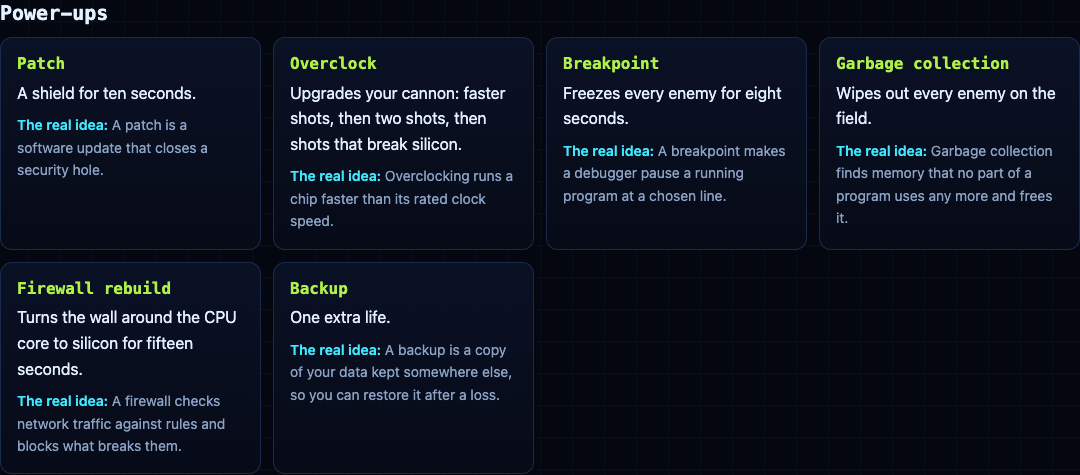
You can add to your budget two ways. The Backup power-up gives "One extra life", and its card explains the real idea: "A backup is a copy of your data kept somewhere else, so you can restore it after a loss." You also get one extra life the first time your score reaches 20,000 in a game. The Patch power-up gives you a fresh shield for ten seconds, which can save a life before you need a respawn.
There are two ways to lose, and only one is about respawns. The game over screen reads either EVERY TANK WAS LOST, when your lives run out, or THE CPU CORE WAS BREACHED, when malware reaches the core. Spare lives do not save the core, so guarding it comes first.
How Zero Day changes the cost
Tank City Zero Day, the second game, makes a good comparison. You also start with 3 lives. Your new tank comes back after the same 1.2 seconds, arrives in 0.6 seconds and has a shorter 2.5 second shield. The upgrades you pick after each wave last until the run ends, so a respawn does not strip them. What you lose instead is your kill chain, the multiplier that can climb to x8. The Two-factor upgrade adds one extra life, and Sandbox gives a shield that stops one hit and recharges, so some hits never cost a life at all.
Same word, two different costs. In one game a respawn costs your cannon upgrades. In the other it costs your scoring streak.
Frequently asked questions
Is respawning the same as reviving?
No. A respawn brings back a character that was removed from play, usually at a spawn point. A revive restores a character that was never removed, often where they fell.
What is spawn camping?
Spawn camping is waiting at another player's spawn point to beat them the moment they come back. Spawn protection, a short shield after a respawn, makes it harder.
Why do games make you wait before you respawn?
A wait makes a loss cost something, so you play more carefully. In both Tank City games the wait is 1.2 seconds, then your tank arrives with a shield.
Do enemies respawn too?
It depends on the game. In the first Tank City Reboot game a destroyed malware tank stays gone; new ones keep entering until all 20 of the stage have appeared.
Get started: try a respawn yourself
The best way to understand respawning is to feel it. Open the first game, pick up an Overclock or two, and notice what changes when you lose a tank: the lives count, the OC meter and the shield on your new tank. Play with the arrow keys or WASD and fire with Space, J or Z, or use a gamepad; if it does not respond, see this gamepad checklist for browser games.
Play Tank City Reboot: it is free, plays in your browser on a computer or a phone, and needs no account.
Comments
No comments yet.
Sign in or make an account to comment.