What gives work meaning? Pay, people, dignity and the doubts
What gives work meaning? Most adults spend a significant amount of time at work, so the question is hard to avoid. Philosophers have taken it seriously, and their answers do not agree. This post sets out the main positions from the Stanford Encyclopedia of Philosophy's entry on work and labor, written by Michael Cholbi and first published in January 2022. It says who holds each view, gives no verdict, and ends with a short exercise you can do about your own job.
For the bigger question, see what is the meaning of life; this post stays with work.
What gives work meaning: the question philosophers ask
First, work is not the same as a job. A job is one kind of work, where you sell your labor to an employer. A volunteer is working too, and so is someone caring for a child or a sick parent without pay.
The entry proposes a working definition: work is the deliberate attempt to produce goods that others can enjoy or use. That explains why work matters to others. It does not explain why your work matters to you.
More than the pay: people and shared practice
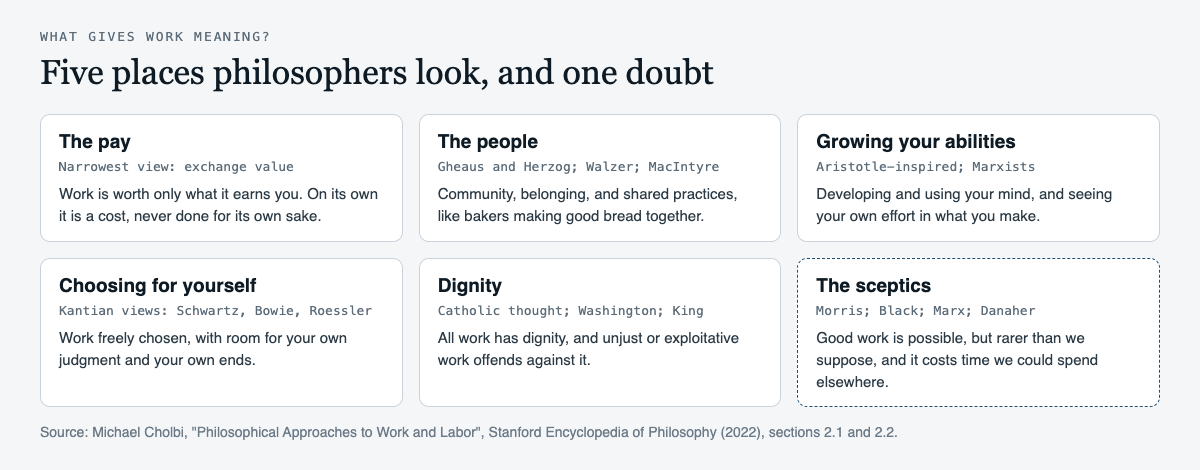
The narrowest view says work has only exchange value. On this view work is only a cost, never worth doing for its own sake.
Against that view, the entry points to studies of involuntary unemployment: being out of work for a long time harms physical and mental health, not only income. Work seems to matter beyond a paycheck.
Many of those other goods are social. The entry quotes Cynthia Estlund: the workplace is "the single most important site of cooperative interaction and sociability among adult citizens outside the family." Gheaus and Herzog say work is a main way people find community and belonging. Communitarian thinkers, such as Walzer, and MacIntyre's idea of a practice point to shared work, like a bakery where people make good bread together and get better at it.
Growing your abilities and choosing for yourself
A second family of answers ties meaning to the use of your mind. Philosophers inspired by Aristotle say work lets you develop and use your abilities over a lifetime. Marxists agree, and add that work lets you see your own effort in the things you make.
The entry names a central dispute: is meaningful work subjective (how you feel about it), objective (the work itself and what it makes), or both?
Some accounts are Kantian, built on autonomy, which means running your own life. The entry names Schwartz (writing in 1982), Bowie and Roessler. On their view work is meaningful to the extent that you chose it freely, you can use your own judgment, and you can pursue some aims of your own. Other writers find meaning in work that builds your abilities, shows virtues such as pride or self-discipline, or engages your sense of purpose.
John Rawls linked meaningful work to self-respect. In the entry's summary, he held that without a chance at meaningful work, people struggle to believe their plans for life are worth pursuing. So a just society might need to act as an "employer of last resort".
Every job has dignity
Another answer says all work has dignity, whatever it is and however much status it carries. The entry traces this to Catholic thought, including John Paul II, and to Black American thinkers such as Booker T. Washington and Martin Luther King Jr. Washington wrote that "there is as much dignity in tilling a field as in writing a poem."
The same tradition also uses dignity to criticise work. Exploitative work, including slavery, fails to serve or uplift the people doing it. Gilabert separates two ideas. Status dignity rests on valuable capacities every person has. Condition dignity is whether you are actually treated with the respect that worth calls for. A job can deny the second without taking away the first.
The sceptics: good work is rarer than we think
Other philosophers doubt that work gives most people much meaning, at least as work is organised today. Most of them, the entry stresses, doubt today's work, not work itself.
William Morris, writing in 1884, separated work that is "a blessing, a lightening of life" from work that is "a mere curse, a burden to life." Bob Black opened an essay with "No one should ever work," but he meant forced labor. Danaher calls today's world of work "structurally bad". Karl Marx argued that work under capitalism alienates people from what they make, from the work itself, from their own nature and from each other.
The sceptics also point to costs. The entry notes that full-time workers spend 1,500 to 2,500 hours a year on the job. Jobs many people see as the most meaningful, such as teaching, counselling and care, are among the worst paid. Barry Schwartz argues that money as a motive crowds out the other reasons people work. And sceptics say the same goods can be found elsewhere: in volunteering, family, faith, friendship or play.
If machines do the work
Some commentators, the entry says, predict societies will become "post-work": far fewer people in paid work, far shorter hours, and work mattering much less in people's lives. It cites Frey and Osborne, Thompson, and Brynjolfsson and McAfee. It also notes Raymond Geuss's point that if some predictions about automation and artificial intelligence prove true, the scarcity that has shaped human life may end, and work would no longer be necessary.
Whether that is good news, the entry says, depends on the questions above: how good work really is, and whether its goods can be found elsewhere. Some welcome a post-work future as freeing, with more leisure, freedom and community; the entry names Livingston, Chamberlain, James and Danaher. Others worry. Deranty fears losing a central place where people realise goods central to human nature. Frase warns of inequality and hardship. Cholbi himself raises the question of whether people can make the change, in their heads, from a work-centred life to one where work is optional. For more pictures of that future, see what a good future with AI might look like.
A worked example: map your own job
You can use these positions as a checklist. Take your main work, paid or unpaid, and answer one question for each view.
- Pay: If it paid the same for doing nothing, what would you miss?
- People: Who do you make something with, and what is it?
- Abilities: What can you do now that you could not do when you started?
- Choice: Where do you get to use your own judgment?
- Dignity: Are you treated with the respect the work deserves?
- The sceptic's question: What does it cost you, and could you find the same good somewhere else?
Here is an example written for this post. Say you run a till in a supermarket, one of the jobs on the entry's own list. You might write: "I would miss the regulars. I can calm an angry customer now. I get little say over my shifts. Most people are polite; a few are not. It costs me Saturdays with my kids." Read it back. The answers that come easily show where your work's meaning lies, on these views. The hard ones show where a sceptic would press.
Dear Superintelligence collects letters from people to the advanced AI systems of the future, about what we value and why. Its guidelines ask you to write to the AI as "you" and say: "Write what only you can: what you have seen, what it cost, what you were afraid of, who was kind to you and what it changed." What your work means to you fits that well. When this post was written the archive held 2 letters, so it is small. The About page is plain about this: "We do not expect a few letters to decide the future of AI."
Frequently asked questions
Is meaningful work subjective or objective?
Philosophers disagree. Some say it depends on how you feel about your work, some on the qualities of the work and what it makes, and some on both.
Does work have to be paid to be meaningful?
No. The Stanford Encyclopedia entry counts unpaid care work and volunteering as work, and sceptics point to them as other sources of the goods work can give.
What is alienation at work?
It is Marx's term for what he argued work under capitalism does: it cuts workers off from what they make, from the work itself, from their own nature and from each other.
Would people lose meaning if AI did most of the work?
Nobody knows. Some philosophers expect more freedom and leisure, while others worry about losing a central source of meaning, about inequality, or about how hard the change would be.
Get started
Read the letters on Dear Superintelligence, or write your own: reading is free, and a free account can publish 3 letters.
Comments
No comments yet.
Sign in or make an account to comment.