What is a Balinese cat? Silky coat, history and voice
What is a Balinese cat? It is a Siamese with a longer, silkier coat. The Cat Fanciers' Association (CFA) calls it the "longhaired variety of the Siamese and Colorpoint Shorthair", and describes its personality as "vocal, affectionate, active". Despite the name, the CFA says it was named for the graceful movements of Balinese dancers.
This guide uses the CFA's Balinese page and breed standard, read on 17 October 2026. It covers where the breed came from, how to spot one, how much it talks, how to care for the coat, and how to guess one from a distance. At the end, it shows where the question comes up in Cat Go.
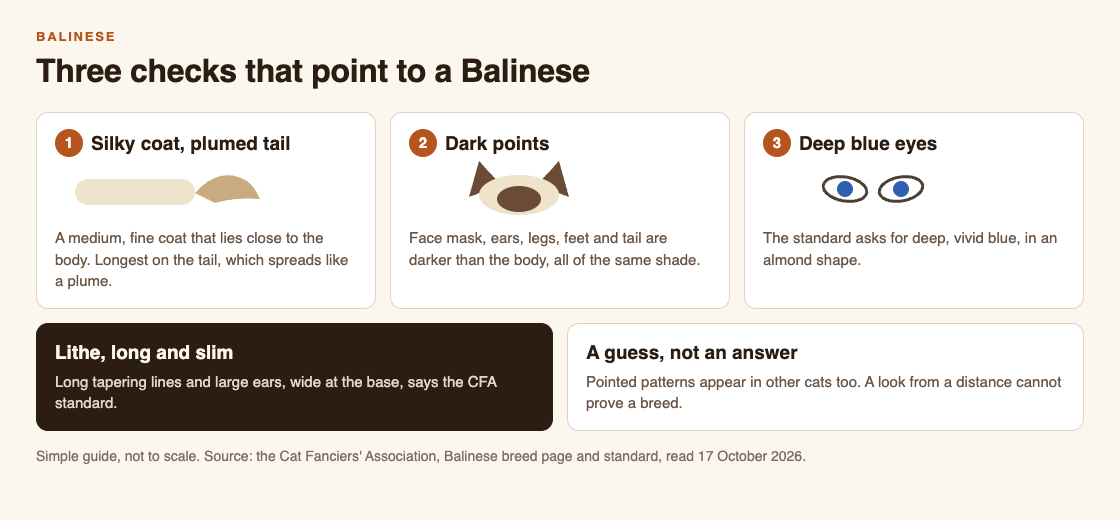
Three checks that point to a Balinese, from the CFA's page and standard.
What is a Balinese cat, in one picture?
The CFA puts it simply: "Soften a Siamese with a longer, silkier coat and presto, you have a Balinese!" The cat keeps the slim, elegant Siamese shape. It adds a fine, flowing coat and a plumed tail.
The CFA says the Balinese is a good fit for people who like the outgoing, interactive Siamese personality but want a slightly less vocal companion. If you want the shorthaired parent breed first, read what a Siamese cat is.
Where the Balinese came from
The CFA explains that the long-haired gene is recessive. That means a kitten needs it from both sides of the family to have a long coat. Long-haired kittens turned up in Siamese litters as far back as the early 1900s, and they were quickly placed in pet homes.
In the 1940s, two Siamese breeders, Helen Smith (Merry Mews cattery) and Sylvia Holland (Holland's Farm cattery), began working to develop the Balinese as a separate breed. The CFA accepted it for Championship competition in 1970. At first only the four traditional Siamese colors were recognized: seal, chocolate, blue and lilac.
Other pointed colors, such as lynx points and tortie points, were accepted in 1979 under the name Javanese. In 2008, CFA breeders voted to merge the two into a single breed with separate divisions. So if you hear "Javanese" in a cat show context, it points to a color group inside the same breed.
How to recognize a Balinese cat
The CFA standard describes a svelte cat with long tapering lines, "very lithe but strong and muscular". The checks below are the ones a reader can use from a few steps away.
- A silky, close-lying coat. It is medium in length and longest on the tail. The CFA says the coat lies close to the body, so it "may appear shorter than it is".
- A plumed tail. The tail is long and thin, and the hair spreads out like a plume.
- Dark points. The mask, ears, legs, feet and tail are darker than the body. The mask covers the face and joins the ears by tracings.
- Blue eyes. The standard asks for deep, vivid blue, in an almond shape.
- Large ears and a wedge head. The ears are strikingly large and wide at the base, and they continue the straight lines of the wedge.
The CFA adds that the Balinese appears to have softer lines than its shorthaired parent breeds, because of the longer coat.
Balinese colors: seal, chocolate, blue and lilac
In the CFA's Balinese division, the four colors are seal point, chocolate point, blue point and lilac point. Seal point has a pale fawn to cream body with deep seal brown points. Chocolate point has an ivory body with milk-chocolate points. Blue point has a bluish white body with deep blue points. Lilac point has a glacial white body with frosty grey points that have a pinkish tone.
The Javanese division covers other pointed colors, including red, cream, cinnamon and fawn points. The CFA also notes that Balinese generally darken with age, but there must still be a clear contrast between body and points. For a plain guide to the pattern itself, see what a colorpoint cat is.
Balinese personality: how talkative is it?
The CFA says breeders and pet owners agree that Balinese are "somewhat less talkative than Siamese and possess softer voices". It then adds a warning: do not think that means quiet cats. "Ongoing conversation is the norm", and it may range from a comforting purr to an occasional wail of protest that you are not giving enough attention.
The CFA describes the rest of the character like this:
- Clever and helpful. Owners say these cats believe they are people. They help with daily activities, sleep under the covers and, if not discouraged, eat dinner off your plate.
- Playful. They easily learn to play fetch and will retrieve toys until you tire of throwing them.
- A clown inside. Despite the regal look, the CFA says every Balinese has a bit of a clown hiding inside. Then it will curl up in your lap and go to sleep.
- Family friendly. They are alert, affectionate and curious, appear quite fond of dogs, and become devoted members of a family. Older children may keep up with the high activity level better than very young ones.
This is a breed description, not a promise. Any single cat has its own temperament, and a mixed-breed cat can be just as chatty.
Grooming, health and finding a Balinese
Grooming
The coat is easier than it looks. The CFA says Balinese are single-coated cats: with no downy undercoat, they are not susceptible to mats and are "extremely easy to care for".
The CFA recommends combing or brushing several times a month to control shedding. Sometimes the natural oils in the coat make a cat look greasy. The CFA says a quick bath is in order then, with a gentle shampoo made for cats and a good rinse. Blow drying is not needed. Keep the cat in a warm area of your home and let it air dry.
Health and finding one
The CFA says Balinese are generally healthy, but they can be predisposed to certain conditions that date back to their Siamese ancestors. Some are minor, such as crossed eyes or tail kinks. Others need genetic or physical testing. Most breeders now practice genetic screening to remove carrier cats from breeding programs.
Breeders also typically recommend a pet insurance policy. The CFA says it offers a free 30-day trial policy with kitten registration.
Finding a kitten may take effort. The CFA calls the Balinese "one of the rarer breeds" it registers. Its advice is to connect with a breeder at a cat show, ask exhibitors of related breeds such as Siamese or Orientals for introductions, be ready to travel for the color or sex you want, and think about adopting a "retired" adult. CFA also runs a Find-A-Breeder website. For a related breed with a big voice, read what an Oriental cat is.
A worked example: is that long-coated cat a Balinese?
Say you meet a cream cat with dark ears and face, walking along a garden wall, and it has long fur on its tail. Here is a way to check, without touching or crowding it.
- Look at the pattern. Are the face, ears, legs and tail darker than the body? That is the pointed pattern.
- Look at the eyes. Blue eyes fit. The standard asks for deep vivid blue.
- Look at the tail. Is the hair spread like a plume? That fits the standard.
- Look at the coat. A close, silky coat with no fluffy undercoat fits. A thick, woolly coat points to another breed or a mix.
- Count the clues. Four or five matches make "Balinese-like" a fair guess. Fewer than that, and the honest answer is that you cannot tell.
Even then it is only a guess. A pointed pattern appears in other breeds and in mixed cats, and only papers or a breeder can settle the question. This is also why most cats you meet are best called mixed breed.
Frequently asked questions
What is a Balinese cat?
It is the longhaired variety of the Siamese and Colorpoint Shorthair, with a silky single coat, a plumed tail and blue eyes, per the CFA.
Is a Balinese cat from Bali?
The CFA says the name was chosen to reflect the graceful movements of Balinese dancers. It does not say the cats came from Bali.
Are Balinese cats quieter than Siamese?
Somewhat. The CFA says they have softer voices and are somewhat less talkative, but "ongoing conversation is the norm".
What is the difference between a Balinese and a Javanese?
Since 2008 the CFA treats them as one breed with two divisions. The Balinese division has the four traditional point colors, and the Javanese division has the others.
Does Cat Go tell me if a cat is a Balinese?
No. After you take a photo, you pick the breed yourself from a list, and "Mixed breed is always a safe pick."
Where does Cat Go come in? Cat Go is a game that plays in your web browser. You walk anywhere, photograph a real cat, lure it with food and catch it. Each catch keeps its breed and where you found it in your Catdex.
The breed question comes after the photo. The game asks "Which breed is it?" and lets you pick from a list of 34 breeds. There is a search box that says "Search breeds, like Siamese or curly". The game also tells you that most cats you meet are mixed breed, and "Mixed breed is always a safe pick." So the checks above help you make a careful guess, and if you are unsure, the safe pick is always there.
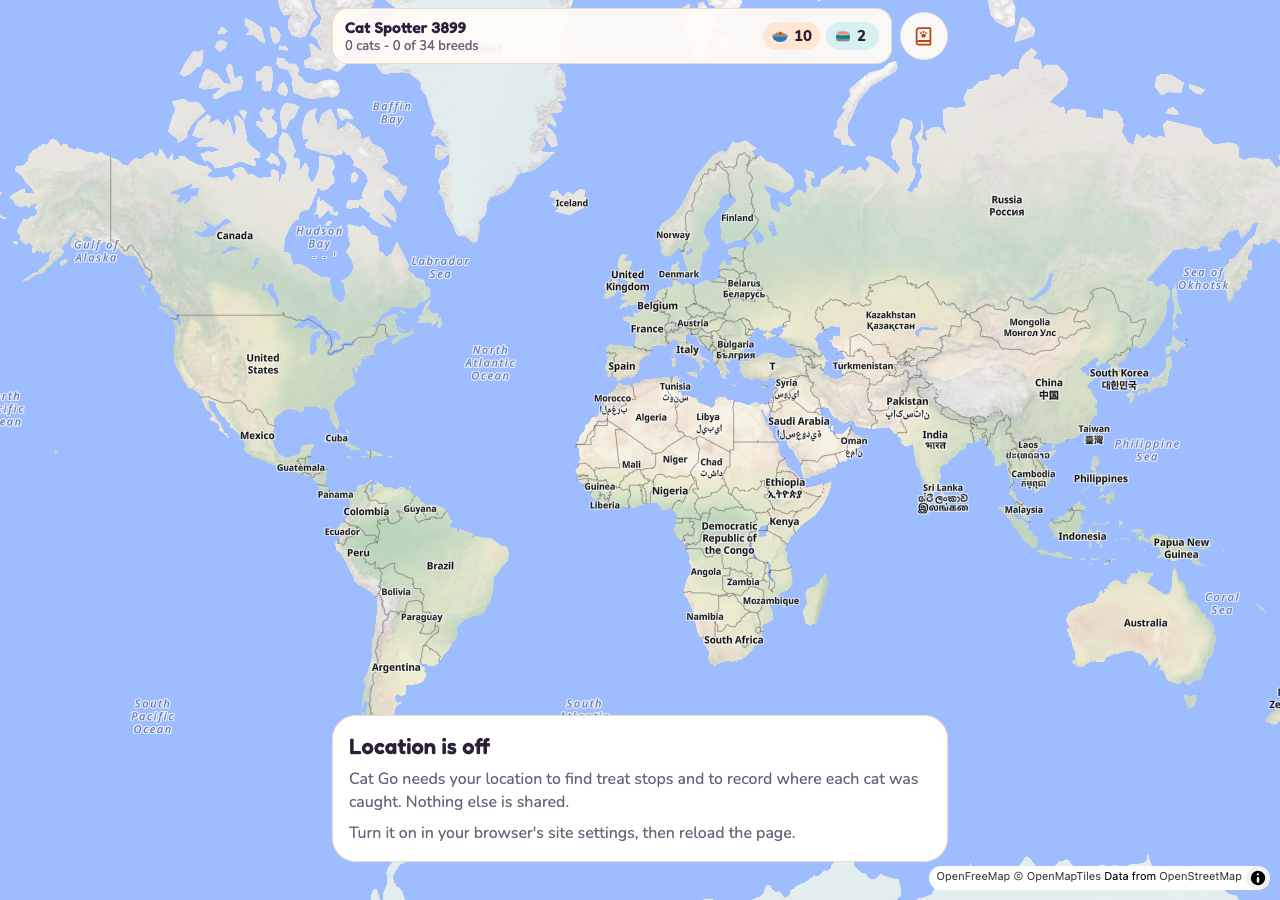
Cat Go's map. The game needs your location to record where each cat was caught.
Cat Go needs your location and your camera. If your location is off, the home screen says so.
Get started
Want to try the "Which breed is it?" question on a real cat? Play Cat Go in your browser: walk anywhere, photograph a real cat, lure it with food and catch it.
Comments
No comments yet.
Sign in or make an account to comment.