What is a Bengal cat? Rosettes, glitter and a lot of energy
What is a Bengal cat? It is a pedigree breed bred to look like a small wild cat, with a spotted or marbled coat, and the only breed whose spots form two-toned rosettes with dark outlines. That is how the Cat Fanciers' Association (the CFA, a cat breed registry) describes it. This guide sets out where the breed came from, what its coat looks like, its colours, its personality and its care, all from the CFA's own Bengal page.
Everything about the breed here comes from the CFA's Bengal page and breed standard, opened for this article. A breed standard is the written description judges use at cat shows.
What is a Bengal cat? The short answer
The CFA says that to most cat lovers, spots spell "wild". Other breeds have spots, but only the Bengal takes them a step further, with rosettes outlined in a darker colour. The breed does have a wild ancestor, but the CFA stresses that many generations of careful breeding went into copying the look of a wild cat while keeping a sweet personality, and that choosing the best temperaments has been the top priority throughout.
Where the Bengal came from
The CFA says two unrelated goals started the breed.
- 1963: Jean Mill, a conservationist working to preserve a small tree-living wildcat called the Asian Leopard Cat, crossed a black domestic tom with a female Asian Leopard Cat.
- Around the same time: Dr. Willard Centerwall began breeding similar crosses, hoping for a domestic cat with the Asian Leopard Cat's natural immunity to feline leukemia.
- Later: Mill obtained breeding cats from Centerwall and used them, with spotted domestic cats, to develop the Bengal. She went on to produce sweet-tempered cats five generations out from the original wildcats.
- 2016: the CFA accepted Bengals for registration, requiring five generations of pure domestic ancestry.
- 2018: Bengals were advanced to championship status at CFA shows.
What does a Bengal cat look like?
The CFA describes a medium to large cat with a sleek, muscular build. The back legs stand slightly higher than the shoulders, and the thick tail, with a rounded tip, is carried lower than the back. Males are generally larger than females.
Many people find the head the most striking part, the CFA says: distinctive face markings, large, luminous eyes, a wide nose and prominent whisker pads. The ears are small to medium, which makes the eyes stand out more.
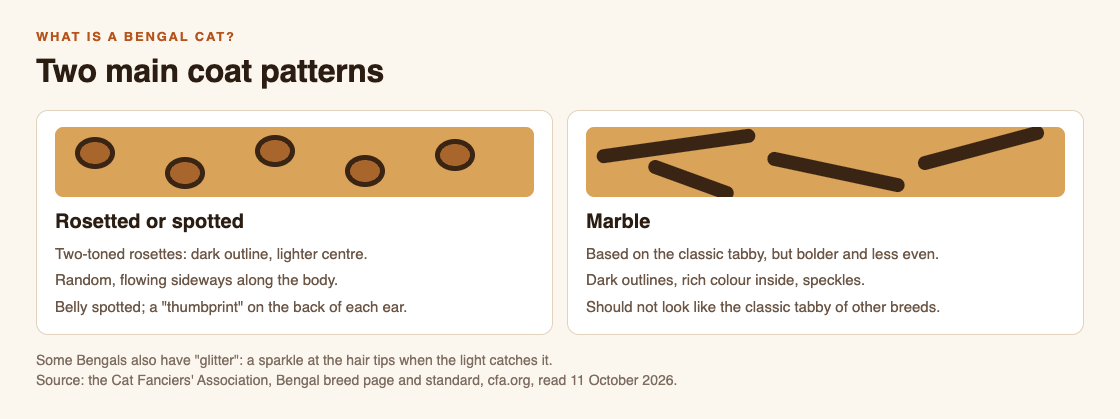
The Bengal's two main patterns, as the CFA standard describes them.
The standard names two main patterns:
- Rosetted or spotted: random rosettes and spots that flow sideways along the body. Rosettes are two-toned, with dark outlines and a lighter centre, and come in shapes the standard calls donut, pancake, paw print and arrowhead. The belly must be spotted, and the backs of the ears have a "thumbprint".
- Marble: based on the classic tabby pattern, but more dramatic and less even, with dark outlines, rich colour inside and speckles. The standard says it should not look like the classic tabby seen in other breeds.
Some Bengals also have what breeders call "glitter": a sparkle at the tips of the hairs when the light catches it. For how the classic tabby compares, see our guide to the four tabby patterns.
Bengal colours in the CFA standard
The CFA says the most recognised colour and pattern is the brown spotted or rosetted tabby. Its standard lists many more, including these:
- Brown, silver and blue tabbies: the standard says these may have any eye colour other than blue.
- Lynx points, minks and sepias: lighter ground colours with darker points. In lynx points, blue is the only eye colour the standard accepts; minks have aqua eyes and sepias green or gold.
- Melanistic: a mostly solid-looking cat with faint "ghost" tabby markings, clearer in kittens.
- Smoke: ghost markings over a whitish undercoat.
- Chocolate, cinnamon, lilac and fawn tabbies.
The CFA adds that Bengals can be shorthaired or longhaired; its standard calls the longhair Bengal the Cashmere.
What is a Bengal cat like to live with?
In the CFA's words, Bengals are confident, curious and athletic, extremely intelligent, and keep a kitten-like energy well into their senior years. It says they are fascinated by water, and may watch you brush your teeth or even try to join you in the shower. They are quite trainable and often learn tricks, and many enjoy going for walks on a harness and leash.
Bengals are often called talkative, but the CFA says that is not true of every Bengal: some chat a lot and others keep quiet. When properly introduced, it says, they get along well with other pets, and their curious, affectionate nature makes them a good choice for families with children.
Bengal coat care and health
The CFA says the coat is very soft and silky, unlikely to mat, and does not shed heavily compared with other shorthair breeds. It recommends brushing once a week with a soft-bristled brush. Bathing should not be needed unless you plan to show the cat.
On health, the CFA says genetic testing lets breeders screen for a number of inherited diseases. Hypertrophic cardiomyopathy, which it calls the most commonly seen heart issue in cats, can only be found with an echocardiogram (a heart scan). Most breeders, it says, have their breeding cats scanned by a cardiologist before the first litter and again at regular intervals.
Is the spotted cat on your street a Bengal? A plain check
You can compare a spotted cat with the CFA's description, but you cannot be sure from looks alone. The CFA's own guide "A Pattern Does Not a Breed Make" explains why: a coat pattern is not a breed, only about five percent of domestic cats belong to any recognised breed, and unless a cat is known to come from a breeder of pedigreed cats, it will almost certainly not be of a specific breed. Our guide "Is my cat a mixed breed?" covers this in more detail.
Here is a calm check you can do from a distance, without going near the cat:
- Look at the spots: are they two-toned rosettes with dark outlines, or plain dark spots? Rosettes match the Bengal description better.
- Look at the flow: the standard wants spots to run sideways along the body, not in vertical stripes.
- Look at the build: a sleek, muscular cat with back legs a little higher than its shoulders.
- Look at the head: big eyes, wide nose, small to medium ears.
- Decide honestly: if you are not sure, it is most likely a spotted tabby of mixed breed.
That last step is where Cat Go comes in. It is a game that plays in your web browser: "Walk anywhere, photograph a real cat, lure it with food and catch it." After you photograph a cat, it asks "Which breed is it?" and you pick from a list with a search box ("Search breeds, like Siamese or curly"). You choose the breed; the game does not decide for you. It also says "Most cats you meet are mixed breed. Rarer breeds are warier." and "Mixed breed is always a safe pick."
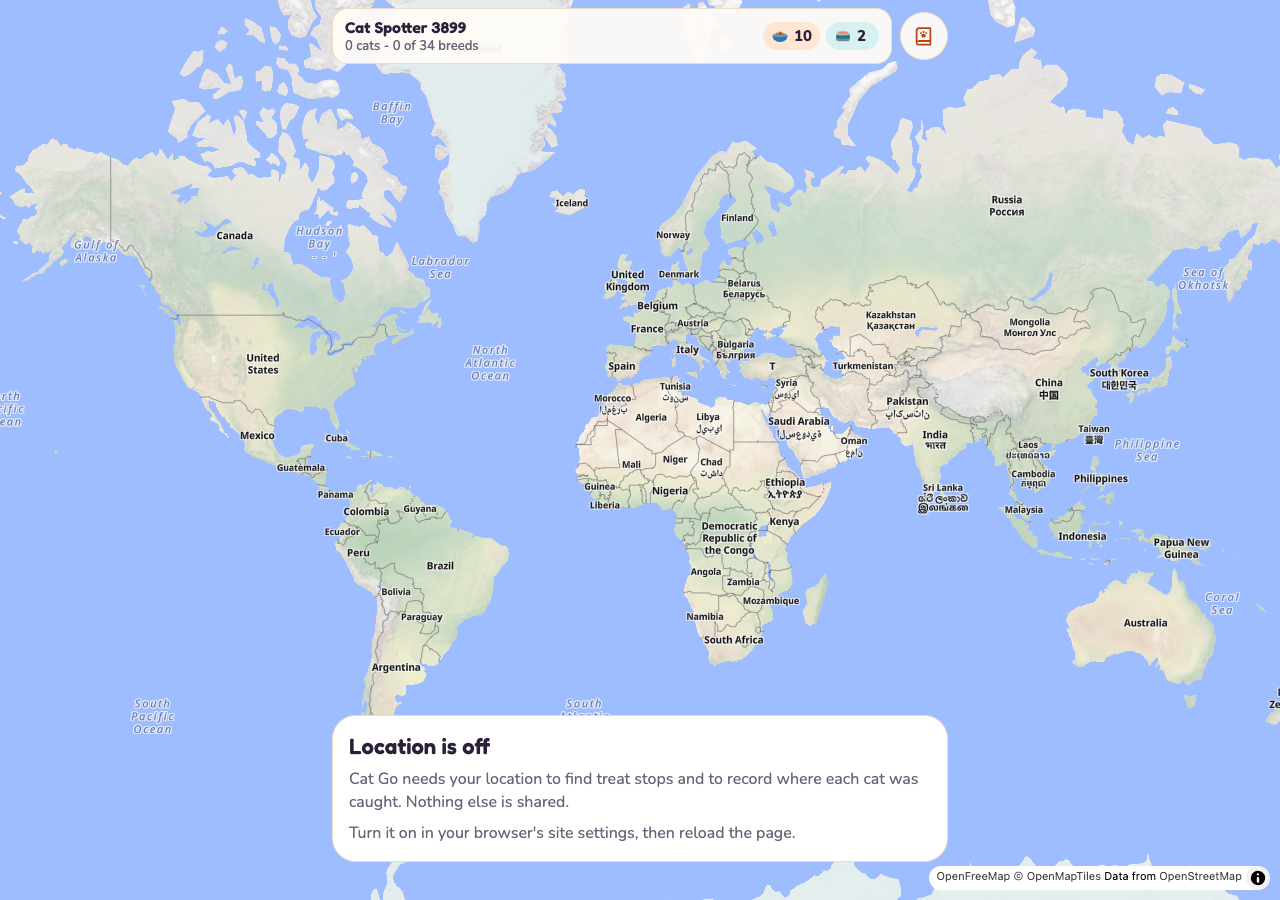
Cat Go's map, where each catch keeps its breed and the place you found it.
The food in Cat Go is all in the game. For a wary cat it says "Tuna works much better on wary cats," and each catch is saved with its breed and where you found it.
Frequently asked questions
Is a Bengal cat part wild?
The breed began with crosses to the Asian Leopard Cat in 1963. The CFA registers Bengals only with five generations of pure domestic ancestry.
What colour eyes do Bengal cats have?
It depends on the colour. The CFA standard gives lynx points blue eyes only, minks aqua and sepias green or gold, while brown, silver and blue tabbies may have any eye colour except blue.
Do Bengal cats shed a lot?
The CFA says the coat does not shed heavily compared with other shorthair breeds, and recommends brushing once a week with a soft-bristled brush.
Are Bengal cats good with children?
The CFA says their curious, affectionate nature makes them a good choice for families with children, and that they get along with other pets when properly introduced.
Get started
Next time you see a spotted cat on a walk, run the five-step check from where you stand, and remember that most spotted cats are tabbies of mixed breed.
Play Cat Go in your browser: walk anywhere, photograph a real cat, pick its breed and keep it in your Catdex.
Comments
No comments yet.
Sign in or make an account to comment.