What is a Birman cat? Blue eyes, white gloves, plainly
What is a Birman cat? It is a pointed, blue-eyed breed with a long, silky coat and four white paws. The Cat Fanciers' Association (CFA), a cat breed registry, calls it a cat of "mystery and legend". This post sticks to what the CFA's own Birman page says, so you can tell the facts from the folk tales.
What is a Birman cat, exactly?
The Birman is known as the "Sacred Cat of Burma". The CFA describes a medium-to-large cat with a broad, rounded head, a medium-length Roman nose (slightly curved, not flat) and striking blue eyes.
The coat is fine and flowing, with a faint golden beige cast on the back and sides that the CFA calls "golden mist". The body is long and stocky, neither slim nor cobby.
Three things set it apart from other cats:
- Points. The face, ears, legs and tail are darker than the body.
- Blue eyes. Almost round, set well apart.
- White gloves. All four paws are white.
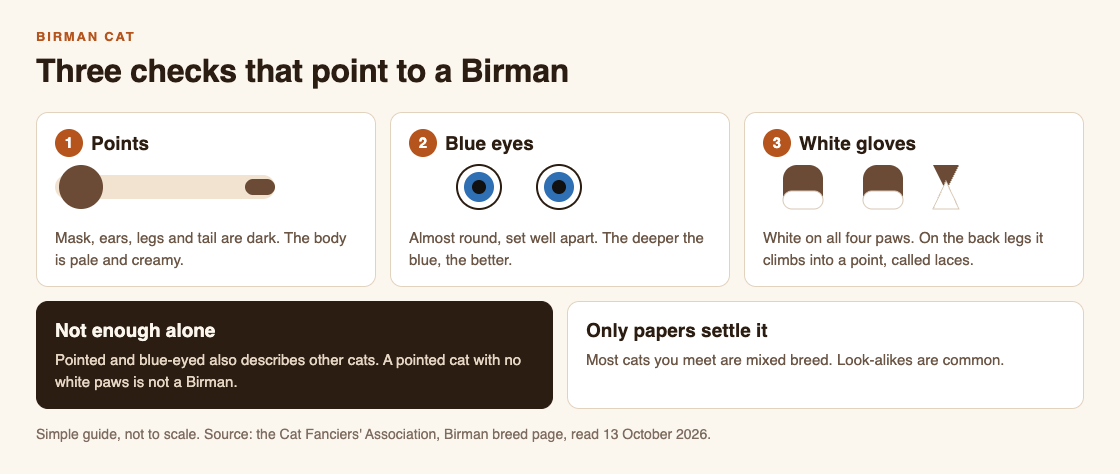
Three checks that point to a Birman, from the CFA's description.
Where the breed comes from
Many folk tales say how the Birman got its markings. The CFA says the real history "keeps everyone guessing".
What it does say is this. A breeding pair was shipped from Burma to France in about 1919. The female arrived pregnant and became the foundation of the breed in France. The name comes from "Birmanie", the French form of Burma.
The Birman reached the United States in 1959 and was accepted for CFA registration in 1967.
The breed nearly vanished. During World War II only one breeding pair was left in Europe. French breeders rebuilt the breed by crossing with Persians and Siamese, and by the early 1950s pure Birman litters were being born again.
One small custom survives from France. Many breeders give all the kittens born in a year names that start with the same letter, and move to the next letter the following year.
Points, gloves, laces and colours
The Birman is a colorpointed cat that also carries the bicolor gene. Our post on what a colorpoint cat is covers the point pattern. The bicolor gene is what adds the white.
The white has names:
- Gloves. White on the front paws, ending in an even line across the paw.
- Laces. White that runs up the back of the hind leg. The CFA says that ideally it ends in a point or an upside-down "V".
The standard wants the two front gloves to match, the two back gloves to match, and the two laces to match. It also says a faultlessly gloved cat is "a rare exception". A show Birman is judged on all of its parts, not only the paws.
The CFA says the Birman was first recognised only in solid seal, blue, lilac and chocolate point. Today it also comes with tabby-patterned points, and in red, cream and tortie point colours.
The body stays pale, with strong contrast against the points. A kitten may not show the golden mist yet. The CFA says the breed takes about three years to mature, so a young cat can look different from an adult.
Eye colour does not change with the coat. The CFA standard asks for blue, and the deeper and more vivid, the better. In the show ring, eyes of any other colour disqualify a cat.
Temperament
The CFA describes Birmans as intelligent cats that enjoy learning and usually respond well to training. They are sociable and people-oriented, and moderately active.
The CFA calls them very "helpful" cats that will try to assist with household tasks. It also calls them patient, even-tempered and tolerant, and an excellent choice for families with children and other pets.
There is one warning. Birmans are very social and do not do well alone for long stretches. If you work outside the home and have no other pet, the CFA suggests you may want to consider a pair.
The voice is soft. Most are "soft spoken", with chirp-like voices. But the CFA says that if you answer every meow, a Birman may become quite a talker. That is a trait of the breed, not a promise about any one cat.
Coat care and health
The Birman coat is long and silky, but the CFA says Birmans shed less than most other long-haired cats. There is no undercoat to tangle, so the coat is easy to care for. A weekly combing should be enough. Most do not need regular baths.
On health, the CFA says breeders test for hypertrophic cardiomyopathy, a heart muscle disease, and other conditions. The aim is to keep the gene pool healthy and diverse. It gives no figures, so this post gives none.
If you are thinking about a Birman, ask the breeder what screening the parents had. Ask your vet about anything specific to your own cat.
A worked example: checking a cat you meet
You spot a cat with a pale body, dark face and blue eyes. Is it a Birman? Work through four steps, in order.
- Points. Is the face darker than the body? Are the ears, legs and tail dark too? If yes, it is pointed. That alone also fits a Siamese or a Ragdoll.
- Paws. Look at all four. Is there white on every paw? A pointed cat with no white gloves is not a Birman by the CFA's standard.
- Back legs. Does the white climb into a point? That is the laces.
- Coat and build. Is the coat long and silky, and the body stocky rather than slim?
Even four yeses are only a look. A pedigree and a registry settle it, not a glance from across the road. Many cats carry the same colours without the papers. See how to tell if a cat is a mixed breed for the honest limits of looking.
Birman or Siamese or Ragdoll?
All three can have points and blue eyes. The difference is in the white and the build.
The Birman has white gloves and laces. The CFA lists a Persian or Siamese type head as a fault in a Birman, so the breed is meant to look distinct from both. Read our plain guides to the Siamese and the Ragdoll to see what each one looks like.
Frequently asked questions
Are Birman cats longhaired?
The CFA describes the coat as medium long to long and silky. It has no undercoat, so it does not mat, and a weekly combing is enough.
Why do Birmans have white paws?
Folk tales give several stories. The CFA's plain answer is that Birmans carry the bicolor gene, which produces the white gloves on the front paws and laces on the back paws.
Do all Birmans have blue eyes?
The standard says yes. Blue eyes are required, and the CFA lists eye colour other than blue as a disqualification in the show ring.
Is a Birman a good family cat?
The CFA calls the breed patient, even-tempered and tolerant, and an excellent choice for families with children and other pets. It adds that they do poorly alone for long periods.
Can Cat Go tell me if a cat is a Birman?
No. In Cat Go you choose the breed yourself from a list. The game does not tell you.
Get started
A breed guide helps most when you can practise on real cats. Cat Go is a game that plays in your web browser. You walk, collect kibble and tuna at treat stops on a map, and photograph a cat you meet. Then it asks "Which breed is it?" and you pick from a list of 34 breeds, with a search box.
The screen says "Most cats you meet are mixed breed", and "Mixed breed is always a safe pick". That fits what you read above: a Birman look is not proof of a Birman. Pick what you honestly see, and keep every catch in your Catdex with its breed and where you found it.

Cat Go's map. The game needs your location to record where each cat was caught.
Cat Go needs the camera and location allowed in your browser. Whether it is worth a walk is up to you.
Play Cat Go in your browser: walk anywhere, photograph a real cat, lure it with food and catch it.
Comments
No comments yet.
Sign in or make an account to comment.