What is a Bombay cat? Look, history and temperament
If you have seen a sleek black cat with round copper eyes and wondered what it was, you may be asking what is a Bombay cat. The Cat Fanciers' Association (the CFA, a cat breed registry) calls it a "miniature panther" made for the parlor. This guide covers where the breed came from, how its coat, eyes and body are described, what the CFA says about its temperament, grooming and health, and how to look at a black cat you meet without jumping to a conclusion.
What is a Bombay cat? The short answer
The Bombay is a shorthair breed with a glossy black coat. The CFA lists its personality as playful and affectionate, and calls Bombays lap cats.
The CFA's own words for it are "Look out, there's a panther in the parlor!" It adds that, despite its exotic name, the Bombay is "a 100% domestic breed" intended to have the look and feel of a miniature panther. The coat is gleaming black, and the eyes are the color of a copper penny.
The name was inspired by the black leopards found in India and the city of Bombay. It does not mean the breed began in India, as you will see next.
Where the breed comes from
The CFA says the breed was born in 1966, when a Kentucky breeder named Nikki Horner decided to combine two popular breeds, the American Shorthair and the Burmese. She wanted a cat that drew on both parents, yet was distinctive enough to be a separate breed.
She began with a black American Shorthair male bred to a Burmese female. Over the next few years she used both line breeding and careful outcrossing to produce her own version of the "parlor panther."
The CFA accepted Bombays for registration in 1970 and advanced them to championship status in 1976. The first Bombay to win a national title did so in 1982.
The breed standard says the Bombay is "not a natural breed but a genetic hybrid." It lists the black American Shorthair and the sable Burmese as the breeds allowed for outcrossing. If you want to meet the two parents, our posts on the American Shorthair and the Burmese go through each.
Coat, eyes and build
The CFA page and its breed standard describe the same few features, and they work best when you look at them together.
- Coat: The page calls it "very dense, short and close-lying," often with such a brilliant sheen that you can see your reflection in it. The standard asks for a fine, short, satin-like coat with a shimmering patent leather sheen.
- Color: A mature cat should be black to the roots. The standard says kitten coats should darken and become more sleek with age.
- Nose and paw pads: Both should be black.
- Eyes: Round, set far apart, and ranging from gold to deep copper. The standard says the greater the depth and brilliance, the better.
- Body: Medium in size and muscular, neither compact nor rangy. The CFA says Bombays feel heavier than they look, and the standard says it has a "surprising weight for its size."
- Head and ears: A rounded head with a short, broad muzzle. The ears are medium in size and set well apart.
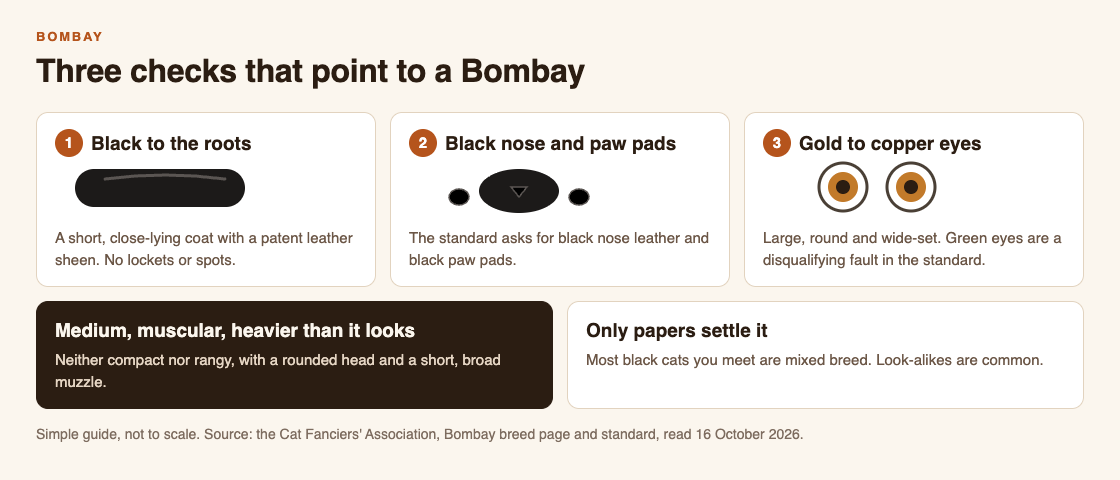
Three checks that point to a Bombay, from the CFA's page and standard.
The standard also lists faults that rule a cat out of the show ring. They include lockets or spots in the coat, nose leather or paw pads that are not black, and green eyes. In the CFA's point score, color carries the most weight at 30 points, then head and ears at 25, body and tail at 20, coat at 20 and eyes at 5.
Temperament: part cat, part dog, part clown
The CFA says Bombays are sometimes described as part cat, part dog and part clown. It calls them a balance between the easy-going American Shorthair and the inquisitive, lap-loving Burmese. Both parent breeds are quite intelligent, and the Bombay follows them.
The mischievous spirit and the love of toys are its own. The CFA says a Bombay may save you money on toys, because it will happily take possession of grocery bags or cracker boxes and amuse itself for hours.
It describes the Bombay as neither hyperactive nor placid. It will keep you on its toes without getting in your way, and it adapts to almost any kind of home.
The CFA also says Bombays are very affectionate, and given to head-butting, kisses and snuggling up with their people at night. Children will be enchanted by this devotion, and, if properly introduced, Bombays will quickly bond with dogs and other pets.
These are the CFA's descriptions of the breed. Each cat is its own character, so a breeder or rescue that knows a particular cat can tell you more than any breed page.
Grooming and health, as the CFA describes them
The CFA says a Bombay may be one of the easiest breeds to groom. The coat is short and satiny, so shedding is moderate to minimal. It suggests a rubber curry brush two or three times a month to remove unwanted hair.
If that is not enough to keep shedding under control, the CFA says a quick bath may help. Bombays typically take well to bathing and are considered "wash-and-wear" cats. It advises asking your breeder about shampoo and conditioner, because every cat's coat is different.
On health, the CFA says Bombays are considered quite healthy because of their hybrid ancestry. It names two things to watch:
- Some Bombays have overly teary eyes, which need regular wiping.
- Hypertrophic cardiomyopathy, which the CFA calls the most common heart problem in cats, has been found in Bombays. Responsible breeders test their cats before breeding to reduce the chance of passing it on to kittens.
For anything about one particular cat, ask your vet. A breed page cannot speak for a single animal.
How to check a black cat you meet
Here is a worked example. You see a glossy black cat with bright eyes sitting on a garden wall during your walk, and you wonder whether it is a Bombay.
- Look from a distance. Let the cat go about its day, and do not approach or touch it. Our post on telling whether a cat is mixed breed gives the longer checklist.
- Look at the coat. The standard wants a short, close-lying coat with a sheen. A coat that looks longer or fluffy is not what the standard describes.
- Look for any markings. The standard wants black to the roots, and lists lockets and spots as faults, so a cat with marks in its coat is not a show Bombay.
- Look at the eyes. Gold to copper fits the standard. Green eyes are a disqualifying fault, so a black cat with green eyes is not a show Bombay.
- Look at the build. A medium, muscular cat with a rounded head fits. You can only judge this from a distance, and a photo can hide a lot.
- Do not stop at the color. Black fur alone cannot tell you the breed. If you want a good photo of one, our post on photographing a black cat covers the light.
At the end, you have a guess, not an answer. A glossy black cat with copper eyes can still be a mixed breed cat, and only papers can settle it.
If you would like to meet the breed for real, the CFA says a cat show is the best place to connect with a breeder. It says Bombays are one of its rarer breeds, so you may have to wait for a kitten, and that a retired show cat may be a less expensive alternative.
Cat Go and breeds
Cat Go is a game you play in your web browser. You walk anywhere, photograph a real cat, lure it with food and catch it. After a cat is spotted, the game asks "Which breed is it?" and gives you a list with a search box, so you can type something like "Siamese" or "curly".
The game also says "Most cats you meet are mixed breed" and "Mixed breed is always a safe pick." That fits what you just read. A black cat with bright eyes can still be a mixed breed cat, and you choose the breed yourself. The game counts 34 breeds in total, and every catch is saved to your Catdex with its breed and the place you found it.

Cat Go's map. The game needs your location to record where each cat was caught.
Cat Go needs the camera and location allowed in your browser. When you take the photo, the game says to fit the whole cat in the frame.
Frequently asked questions
Where does the Bombay come from?
The CFA says it was created in Kentucky in 1966 by Nikki Horner, who combined the American Shorthair and the Burmese. It is a domestic hybrid, not a natural breed.
What color are a Bombay's eyes?
Gold to deep copper, according to the CFA standard. Green eyes are a disqualifying fault in the show ring.
Does a Bombay need a lot of grooming?
The CFA calls it one of the easiest breeds to groom. It suggests a rubber curry brush two or three times a month, and says shedding is moderate to minimal.
Are Bombays good with children and other pets?
The CFA says children will be enchanted by a Bombay's devotion, and that if properly introduced, Bombays will quickly bond with dogs and other pets.
Does Cat Go tell me if a cat is a Bombay?
No. After you take a photo, you pick the breed yourself from a list, and "Mixed breed is always a safe pick."
Get started
Ready to try the "Which breed is it?" question on a real cat? Play Cat Go in your browser: walk anywhere, photograph a real cat, lure it with food and catch it.
Comments
No comments yet.
Sign in or make an account to comment.