What is a British Shorthair cat? The teddy bear breed, plainly
What is a British Shorthair cat? It is a stocky, round-faced breed with a plush, very dense coat, best known in solid blue. The Cat Fanciers' Association (CFA), a large pedigreed cat registry, says its devotees often liken it to a teddy bear, and describes it as calm and quiet, a cat that enjoys people.
Everything in this guide comes from the CFA's own British Shorthair page and breed standard: where the breed came from, how to recognise one, what it is like to live with, and why the round grey cat on your street may not be one.
What is a British Shorthair cat? The short answer
The CFA's breed card sums it up in a few words: stocky, sturdy, with a plush coat. Blue is very popular, but the breed comes in other colours too.
Its standard adds the shape. A British Shorthair is compact, well balanced and powerful, with a full, broad chest, short to medium strong legs, rounded paws and a thick tail. The standard also asks for balance: no feature should be exaggerated to the point of weakness or extremes.
The coat is the breed's famous feature. The CFA says it has more hairs per square inch than any other breed, which makes it rich to the touch yet easy to care for.
Where the British Shorthair came from
The CFA calls the breed the modern embodiment of ancient Roman cats. British Shorthairs first came into the public eye at cat shows at London's Crystal Palace around the turn of the 20th century.
The two World Wars hit the breed hard. The CFA says they wreaked havoc on the gene pool, and breeders crossed the cats with Persians and with "moggies", random-bred domestic shorthairs, to keep the type going and then improve it.
It worked. By the 1950s, a blue male named Brynbuboo Little Monarch became the very first Grand Champion of any breed with the UK's Governing Council of the Cat Fancy. He was such a popular stud that most British Shorthairs today trace their ancestry back to him.
The breed first reached the United States in the early 1900s, where the cats were registered as "British Blues". Today they are seen in many colours, including other solids, bicolors and tabbies.
How to recognise a British Shorthair
The CFA's standard gives five things to look for.
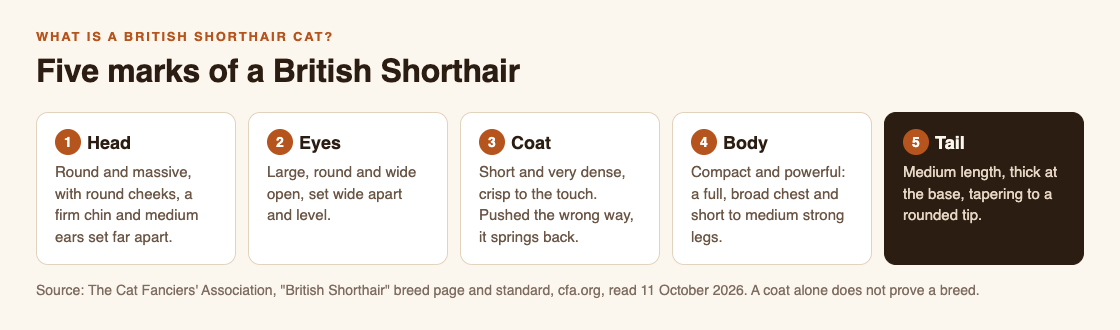
Five marks of a British Shorthair, from the CFA's breed page and standard.
- The head: round and massive, with round cheeks, a firm chin, and medium ears set far apart, rounded at the tips.
- The eyes: large, round and wide open, set wide apart and level.
- The coat: short, very dense and crisp to the touch, not woolly. Push it against the grain and it returns toward where it was.
- The body: medium to large and powerful, with a level back and a deep, broad chest.
- The tail: medium length, thicker at the base, tapering slightly to a rounded tip.
The CFA also points to prominent whisker pads that give the face the look of a smile. It adds that Lewis Carroll's grinning Cheshire Cat is presumed to be a tabby British Shorthair.
How big does a British Shorthair get?
Slowly, and solidly. The CFA says the breed does not reach its full size until about three years of age, and its standard says a full three to five years for full maturity. Males may grow as large as 17 pounds, while females are somewhat smaller and less massive in all respects.
The CFA notes that the broad chest, muscular legs and powerful body can look a little intimidating, which belies the breed's gentle nature. It also says these cats are most comfortable with all four feet on the floor, so they rarely climb onto kitchen counters.
What a British Shorthair is like to live with
The CFA describes a quiet, steady companion that takes a keen interest in whatever its people are doing.
- Close, but not on you: it likes to supervise from nearby rather than help, and will wait for an invitation to sit beside you rather than jump into your lap.
- The whole family: it gives attention to each person in the house rather than picking one favourite.
- Routine: it learns your day, follows you from room to room as you go through it, and may protest with a gentle paw if something changes a lot.
- Other pets and children: it adjusts easily to a dog or another pet, and is patient with children, though it may withdraw during loud activity. The CFA says to teach children that these cats are not fond of being carried around.
- Voice: it may comment on your day now and then, but rarely holds a long conversation.
For grooming, the CFA says some shedding is to be expected from such a dense coat, but most owners find a quick weekly comb or brush is enough. Add regular claw clipping and an occasional ear cleaning.
On health, the CFA says there are no breed-specific health issues of concern. It does flag one thing: cats have two well-known blood types, A and B, with A the more common, and many British Shorthair lines carry type B. Its advice for owners is simply to know your cat's blood type in case it ever needs a transfusion.
Is that round grey cat a British Shorthair?
Maybe not. The CFA's coat and color descriptions make the point that a coat's colour and pattern do not tell you the breed. A thick-set blue-grey cat on a garden wall could be a British Shorthair, or a mixed-breed cat that shares the colour. Our guide to the domestic shorthair cat explains the difference.
Cat Go is a game that plays in your web browser, where that question comes up on every catch: "Walk anywhere, photograph a real cat, lure it with food and catch it."

The bar at the top counts your cats and breeds out of the game's 34.
Here is how to handle a maybe-British-Shorthair on a walk:
- Stay where you are and tap the camera. The screen says "Fit the whole cat in the frame", so you can see the round head and the thick tail later.
- The game asks "Which breed is it?" and gives you a list with a search box. You pick; the game does not decide for you.
- Check the five marks above: the round head, the big round eyes, the dense coat, the broad chest and the thick tail. If you cannot be sure, the game itself says "Mixed breed is always a safe pick."
- Toss in-game treats to win it over. The screen warns that rarer breeds are warier, and that tuna works much better on wary cats.
The catch keeps its breed and where you found it. Our guides on whether a cat is a mixed breed and on the Maine Coon help with other breed picks.
Frequently asked questions
Are British Shorthairs always blue?
No. The CFA says blue is very popular, and the first cats in the US were registered as "British Blues", but the breed now comes in many colours, including other solids, bicolors and tabbies.
Do British Shorthairs like to be held?
The CFA says these cats are not fond of being carried around. They prefer to sit beside you, and will wait for an invitation rather than jump into your lap.
How big is a British Shorthair?
The CFA says males may grow as large as 17 pounds, with females somewhat smaller. The breed is slow to mature and takes about three years, or more, to reach full size.
How often does a British Shorthair need grooming?
The CFA says a quick weekly combing or brushing is enough for most owners, plus regular claw clipping and an occasional ear cleaning.
Get started
Next time you see a round-faced, thick-coated cat watching the street, check the head, the eyes and the tail. Then take a walk and see who you meet.
Play Cat Go in your browser: walk anywhere, photograph a real cat, lure it with food and catch it.
Comments
No comments yet.
Sign in or make an account to comment.