What is a Burmese cat? Small, heavy and very people-loving
What is a Burmese cat? In the Cat Fanciers' Association's words, it is a medium-sized cat with substantial bone and muscle and "a surprising weight for its size", a rounded head, large gold eyes and a very short, glossy coat. The CFA, the US cat breed registry, says Burmese are often called "Velcro kitties" because they stick so close to their people. This guide covers the look and the four colours, the one cat most Burmese trace back to, what they are like to live with, and why a brown cat on the street is most likely not one.
Everything about the breed here comes from the CFA's Burmese breed page and standard, opened for this article.
What is a Burmese cat? The short answer
The CFA describes a cat that does not look large, but surprises you when you pick it up with how much muscle and weight is packed into its small frame. It is sometimes compared to a small bulldog. The head is rounded with no flat planes, the muzzle short and broad, and the bright gold eyes are large and set well apart, giving what the CFA calls a sweet, innocent-looking expression.
The coat is very short, fine and glossy, lying close to the body with a satin-like finish. Burmese are fully grown at 18 months. A mature male may reach or pass 12 pounds; females are usually smaller.
The four Burmese colours
The CFA shows Burmese in four colours, and its standard lists any other colour as a fault that disqualifies a show cat.
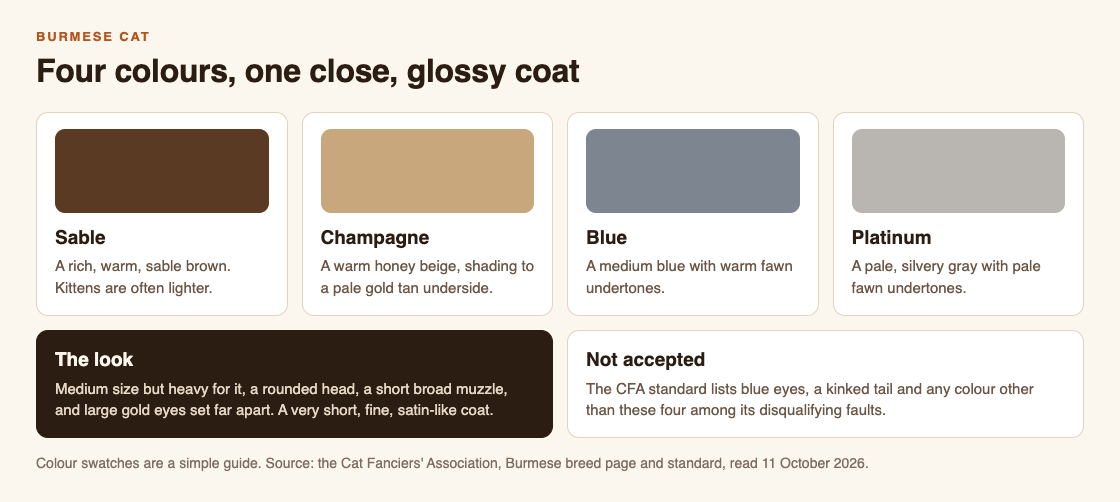
The four Burmese colours, in the words of the CFA standard.
- Sable: a rich, warm sable brown, a little lighter on the underparts. Kittens are often lighter in colour.
- Champagne: a warm honey beige, shading to a pale gold tan underside.
- Blue: a medium blue with warm fawn undertones.
- Platinum: a pale, silvery gray with pale fawn undertones.
The eyes range from yellow to gold, and the standard prefers deeper, more brilliant colour. Green eyes count against a show cat, and blue eyes disqualify one.
Where the Burmese comes from: one cat called Wong Mau
Burmese occur naturally on the Malay Peninsula, and a few have been imported. But the CFA says most of today's Burmese trace back to one cat, Wong Mau, brought to America in 1930. She was a small, compact, walnut brown female with darker areas on her head, legs and tail.
Wong Mau was bred to Siamese and had three different types of kittens: some with Siamese markings, some like their mother, and some a solid, dark chocolate brown. The solid brown cats bred true. The CFA began registering these early Burmese in 1936, and the breed reached championship status in 1959. Lighter colours later cropped up in litters and, the CFA says, were accepted and renamed "with much controversy". Our guide to the Siamese cat covers the breed on the other side of that first cross.
What Burmese are like
The CFA calls Burmese curious, clever and friendly cats that adore their people.
- Close company. Extremely people-oriented, they follow you from room to room, look for warm laps, and look forward to sleeping on, or even in, your bed if allowed. Our guide on why cats follow you around covers the habit in any cat.
- Affection for all. They do not focus on one special person; they give affection to everyone within reach.
- Families. The CFA says they are known for being good with children, and typically like, or at least tolerate, the family dog.
- Play. They readily learn "fetch" and other games. Spirited as kittens, they mellow as adults but stay playful and active well into old age.
- Voice. They are generally soft-spoken, but if something is wrong, they will let you know.
Care and health notes
The CFA calls Burmese low-maintenance. The coat sheds very little but should be brushed weekly with a rubber brush to remove dead hair, and regular bathing is not needed.
On health, it calls the Burmese a relatively healthy natural breed that can live a long life with proper care. Burmese once had more than the average number of cases of feline infectious peritonitis (FIP), which has a strong genetic part; the CFA says careful breeding has largely removed it, so it is now no more common in Burmese than in any other breed. It adds that some sources suggest older Burmese may be prone to diabetes, but that research on whether it is inherited is not yet conclusive. Its advice: ask a breeder about diabetes in their lines, and as your cat ages, keep up regular checkups and watch its carbohydrates.
Is that brown cat a Burmese? A worked example
Say you meet a short-haired, dark brown cat with yellow eyes on your street. Is it a Burmese? Here is a three-step check using the CFA's own pages.
- Check the shape. The Burmese standard asks for a rounded head with a short, broad muzzle, large eyes set far apart, and a compact, muscular body. A long, wedge-shaped head counts against a Burmese.
- Check the coat and eyes. The standard wants a very short, close, glossy coat with no barring, and yellow to gold eyes. Distinct barring on the body, lockets or spots, or blue eyes all disqualify a show Burmese.
- Remember the odds. The CFA's guide "A Pattern Does Not a Breed Make" says only about five percent of domestic cats belong to any recognised breed, and that unless a cat is known to come from a breeder of pedigreed cats, it will almost certainly not be of a specific breed.
So the cat on your street may match some of the Burmese look, but most likely it is a solid brown mixed breed.
Recording the breed in Cat Go
Cat Go is a game that plays in your web browser: "Walk anywhere, photograph a real cat, lure it with food and catch it. Every catch keeps its breed and where you found it." A catch starts with a photo. Then it asks "Which breed is it?" and you pick from a list with a search box. You choose the breed; the game does not decide for you.
The game's own advice matches the CFA's odds: "Most cats you meet are mixed breed. Rarer breeds are warier." and "Mixed breed is always a safe pick." The kibble and tuna you toss are food inside the game, never real food.
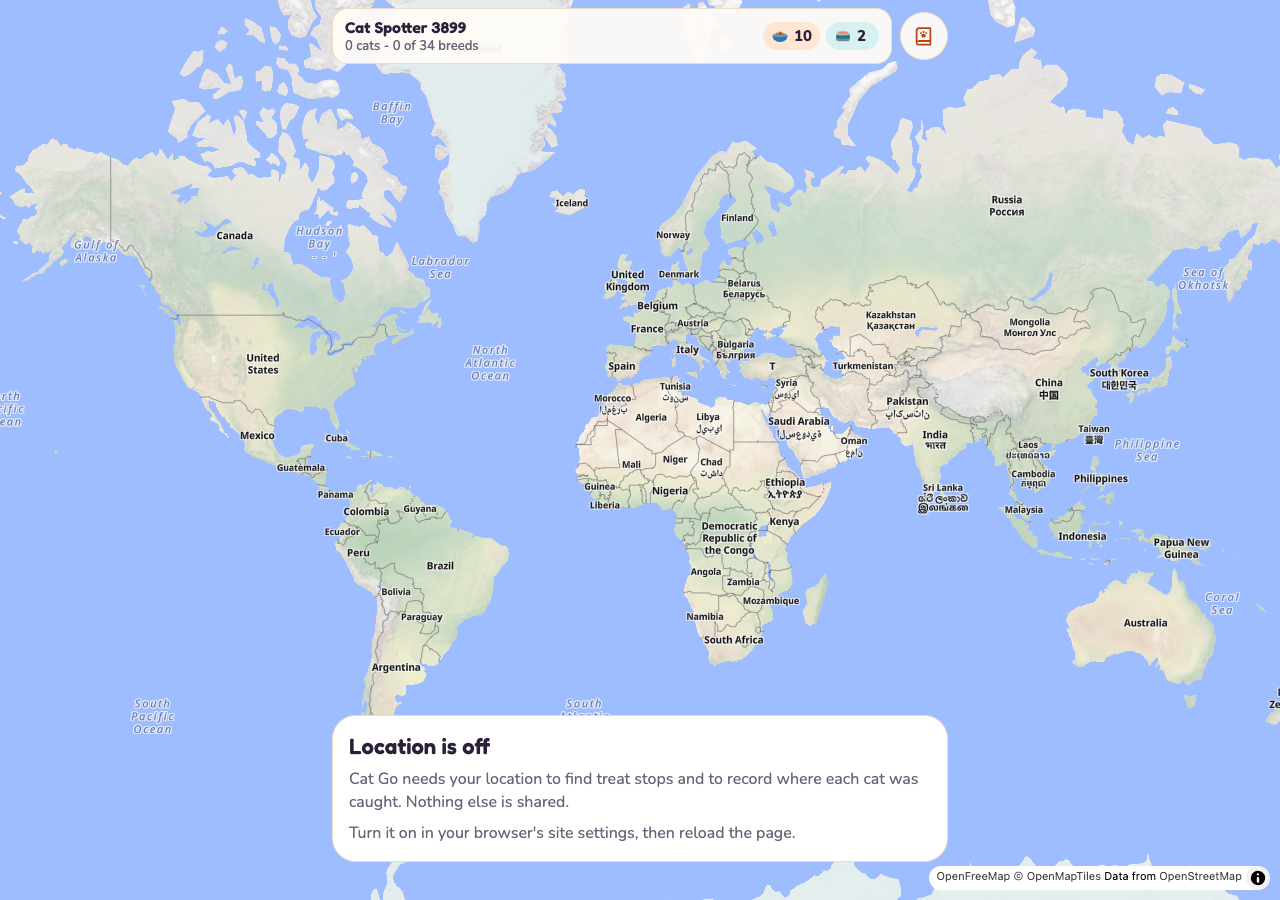
Cat Go's map, where each catch is recorded with the place you found the cat.
Frequently asked questions
Why are Burmese called Velcro cats?
The CFA says Burmese are often called "Velcro kitties" because they are so physically possessive of their people, following them from room to room and seeking out laps.
What colours do Burmese cats come in?
The CFA shows them in four: sable, champagne, blue and platinum.
How big do Burmese cats get?
They are medium sized but heavy for their size. The CFA says they are fully grown at 18 months, and a mature male may reach or exceed 12 pounds, with females usually smaller.
Are Burmese cats good with children?
The CFA says Burmese are known for being good with children, and typically like, or at least tolerate, the family dog.
Get started
Next time you meet a sleek brown cat on a walk, take a calm photo and decide for yourself what it is. Open Cat Go in your browser, allow location and the camera, and start your Catdex with the cats you meet.
Comments
No comments yet.
Sign in or make an account to comment.