What is a calico cat? A plain guide to the pattern
What is a calico cat? It is a mostly white cat with large patches of black and orange, so its coat looks like a patchwork quilt. "Calico" names the pattern of the coat, not a breed. This guide explains what cat experts mean by the word, why calico cats are nearly always female, and how to tell a calico from the patchy cats that look like one.
What is a calico cat? The short answer
The Cat Fanciers' Association (CFA), a cat breed registry, has a page that pairs the names people use with the names the cat world uses. On its Colors of Cats page, the common names "Tri-color" and "Harlequin" both have one correct name: Calico.
The CFA's Coat and Color Descriptions page gives the definition. A calico, it says, is a female cat with white and large solid areas of black and red. Red is what the cat world calls orange or ginger, so in everyday words: white, black and orange, in big clear patches.
The same page lists two softer versions. A calico can have white with blue and cream patches instead, or white with lilac and cream. Blue is the cat world's word for gray, and cream is a pale beige. A gray and cream calico is often called a dilute calico.
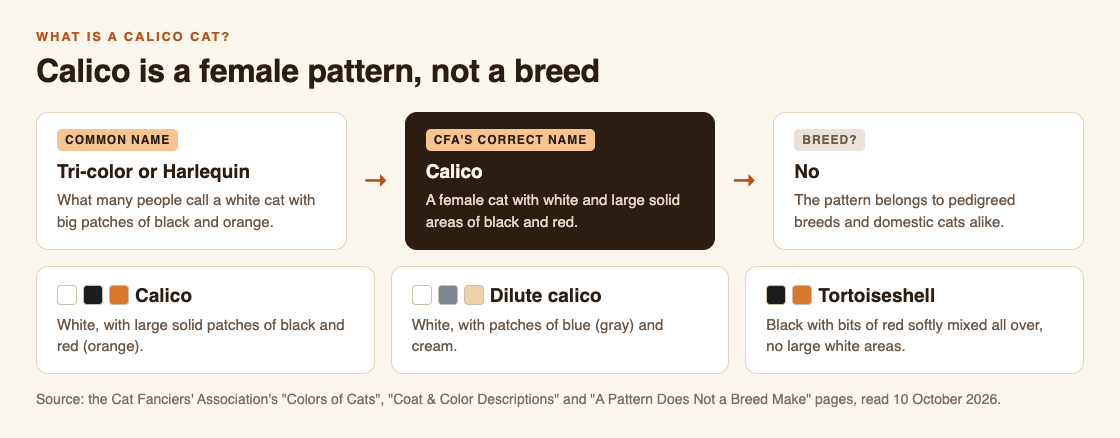
One pattern, a softer version, and its closest cousin.
Why are calico cats almost always female?
This is the part most people find surprising. The CFA describes both calico and tortoiseshell as female patterns. On its Coat and Color Descriptions page, it says many of the patchy, more-than-one-color patterns, calico among them, are related to the sex linked orange gene: a gene tied to whether the cat is male or female.
The CFA's Basic Feline Genetics page adds an honest caveat. It says tortoiseshell cats, the calico's close cousin without the white, are almost always female, "but males can and do occur occasionally (and are not always sterile)." The page also warns that its rules are generally true, with exceptions.
So the plain answer is: if you meet a calico, it is very likely a female. Very likely is not always, and a cat's sex is not something to check on a cat you meet in the street.
Is a calico cat a breed?
No. The CFA article "A Pattern Does Not a Breed Make" names calico and tortoiseshell as two popular female-only patterns that are often used as breed names. Neither is a breed, it says. These patterns belong to pedigreed breeds and domestic cats alike.
The article shows this with photos. One is a longhair Scottish Fold in the calico pattern; another is a Manx in a dilute calico pattern. The Coat and Color Descriptions page makes the same point another way: you can have a Tortoiseshell Persian or a Tortoiseshell Cornish Rex. The pattern sits on top of the breed. It does not make one.
The same article also puts the odds in plain numbers. The CFA recognizes 46 breeds, and only about five percent of all domestic cats belong to any recognized breed. So most calicos you meet are everyday mixed-breed cats that happen to wear a striking coat. For how to make that call on any cat, see Is my cat a mixed breed? How to tell in 5 checks.
Calico, tortoiseshell and bi-color: how to tell them apart
Three coats get mixed up all the time. Here is how the CFA's definitions separate them.
- Calico. White, with large solid patches of black and orange. You can point to each patch and say where it starts and stops.
- Tortoiseshell. The CFA describes it as a black (or sometimes chocolate) cat with bits of red softly mixed all over the body. The colors blend and speckle rather than sit in clean blocks, and there are no large white areas. The CFA adds that a tortoiseshell can be "augmented with white", so a cat can sit somewhere between the two.
- Bi-color. White with one other color. A red and white cat is a bi-color, not a calico, however bright the orange. The CFA says the bi-color colors occur in both male and female cats, which is one more way they differ from calico.
A black and white bi-color has its own nickname, the tuxedo. If you want the full story on that coat, see What is a tuxedo cat?
Where the calico pattern comes from
The CFA's genetics page gives two simple rules that explain a calico's parents, without needing a lab.
- The orange. A red or cream kitten must have a red, cream or tortoiseshell mother. The CFA ties the orange in patchy coats to the sex linked orange gene.
- The white. The white on a calico is white spotting, patches where the coat has no color. The CFA says a kitten with white spotting, and it names calico first, must have a parent with white spotting.
That is as far as the CFA's page goes, and as far as this guide goes. It is enough to see why calico is a pattern that turns up in many families of cats, rather than a breed that comes from one.
A worked example: three patchy cats on one walk
When people ask the author of the CFA article what their cat is, she answers with its color and pattern, not a breed. You can do the same. Say you pass three patchy cats on an evening walk, each seen from the pavement.
- The first is mostly white, with a black patch over one eye, an orange patch on its back and a black tail. Large, clean patches of black and orange on white: a calico.
- The second has the same colors, but there is almost no white, and the black and orange are speckled together all over. That is a tortoiseshell.
- The third is white with big orange patches and no black at all. One color with white: a red and white bi-color. It could be male or female.
Notice what you did not say: a breed. With no pedigree to go on, the honest answer for all three is "mixed breed", followed by the pattern. And nobody had to approach or touch a cat to name its coat.
Log your calico cats with Cat Go
A calico is one of the easiest cats to remember once you have seen it. Cat Go is a game that plays in your web browser. In the site's own words: "Walk anywhere, photograph a real cat, lure it with food and catch it. Every catch keeps its breed and where you found it."
Here is how the first cat from the example would go:
- Tap the camera on the map and take its photo. The camera screen says "Fit the whole cat in the frame", which matters for a calico: the patches are the whole point.
- The game asks "Which breed is it?" and you pick from a list. You make the call, not the game.
- Calico is a pattern, so for a street cat the honest pick is usually mixed breed. The game agrees: "Most cats you meet are mixed breed. Rarer breeds are warier." and "Mixed breed is always a safe pick."
- Toss in-game treats to win it over. A caught cat is "Saved to your Catdex with its breed and the place you found it", and you can give it a name. "Patches" is the obvious one.
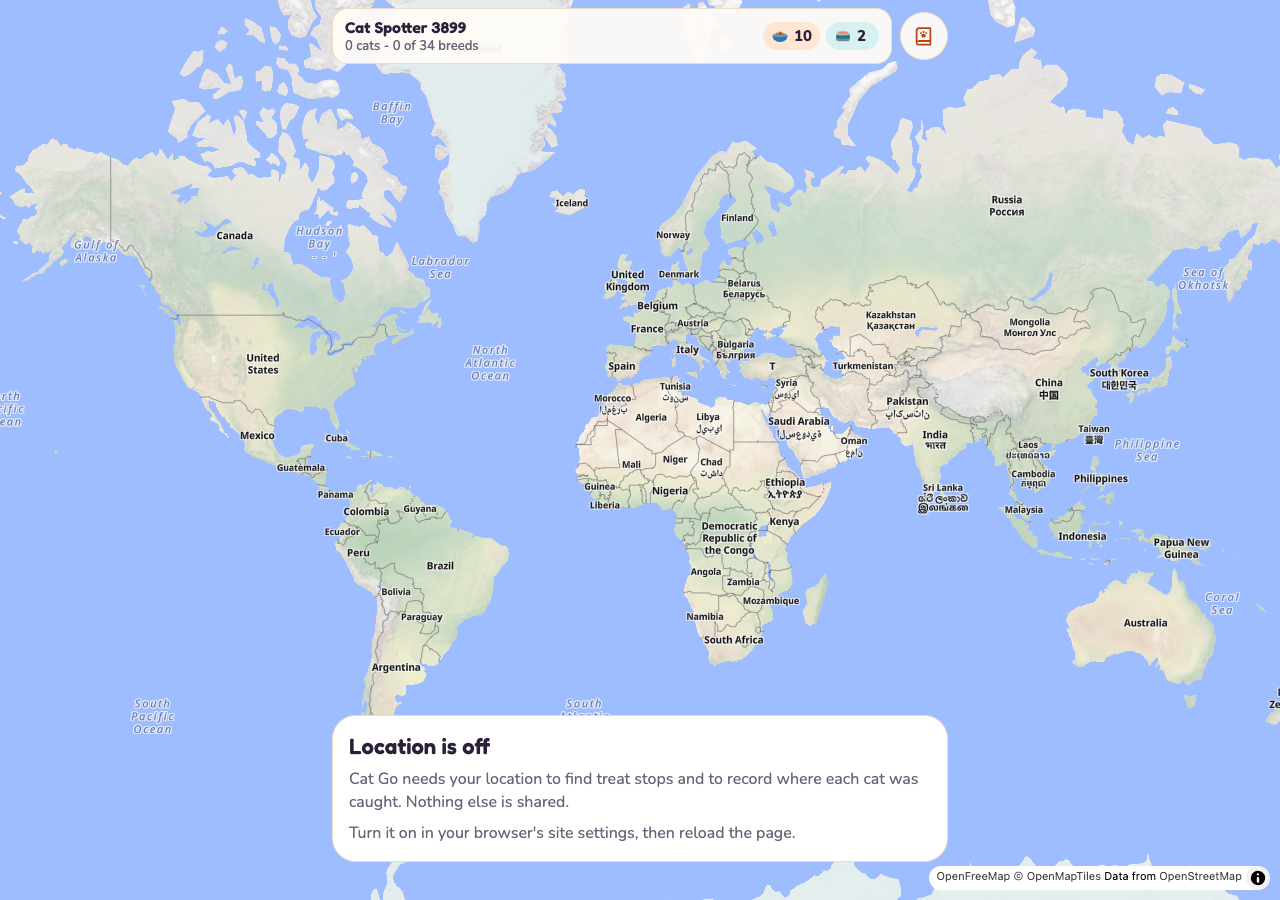
The bar at the top counts your cats and breeds out of the game's 34.
The treats and the catch are inside the game; the real cat only has its photo taken. Cat Go needs the camera and location allowed in your browser.
Frequently asked questions
What is a calico cat?
A cat with white and large solid patches of black and orange (or gray and cream in a dilute calico). Calico is the name of the coat pattern, not a breed.
Are all calico cats female?
Almost all. The CFA describes calico as a female pattern linked to the sex linked orange gene, and says males of the related tortoiseshell pattern occur only occasionally.
What is the difference between a calico and a tortoiseshell?
A calico has white with large, clean patches of black and orange. A tortoiseshell is black with bits of red softly mixed all over, with no large white areas.
Can a pedigreed cat be calico?
Yes. The CFA shows a Scottish Fold in the calico pattern and a Manx in dilute calico; the pattern belongs to pedigreed breeds and domestic cats alike.
Get started
Next time a patchy cat crosses your path, name its colors and pattern before you guess a breed. Then play Cat Go in your browser: walk anywhere, photograph a real cat, lure it with food and catch it, and keep its breed and the place you found it in your Catdex.
Comments
No comments yet.
Sign in or make an account to comment.