What is a chinchilla cat? The lightest tipped coat, explained
What is a chinchilla cat? It is not a breed. In the words of the Cat Fanciers' Association (CFA), a large pedigreed cat registry, chinchillas are the shaded and tipped cats with the least colour on each hair. The hair is white at the root and coloured only at the end, which gives the coat its sparkle.
This guide sets out what the CFA's own pages say: how a chinchilla differs from a shaded or smoke cat, what the Persian and Exotic standards ask for, the parent rule behind the coat, and what to do when you meet a silvery cat on a walk.
What is a chinchilla cat? A coat, not a breed
The CFA's coat and color descriptions start from one point: the words for colour and pattern describe the coat, and they do not suggest the breed. Its examples are that tabby is a pattern, not a breed, and that calico and tortoiseshell also name patterns.
Chinchilla works the same way. It names how much colour sits on the end of each hair. A chinchilla Persian and a chinchilla Exotic share the coat; the body, face and coat length come from the breed.
Smoke, shaded and chinchilla: one coat, three amounts of colour
The CFA describes a family it calls "shaded and tipped colors". On these cats, the hair is white, or silver, at the roots, and the end of each hair carries the cat's main colour, such as black, blue, red or cream.
What changes is how much of each hair is coloured. In the CFA's words, cats with the heaviest amount of colour are called smokes, and those with the least are called chinchillas. A shaded silver falls between the two.
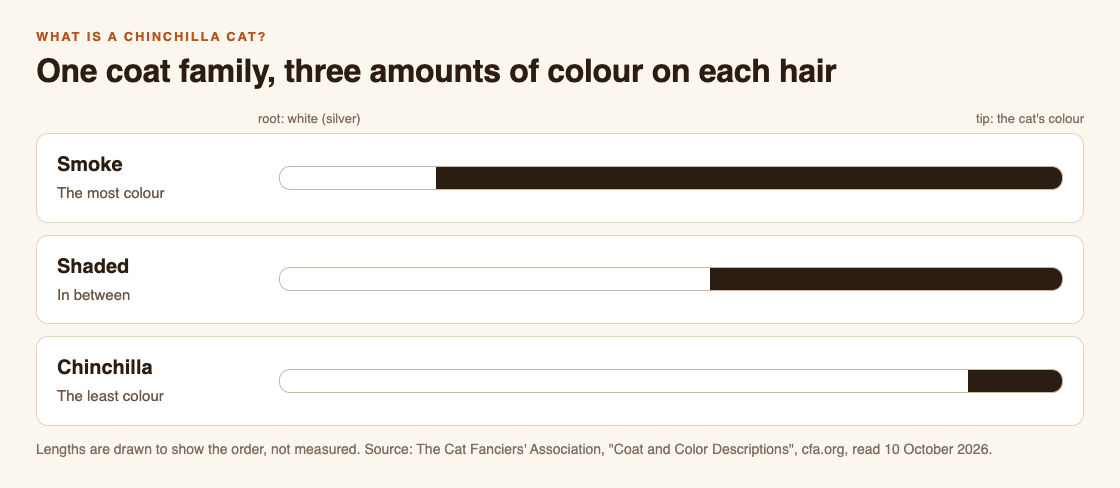
Smoke has the most colour on each hair, chinchilla the least, and shaded falls in between. Source: the CFA.
So a chinchilla is the palest member of the family. Our guide to smoke cats covers the darkest one.
What a chinchilla silver looks like, by the standard
The CFA's Persian breed standard puts the chinchillas in its Silver and Golden Division. It describes the chinchilla silver like this:
- Undercoat: pure white.
- Tipping: the coat on the back, flanks, head and tail tipped with black, enough to give "the characteristic sparkling silver appearance". The legs may be slightly shaded.
- White areas: chin, ear tufts, stomach and chest pure white.
- Outlines: the rims of the eyes, the lips and the nose outlined with black.
- Nose and paws: brick red nose leather and black paw pads.
- Eyes: for every colour in the division, green or blue-green.
The shaded silver, listed right after it, has a mantle of black tipping running down from the ridge of the back. The standard says its general effect should be "much darker than a chinchilla".
Chinchilla golden and other colours
Silver is not the only chinchilla. The same Persian standard lists a chinchilla golden: an undercoat of pale honey to bright apricot, tipped with black to bring out a golden look. Its general effect is lighter than a shaded golden "due to less tipping".
The standard also lists a shell cameo, which it calls the red chinchilla: a white undercoat with the back, flanks, head and tail lightly tipped with red.
The Persian is split into seven divisions for showing, and the CFA names two of them for these coats: silver and goldens, and shaded and smokes.
Which breeds come in chinchilla?
On the CFA pages opened for this guide, two breeds list chinchilla colours in their standards: the Persian and the Exotic. This guide does not say which other registries or breeds use the word.
The Exotic has a chinchilla story of its own. The CFA's Exotic breed page says that in the 1950s, some Persian breeders crossed their cats with American Shorthairs. Many of the shorthaired kittens were shaded silver or chinchilla, colours that did not then exist in any shorthair breed. The CFA made them a breed in 1966, first called the Exotic Shorthair and today simply the Exotic.
The Exotic standard lists chinchilla silver, blue chinchilla silver, chinchilla golden and blue chinchilla golden, also with green or blue-green eyes.
Where the coat comes from: the CFA's parent rule
The CFA's basic feline genetics page gives two rules for this coat. It says its statements are generally true, with exceptions.
- A cat with a white undercoat, including the chinchilla silver, shaded silver, silver tabby, cameo and smoke, must have a parent with a white undercoat.
- A shaded or chinchilla kitten must have at least one parent with a white undercoat and one parent that is tabby. The page counts chinchilla and shaded as tabby colouring.
That second rule surprises many people, since a chinchilla shows no stripes. If you want to know what the tabby patterns themselves look like, our guide to tabby cats covers all four.
A silvery cat on your street: how to record it
A pale, sparkly cat you meet outside may share the coat without belonging to any breed. A coat colour says nothing about pedigree, which is the CFA's own point. Our guide on whether a cat is a mixed breed walks through why most cats you meet are.
Cat Go is a game that plays in your web browser where that question comes up on every catch: "Walk anywhere, photograph a real cat, lure it with food and catch it."
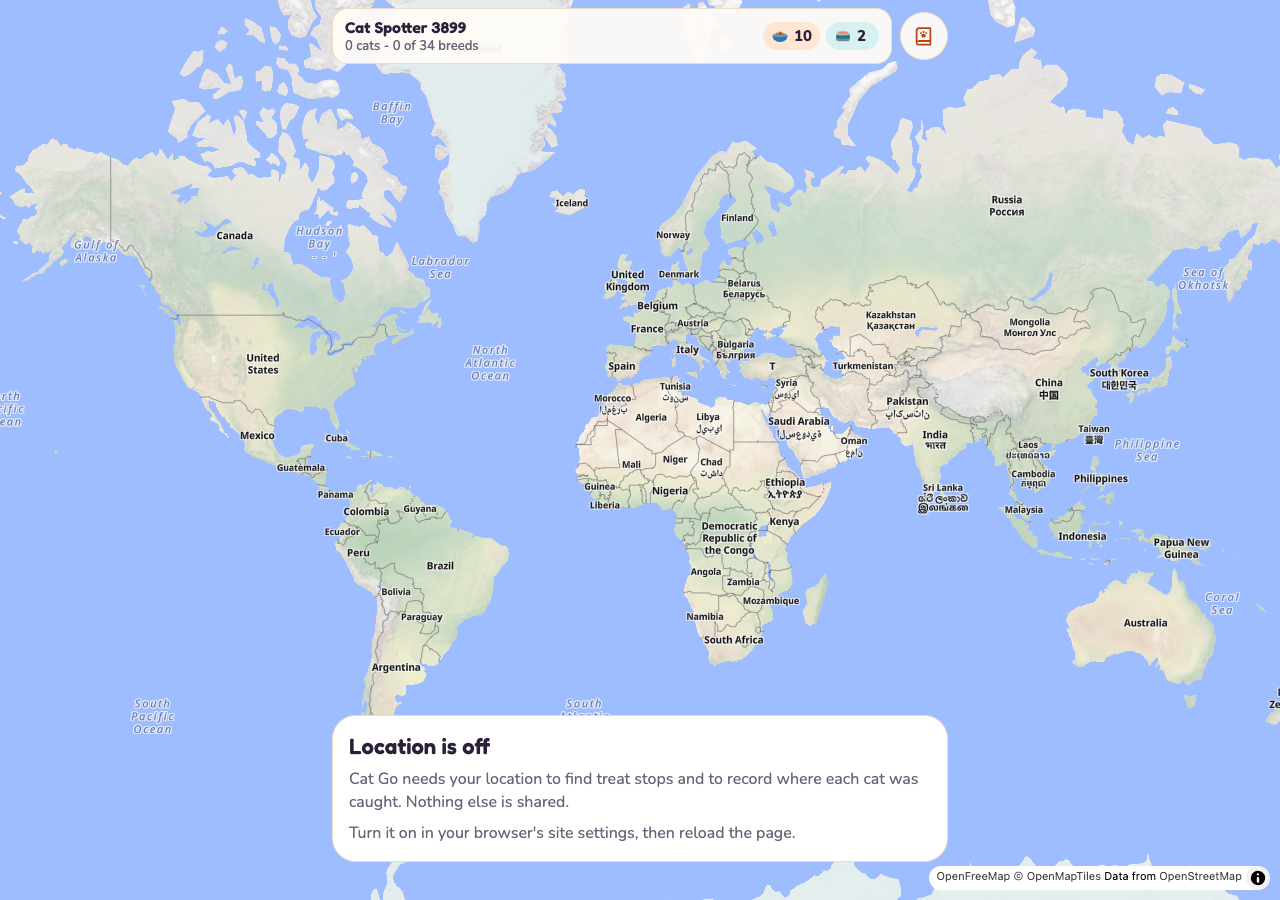
The bar at the top counts your cats and breeds out of the game's 34.
Here is how it goes when you spot a silvery cat:
- Stay where you are and tap the camera. The screen says "Fit the whole cat in the frame".
- The game asks "Which breed is it?" and gives you a list with a search box. You pick; the game does not decide for you.
- The screen reminds you: "Most cats you meet are mixed breed. Rarer breeds are warier." and "Mixed breed is always a safe pick."
- Toss in-game treats to win it over. The catch keeps its breed and where you found it.
Look closely before you pick. If the cat sparkles silver but you cannot be sure of its breed, mixed breed is the honest choice.
Frequently asked questions
Is a chinchilla cat a breed?
No. The CFA uses chinchilla for a coat: the shaded and tipped cats with the least colour on each hair.
What is the difference between a chinchilla and a shaded silver?
The amount of tipping. The CFA's Persian standard says a shaded silver's general effect should be much darker than a chinchilla's.
What colour eyes does a chinchilla Persian have?
The CFA's Persian standard asks for green or blue-green eyes for every colour in its Silver and Golden Division.
Can a chinchilla kitten have two parents without a white undercoat?
By the CFA's genetics page, generally not: a chinchilla kitten needs at least one parent with a white undercoat, and one that is tabby.
Get started
Next time a cat seems to shimmer as it moves, look at the tips of its fur. Then take your phone for a walk and see who you meet.
Play Cat Go in your browser: walk anywhere, photograph a real cat, lure it with food and catch it.
Comments
No comments yet.
Sign in or make an account to comment.