What is a colorpoint cat? A plain guide to the pattern
What is a colorpoint cat? It is a cat with its color on the face, ears, feet and tail, and a lighter body. The Cat Fanciers' Association (CFA) calls this the pointed pattern and says it may also be described as color point. This guide sets out what makes a cat pointed, the colors and patterns the points come in, which breeds carry it, and how to name the pointed cat you meet on a walk.
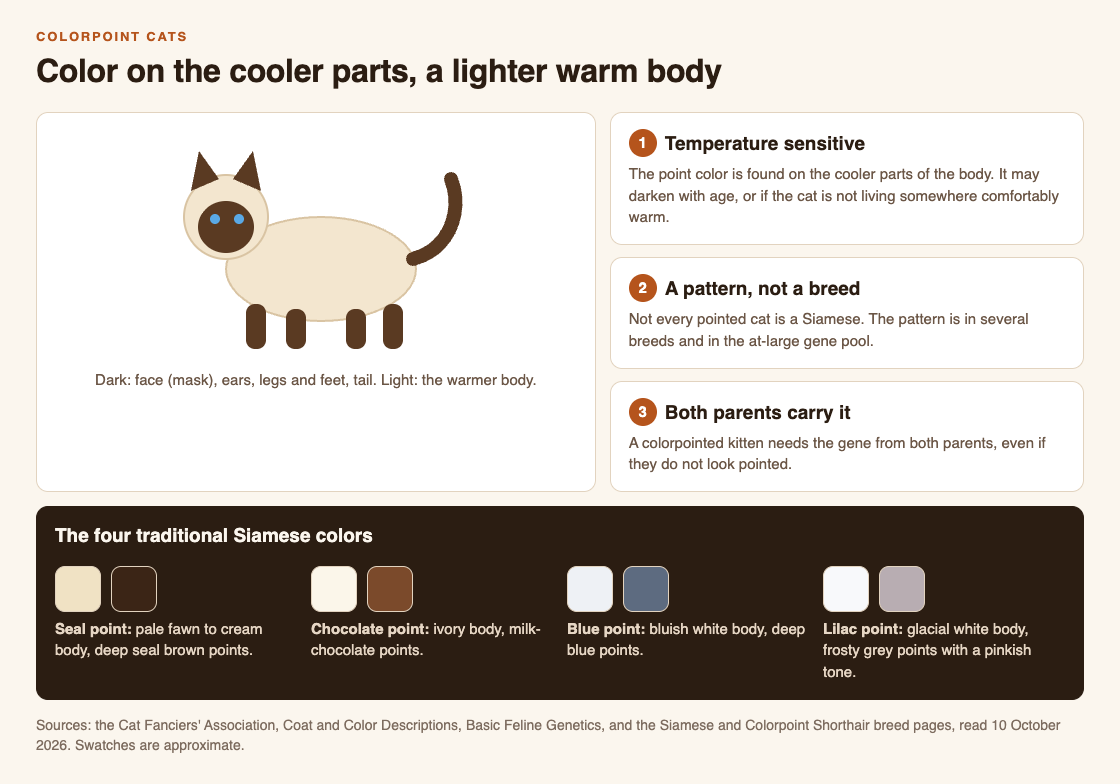
The pointed pattern and the four traditional Siamese colors, from the Cat Fanciers' Association.
What is a colorpoint cat? The short answer
On its Coat and Color Descriptions page, the CFA says a cat with a pointed pattern has all of its color or pattern at the extremities: the face, ears, feet and tail. The points are the darker parts. The body in between is lighter.
The CFA adds that many people call any cat like this a Siamese. It is not that simple. The Siamese gene is responsible for the pattern, and Siamese cats have it, but not every cat with the pointed pattern is a Siamese. The CFA says the pattern, also called the Himalayan pattern, has been brought into several breeds and also into the at-large gene pool, which means you can meet it in cats of no breed at all.
Why the points are darker: a temperature-sensitive color
The CFA's Colorpoint Shorthair page gives the reason in one line. As with the Siamese, the point color is temperature-sensitive and is found on the cooler parts of the body, while the warmer torso is substantially lighter.
Two things follow, both in the CFA's own words:
- Coats can darken. The color may become darker with age, or if the cat is not living somewhere comfortably warm. The Siamese breed standard makes allowance for darker color in older cats, since Siamese generally darken with age.
- Contrast still matters. Even so, for a show Siamese there must be definite contrast between the body color and the points.
The CFA's Ragdoll page adds a third: Ragdolls reach full coat and color at about three years of age. So a young pointed cat may still be changing.
How a cat gets the pattern
The CFA's Basic Feline Genetics page sets out three plain rules:
- To get a colorpointed kitten, both parents must carry the colorpoint gene, even if they do not look colorpointed themselves.
- Two colorpointed parents cannot produce a kitten that is not colorpointed.
- A mink colored cat carries the colorpoint gene.
The first rule is why a pointed kitten can turn up in a litter from two cats with no points at all. It is also why the pattern is found among mixed breed cats. Our guide to telling whether your cat is a mixed breed covers that side of things.
Colorpoint colors: seal, chocolate, blue, lilac and more
The CFA lists the colors a pointed cat may have: seal point, blue point, chocolate point, lilac point, red point and cream point; the tabby versions of each; and blue-cream, tortie and lilac tortie point.
The first four are the traditional Siamese colors. The Siamese breed standard describes each one:
- Seal point: a body of even pale fawn to cream, warm in tone, with points of deep seal brown.
- Chocolate point: an ivory body, with points of milk-chocolate color, warm in tone.
- Blue point: a bluish white body, cold in tone, with points of deep blue.
- Lilac point: a glacial white body, with points of frosty grey with a pinkish tone.
The Colorpoint Shorthair breed began when breeders mixed the red gene into those four Siamese colors. The CFA says it is structurally identical to the Siamese and is judged in three classes: solid point (red and cream), lynx point, and particolors such as seal-tortie and blue-cream.
Lynx, tortie and white: patterns on the points
Color is one part of the name. Pattern is the next.
Lynx point
The CFA says tabby points are generally called lynx points. So a pointed cat whose points show tabby markings is a lynx point. The CFA adds that some lynx-pointed cats look as if they wear eyeliner, because the tabby markings make the eyes look larger. Our guide to what a tabby cat is explains the tabby patterns themselves.
Tortie point
Tortie point, blue-cream point and lilac tortie point are on the CFA's list. The CFA's coat page says many parti-color coats, tortoiseshell and blue-cream among them, are related to the sex linked orange gene; see our guide to what a calico cat is for how that gene shapes a coat.
Points with white
Some pointed breeds also carry the bicolor gene. The CFA says Birmans are color-pointed cats with the bicolor gene, which gives them white gloves on the front paws and laces on the back paws, and that three of the four Ragdoll patterns also have the bicolor gene.
Breeds with the colorpoint pattern
Here is what the CFA's breed pages say, breed by breed:
- Siamese: long, slender body with color at the points in chocolate, seal, blue and lilac; eye color deep vivid blue.
- Colorpoint Shorthair: the Siamese type in other point colors, from red and cream to lynx and tortie points.
- Ragdoll: all Ragdolls have the colorpoint gene, so the body is always lighter than the head, legs and tail.
- Birman: a color-pointed cat with long silky hair, blue eyes and four white feet.
On eyes, the CFA's coat page says eye color is genetically controlled only in breeds influenced by the Burmese or Siamese gene: yellow by the Burmese gene and blue by the Siamese gene. It adds that mink Tonkinese have aqua eyes.
How to name a pointed cat you meet
The CFA suggests an order for describing any cat: color first, then pattern, then coat length and special features, with the breed added at the end. Its own example is "a seal tortie lynx point Colorpoint Shorthair."
Here is a worked example with a cat you might spot on a walk, and Cat Go open in your browser.
- Find the points. A cat on a doorstep has a cream body and a dark brown face, ears, legs and tail. That is the pointed pattern.
- Name the color. Deep brown points on a pale fawn to cream body match the CFA's seal point.
- Check for a pattern. Tabby markings in the points would make it a seal tabby point, which the CFA generally calls a lynx point. Points of one even color keep it a seal point.
- Stop before the breed. The CFA is clear that a pointed cat is not always a Siamese, and a cat met on the street has no papers to check. So you stop at "a seal point cat."
- Take the photo. In Cat Go, tap the camera on the map and, as the screen says, "Fit the whole cat in the frame." Keep your distance; everything after the photo happens in the game.
- Pick the breed yourself. The game asks "Which breed is it?" and reminds you that "Most cats you meet are mixed breed" and "Mixed breed is always a safe pick." For the cat on the doorstep, mixed breed is the honest answer.
Once caught, the cat is saved to your Catdex with its breed and the place you found it, and the bar at the top counts the breeds you have found out of 34.

Cat Go starts on a map. You tap the camera when you spot a cat.
Frequently asked questions
Is a colorpoint cat a breed?
No. The CFA calls it a pattern, with color on the face, ears, feet and tail, and says it is found in several breeds and in the at-large gene pool.
Why are a colorpoint cat's points darker?
The CFA says the point color is temperature-sensitive and found on the cooler parts of the body, while the warmer torso is lighter. The color may darken with age or if the cat is not kept comfortably warm.
Can two cats without points have a colorpoint kitten?
Yes. The CFA says both parents must carry the colorpoint gene, even if they do not look colorpointed themselves.
What is a lynx point cat?
A pointed cat with tabby markings in its points. The CFA says tabby points are generally called lynx points.
Get started
Cat Go turns the cats you meet on a walk into a collection, pointed or not. It plays in your web browser and needs the camera and location allowed. You photograph a real cat, pick its breed, win it over with in-game treats, and keep it in your Catdex with the place you found it.
Play Cat Go: walk anywhere, photograph a real cat, lure it with food and catch it.
Comments
No comments yet.
Sign in or make an account to comment.