What Is a Difficulty Curve in Video Games? A Plain Guide
If you have ever breezed through the first level of a game and then hit a wall an hour later, you have felt a difficulty curve. So, what is a difficulty curve in video games? It is the way a game's challenge changes as you play, from the first minute to the last. This guide explains what a good curve aims for, the levers a game pulls to make itself harder, and then reads the real curve of a free browser tank game, wave by wave, from its code.
What is a difficulty curve in video games? The short answer
Picture a chart. Put time or progress along the bottom and challenge up the side. Mark how hard each level or wave is and join the dots. That line is the difficulty curve.
The curve is not one setting. It is the sum of many small choices: which enemies show up, how many, how fast, how tough, and what the map looks like. Change any one of them and the line moves.
What a good curve aims for: not bored, not frustrated
Game designers have a name for this work: game balance, which adjusts "rewards, challenges, and/or elements of a game to create the intended player experience."
The aim is easy to say. Writing about games that adjust their own difficulty, Wikipedia puts the goal as keeping the player from becoming "bored if the game is too easy or frustrated if it is too difficult." The designer Chris Crawford wrote in 1982 that a graph of a typical player's score over time "should show a curve sloping smoothly and steadily upward."
So think of two lines. One is the challenge the game throws at you. The other is your skill, which climbs as you learn the controls and the enemies. Keep them close, with challenge a little ahead, and you stay interested.
There is often a third line: your power. If the game lets you grow stronger, the difficulty you feel is the gap between the enemies' growth and yours.
The levers that make a game harder
Most curves are built from the same few levers:
- Which enemies appear. Swapping weak enemies for strong ones.
- How tough they are. More hit points means more shots per kill.
- Speed and timing. Faster enemies, arriving closer together.
- How many at once. More enemies on the field means more to track.
- The map. A new layout changes the problem, not just its size.
A useful habit when you read any game: ask which lever changed this level. If several change at once, the level will feel like a jump.
Worked example 1: the stages of Tank City Reboot
Tank City Reboot is a free browser game where your antivirus tank guards a CPU core from malware tanks. Each stage sends 20 of them. Here is how the mix changes across the six stages, from the game's code:
- FIREWALL: 18 worms and 2 trojans.
- CACHE: 14 worms, 4 trojans and 2 rootkits.
- COOLANT: 9 worms, 5 trojans, 4 spyware and 2 rootkits.
- ENCRYPTION: 5 worms, 6 trojans, 5 spyware and 4 rootkits.
- DATA BUS: 2 worms, 6 trojans, 6 spyware and 6 rootkits.
- KERNEL: 4 trojans, 6 spyware and 10 rootkits.
Read it lever by lever. The enemy lever: the worm, the slow basic tank that takes one hit, falls from 18 to none. The toughness lever: rootkits are armored and take four hits, and they rise from 0 to 10. The timing lever: a new tank enters every 2.6 seconds on stage 1, a quarter second sooner each stage, down to 1.1 seconds from stage 7. The map lever: COOLANT has two rivers tanks cannot cross, and ENCRYPTION is full of encrypted zones that hide any tank inside, one right above the core.
After stage 6 the maps repeat, every stage uses the KERNEL lineup, and enemy speed rises 8% each loop. The curve keeps climbing in steps.
Your power line moves too. Overclock upgrades your cannon in three steps, but it goes back to zero when you lose a tank. So the curve feels steepest right after a mistake.
Worked example 2: the waves of Tank City Zero Day
The second game, Tank City Zero Day, runs in waves with no end, so its curve is a set of formulas. For a normal wave, from its rules:
- At least 6 threats plus 2 per wave, up to 30.
- At most 4 on the field at once, plus one more every three waves, up to 8.
- 2.0 seconds between entries, minus 0.08 per wave, never under 0.6.
- Enemy speed up 3% per wave, until wave 15.
Work out wave 9 yourself. Threats: 6 plus 18 is 24. On the field: 4 plus 3 is 7. Gap: 2.0 minus 0.72 is 1.28 seconds. Speed: 27% above their base speed. Every lever has moved, but each only a little.
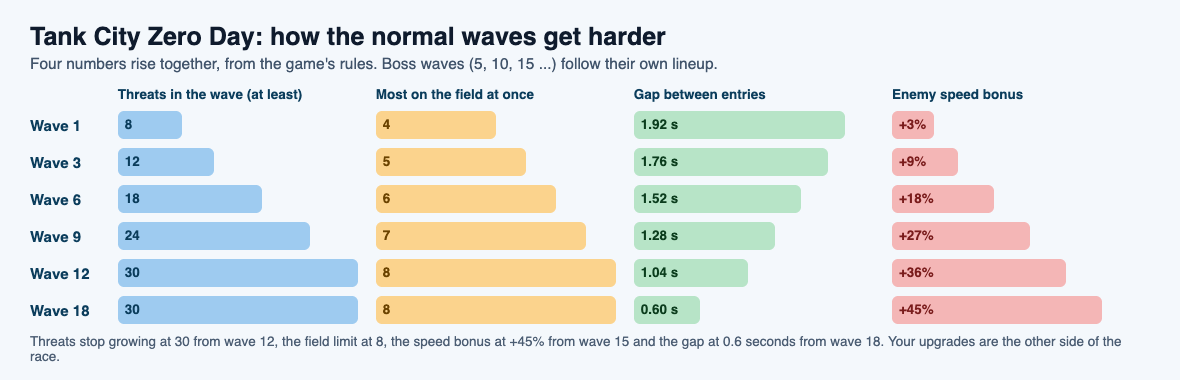
Four levers move together, a little each wave, then level off.
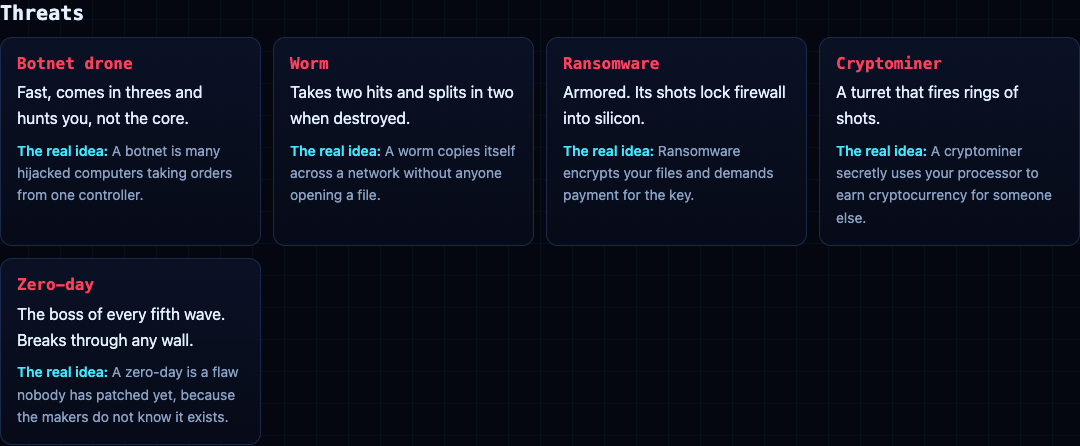
New enemies arrive one at a time. Waves 1 and 2 send only botnet drones and worms. Ransomware joins from wave 3 and cryptominers from wave 4. Every fifth wave a zero-day boss breaks in: a planned peak. It takes 40 hits on wave 5 and 15 more on each later boss.
Against that, your power line climbs. After each wave you pick one of three upgrades, such as Cache (fire 30% faster) or Multithreading (more shots per volley), and they last until the run ends. The felt difficulty is the race between the chart above and your upgrades.
Keeping the curve fair
A steep curve is fine. An unfair one is not. Both games add small safety nets so one mistake does not end the run:
- In the first game a new tank gets a 3.9 second shield after it arrives, so you are not hit the instant you respawn. You also get one extra life the first time your score reaches 20,000.
- In Zero Day a dash makes you untouchable for a fifth of a second.
- Zero Day builds a fresh arena for every wave from a seed, then checks that every enemy gate and your start can reach the core going round silicon and coolant. An arena that fails is drawn again. Random maps never make a wave you cannot answer.
If you build games, copy that last idea. Write down every number that changes challenge, change one per level where you can, and test that each level can be won.
Frequently asked questions
Is a difficulty curve the same as a learning curve?
No. A learning curve is how fast you get better. A difficulty curve is how fast the game gets harder. A good game keeps the two close.
What is dynamic difficulty?
It is a game adjusting its own challenge while you play, based on how well you are doing. Both Tank City games use fixed rules instead, the same for every player.
What is a difficulty spike?
A sudden jump that is much harder than the levels around it. A boss wave is a planned spike; an accidental one usually tests something the game never taught.
How long should the easy start of a game last?
Long enough to teach the controls and the first enemy. In the first Tank City Reboot stage, 18 of the 20 tanks are basic worms, which gives you a whole stage to learn.
Get started
Play stage 1 of the first game and watch the mix change as you reach CACHE and COOLANT. Then try Zero Day and see how your upgrades race the waves. Arrow keys and Space work on a computer, and a touch pad appears on a phone.
Play Tank City Reboot: it is free, plays in your browser on a computer or a phone, and needs no account.
Comments
No comments yet.
Sign in or make an account to comment.