What is a domestic shorthair cat? A plain answer
What is a domestic shorthair cat? It is a cat with a short coat and a family tree of mixed ancestry. It is not a breed. If a vet, a shelter or an insurer wrote "domestic shorthair" on your cat's papers, they were describing what your cat looks like, not naming a pedigree. This guide explains where the name comes from, why it gets mixed up with a real breed, and how to label a short-coated cat you meet with confidence.
What is a domestic shorthair cat? The short answer
PDSA, the UK vet charity, puts it in one line on its domestic breeds page: domestic shorthairs, medium hairs and longhairs are not a recognised breed, but they are still the most common type of cat owned in the UK.
So "domestic shorthair" works like a description. It tells you two things:
- Domestic: a pet cat of mixed ancestry, with no known pedigree.
- Shorthair: the coat is short and sleek.
Swap the second word and you get the siblings. PDSA describes domestic medium hairs as having a slightly longer, sleek coat, and domestic longhairs as having a much longer coat that needs regular grooming. All three are the same idea: an ordinary, much-loved cat, sorted by the length of its fur.
Where the name came from
The confusion has a real history. The Cat Fanciers' Association (CFA), a cat breed registry, tells it on its American Shorthair page.
Short-haired cats came to North America with early settlers, on ships that kept cats aboard to control rodents. Over time a breed was developed from them. That breed was one of the first five the CFA recognized when it was founded in 1906. And here is the twist: it was originally shown as "Domestic Shorthairs". It only took the name American Shorthair in 1965.
So for decades, "Domestic Shorthair" was the show name of a pedigreed breed. Today the same words mean the opposite: a cat with no breed at all. That is why so many people search the term and come away unsure.
Domestic shorthair vs American Shorthair
They can look alike at a glance. Both have short coats, and both are often tabbies. The difference is what sits behind the look.
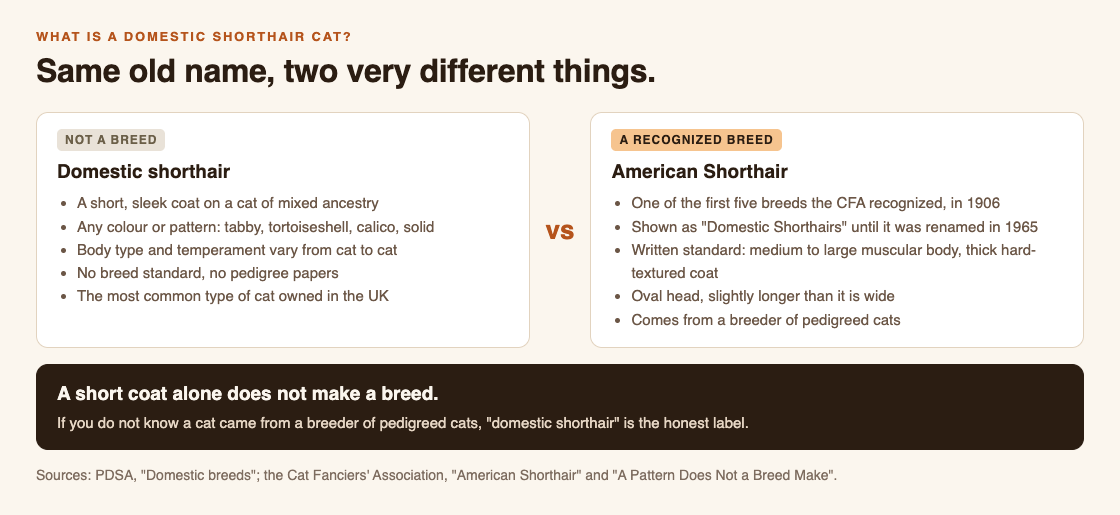
A short coat alone does not make a breed.
The American Shorthair has a written standard. The CFA describes a medium to large, muscular body, a thick, hard-textured coat, and an oval head slightly longer than it is wide. It comes in over 100 colour combinations, and a pedigreed kitten comes from a breeder who, by and large, pairs two cats of the same breed.
A domestic shorthair has no standard to match. PDSA notes that domestic cats can have very different body types, shapes and builds, depending on the breeds somewhere in their history. One might be long and slim, the next stocky and round-faced.
The CFA's article A Pattern Does Not a Breed Make gives the rule of thumb. Unless a cat is known to have come from a breeder of pedigreed cats, it will almost certainly not be of a specific breed. The same article says only about five percent of all domestic cats belong to any recognized breed.
Why no two domestic shorthairs look alike
If you have ever seen a litter of kittens in four different coats, this part will make sense. The CFA explains that when a breeder pairs two cats of the same breed, the kittens should show the attributes of that breed. A domestic cat mating, by contrast, could produce four kittens that look nothing like each other, in pattern or in body type. The parents simply have no fixed traits to pass on.
PDSA adds that domestic cats vary greatly in temperament too. Some are very lively. Others are much more laid back. It also notes that because their genetic base is so wide, it lists no specific health issues for domestic cats.
The coat colour tells you nothing about breed either. PDSA lists tortoiseshell, calico, tabby, and solid colours from black all the way to white among domestic cats. A short-coated black cat, a brown tabby and a tortoiseshell can all be domestic shorthairs.
How to tell if a cat is a domestic shorthair: a worked example
Say you meet a short-haired grey cat on a wall near your home. It has a round face and yellow eyes. Is it a breed, or a domestic shorthair? Ask three questions, in this order.
- Do you know where it came from? You do not. It is a neighbour's cat, or no one's. By the CFA's rule of thumb, that already points to no specific breed.
- How long is the coat? Short and sleek, close to the body. That makes it a shorthair, not a medium hair or a longhair.
- Does the whole cat match one breed's standard? Grey fur and a round face might remind you of a British Shorthair. But a breed is judged on head, body, coat and colour together, and a loose likeness on one or two is common in mixed cats.
Result: a domestic shorthair. That is a complete and correct answer. It is also the answer for the large majority of short-haired cats you will ever meet.
For more on telling a breed from a coat pattern, see our guide Is my cat a mixed breed? How to tell in 5 checks.
Can a domestic shorthair be shown?
Yes. The CFA has a Household Pet class for non-pedigreed cats. Household pets are judged in one group, without regard to sex, coat length, age or colour. There is no written standard. Instead, the CFA says they are judged for their uniqueness, pleasing appearance, unusual markings and sweet dispositions.
The CFA's show rules add two conditions: a household pet may not be declawed, and if it is over eight months old it must be neutered or spayed. So a domestic shorthair is not a lesser cat in the show world. It simply competes on different terms.
Log the cats you meet with Cat Go
Once you can tell a domestic shorthair from a breed, every walk is full of small puzzles. Cat Go is a game that plays in your web browser and turns that into a collection. In the site's own words: "Walk anywhere, photograph a real cat, lure it with food and catch it. Every catch keeps its breed and where you found it."
Here is how the grey cat on the wall would go:
- Tap the camera on the map and take its photo. The camera screen says "Fit the whole cat in the frame".
- The game asks "Which breed is it?" and gives you a list with a search box. You choose; the game does not decide for you.
- Run your three questions. If the answer is domestic shorthair, the screen backs you up: "Most cats you meet are mixed breed. Rarer breeds are warier." and "Mixed breed is always a safe pick."
- Toss in-game treats to win the cat over. A caught cat is "Saved to your Catdex with its breed and the place you found it", and you can give it a name.
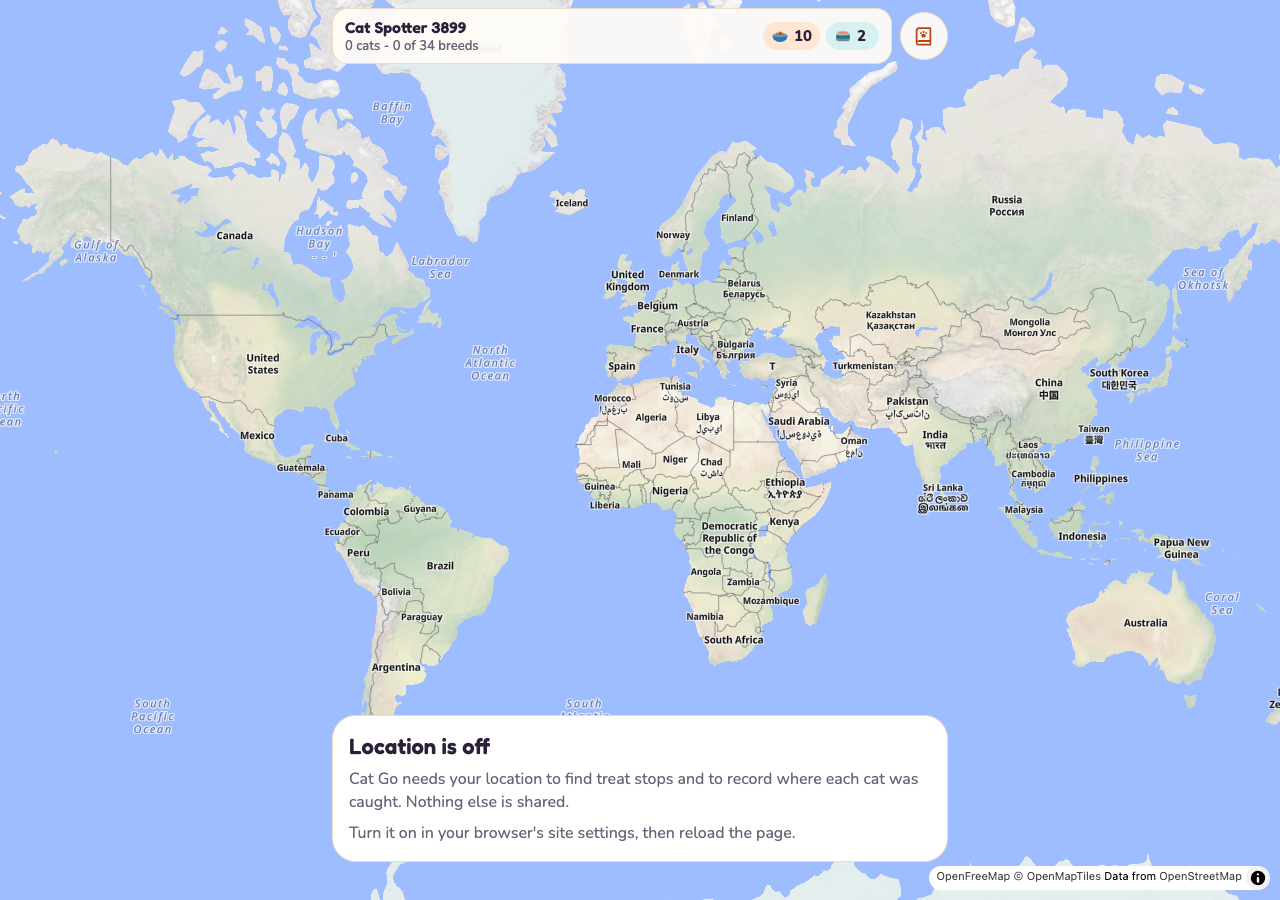
Cat Go's home screen counts cats caught and breeds found out of 34.
The bar at the top counts your cats and your breeds out of the game's 34. Most of your catches will be mixed breed, which is exactly what the CFA's numbers predict. The rarer breeds are the ones worth a second look. Cat Go needs the camera and location allowed in your browser.
Frequently asked questions
Is a domestic shorthair a breed?
No. PDSA says domestic shorthairs are not a recognised breed, though they are the most common type of cat owned in the UK. The term describes a short-coated cat of mixed ancestry.
What is the difference between a domestic shorthair and an American Shorthair?
The American Shorthair is a pedigreed breed with a written standard, recognized by the CFA since 1906. It was shown as "Domestic Shorthairs" until 1965, which is why the names get confused.
Why does my domestic shorthair look different from others?
Domestic cats are of mixed ancestry, so their body type, coat colour and temperament vary greatly. The CFA notes one litter can hold kittens that look nothing alike.
What breed should I pick for a domestic shorthair in Cat Go?
Pick mixed breed. The game itself says "Mixed breed is always a safe pick", and you always choose the breed yourself.
Get started
Next time you spot a short-haired cat on your walk, ask the three questions before you name it. Then play Cat Go in your browser: walk anywhere, photograph a real cat, lure it with food and catch it, and keep its breed and the place you found it in your Catdex.
Comments
No comments yet.
Sign in or make an account to comment.