What is a Japanese Bobtail cat? Tail, history and traits
What is a Japanese Bobtail cat? It is a medium-sized cat with a short, curved or kinked tail that looks like a pom-pom, and a long history in Japan. This guide follows the Cat Fanciers' Association's Japanese Bobtail page and its breed standard, then shows how to check a short-tailed cat you meet, and how that fits the "Which breed is it?" question in Cat Go.
What is a Japanese Bobtail cat? The short answer
The CFA lists the Japanese Bobtail in longhair and shorthair coats, with a short pom-pom tail and many colors and patterns. It gives the personality as active, intelligent and affectionate.
The CFA's page calls these cats "as active as they are beautiful" and says they are often in motion but always interactive and affectionate. It adds that they were once the pampered darlings of Japanese nobles.
The tail is the whole point of the breed. The CFA says every cat's bobtail is due to a dominant gene, not to any cropping, and that each one is as unique as a fingerprint.
The breed standard describes a short tail that should resemble a bunny tail, with the hair fanning out into a pom-pom that hides the bones underneath. The tail is made of one or more curves, angles or kinks, or any mix of them. It may be flexible or rigid, and the direction it is carried does not matter.
For showing, the CFA says the tail must be clearly visible and must not extend more than three inches from the body. It adds that the bones are sometimes curled up, so the tail may actually be longer than it looks. It also says the tails are sensitive and should always be handled with care.
Where the breed comes from
The CFA says bobtails appear in Japanese scrolls, prints and carvings dating back to the Middle Ages, and that they are thought to have been brought from Korea as far back as the sixth century. Their ownership was restricted to members of the court until 1602, when an imperial edict required all cats to be released into the streets.
The CFA's reason for the edict is an infestation of vermin that threatened the silk industry. It says the bobtails fought the rodents and helped preserve the silkworms. In the process they spread through the country and interbred with street cats, until the dominant bobtail became part of the signature look of most Japanese cats.
The first Japanese Bobtails were imported to the United States in 1968. Shorthairs reached CFA Championship status in 1976, and the longhair bobtail followed in 1993.
Head, eyes, coat and colors
The CFA's page and standard give a clear picture of the rest of the cat.
- Build. A medium-sized cat with clean lines, well muscled but straight and slender rather than massive. The hind legs are noticeably longer than the forelegs.
- Head. Long and finely chiseled, forming almost a perfect equilateral triangle, with high cheekbones. The nose is long, with two parallel lines from tip to brow.
- Ears. Large, upright and expressive, set wide apart.
- Eyes. Large and oval rather than round, wide and alert, set at a pronounced slant when seen in profile.
- Coat. Shorthair is medium length, soft and silky. Longhair is medium-long to long, also soft and silky, with a frontal ruff and ear and toe tufts desirable. Neither has a noticeable undercoat.
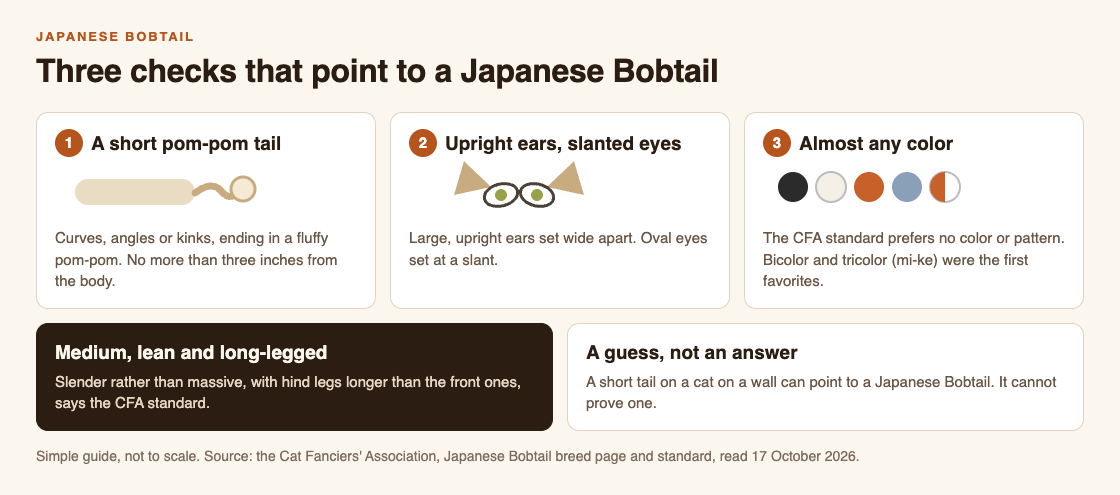
Three checks that point to a Japanese Bobtail, from the CFA's page and standard.
Unlike many breeds, this one has no single color. The standard says no color or pattern is preferred over any other, and the CFA says all colors are accepted in the show hall, including solids, tabbies, smokes and pointed colors, because these are "street" cats.
When the breed was first introduced, the CFA says bicolor and mi-ke were the most popular. Mi-ke means tricolor, or calico, and the standard defines the classic one as black, red and white in any combination. For a closer look at that pattern, see what a calico cat is.
Temperament: active, clever and talkative in a soft voice
The CFA calls Japanese Bobtails inquisitive, intelligent problem-solvers that are playful and agile, and says they excel at Feline Agility. It describes a high activity level and a short attention span, and calls them a source of amusement as well as a loving family pet.
On other animals, the CFA says they get along well with dogs and children of all ages, but that other cats sometimes need extra time to get used to a new cat that seems to be lacking a tail. It also says bobtails require a fair amount of attention and interaction to thrive, and will ask for it if you do not provide enough. Their soft voices produce a variety of sounds, which the CFA calls charming conversation without being noisy.
Grooming and health, as the CFA describes them
The CFA says bobtails have no undercoat and shed only minimally. For a shorthair, it suggests combing several times a month with a flea comb to remove dead hair and encourage new coat growth. Longhairs need combing more often, but their coats do not tangle or mat.
On health, the CFA says there are no known abnormalities associated with the distinctive tail, and calls the bobtail a sturdy, natural breed with no specific health concerns. Because the breed is somewhat rare, it says breeders work to keep an appropriate level of diversity in the gene pool: U.S. breeders in CFA have always been able to import Japanese street cats for their programs, and genetic testing is also used to head off problems.
For anything about one particular cat, ask your vet. A breed page cannot speak for a single animal.
How to check a short-tailed cat you meet
Here is a worked example. You see a cat with a stubby, kinked tail sunning itself on a step during your walk, and you wonder whether it is a Japanese Bobtail.
- Look from a distance. Let the cat go about its day, and do not approach or touch it. Our post on telling whether a cat is mixed breed gives the longer checklist.
- Look at the tail. The standard wants a short tail made of curves, angles or kinks, with fluffy hair that looks like a pom-pom starting at the base of the spine. A tail that is long, or a stub with no fluffy look, does not fit.
- Look at the head. Large, upright ears set wide apart, and oval eyes set at a slant, are what the standard describes.
- Look at the build. The standard wants a lean, slender cat with long legs and the hind legs longer than the front ones, not a heavy or cobby one.
- Do not lean on the color. Since the breed comes in nearly every color, the coat tells you almost nothing. A calico cat with a tail of any length is still a calico.
At the end, you have a guess, not an answer. A cat with a short tail can still be a mixed breed cat.
If you would like to meet the breed for real, the CFA says that given its rarity, the Japanese Bobtail is not necessarily going to be found at your local show. For another breed with a long face and large ears, see what an Oriental cat is, or what a Manx cat is, another breed the CFA describes by its tail.
Cat Go and breeds
Cat Go is a game you play in your web browser. You walk anywhere, photograph a real cat, lure it with food and catch it. After a cat is spotted, the game asks "Which breed is it?" and gives you a list with a search box, so you can type something like "Siamese" or "curly".
The game also says "Most cats you meet are mixed breed" and "Mixed breed is always a safe pick." That fits what you just read. A cat with a short tail can still be a mixed breed cat, and you choose the breed yourself. The game counts 34 breeds in total, and every catch is saved to your Catdex with its breed and the place you found it.

Cat Go's map. The game needs your location to record where each cat was caught.
Cat Go needs the camera and location allowed in your browser. When you take the photo, the game says to fit the whole cat in the frame.
Frequently asked questions
Why does a Japanese Bobtail have a short tail?
The CFA says the bobtail is due to a dominant gene, not to any cropping. It says each cat's tail is as unique as a fingerprint.
Where does the Japanese Bobtail come from?
Japan. The CFA says bobtails appear in scrolls, prints and carvings from the Middle Ages and are thought to have been brought from Korea as far back as the sixth century. The first came to the United States in 1968.
What color is a Japanese Bobtail?
Almost any. The CFA standard says no color or pattern is preferred over any other. Bicolor and mi-ke, the tricolor often called calico, were the most popular when the breed was first introduced.
Does a Japanese Bobtail need a lot of grooming?
Not much. The CFA says there is no undercoat and shedding is minimal. It suggests combing a shorthair several times a month, and a longhair more often.
Does Cat Go tell me if a cat is a Japanese Bobtail?
No. After you take a photo, you pick the breed yourself from a list, and "Mixed breed is always a safe pick."
Get started
Ready to try the "Which breed is it?" question on a real cat? Play Cat Go in your browser: walk anywhere, photograph a real cat, lure it with food and catch it.
Comments
No comments yet.
Sign in or make an account to comment.