What is a Korat cat? Look, history and temperament
What is a Korat cat? It is a rare, shorthaired cat from Thailand with a silver-tipped blue coat, a heart-shaped face and large green eyes. This guide follows the Cat Fanciers' Association's Korat page and its breed standard, then shows how to check a blue-grey cat you meet, and how that fits the "Which breed is it?" question in Cat Go.
What is a Korat cat? The short answer
The CFA describes the Korat as a Thai "good luck" cat with a silver blue coat and a heart shaped face, and lists its personality as energetic and affectionate. Its standard says the name is said "Koh-raht", and calls it a rare cat even in Thailand, where it is greatly loved.
The CFA says the Korat's look has hardly changed at all over the years, and describes the cat as loyal, trusting and extremely expressive. It adds that Korats are highly skilled at communicating with their humans.
Where the breed comes from
According to the CFA, the Korat was first discovered in Amour Pimai, part of the Korat province in Thailand. It dates the breed's history back to the 1300s.
The earliest known record is a book from the Ayudhya period of Thai history (1350 to 1767), The Cat-Book of Poems, also called Smud Khoi of Cats. It illustrates 17 "good luck" cats of Thailand, and the CFA says the Korat is the best known of them. Traditionally the cats were given as gifts to brides, and they were considered harbingers of luck and happiness.
The CFA says Jean Johnson imported the first two Korats into the United States in 1959. Ten years later Daphne Negus traveled to Thailand and came back with nine Korats to strengthen the bloodlines, and the CFA credits her with an important part in the breed's development.
Coat, eyes and head
The CFA's page and standard give the same picture, and a few details make it easy to check.
- Coat. A single coat, short, glossy and fine, lying close to the body. The standard asks for silver-tipped blue all over, with enough silver to give a "silver halo effect". The hair is usually lighter at the roots, with a gradient of blue that is deepest just before the silver tips.
- Head. Seen from the front, the head is heart-shaped. The eyebrow ridges form the upper curves of the heart, and the sides of the face curve down to a strong chin.
- Eyes. Large and luminous, wide open and oversized for the face. The standard prefers luminous green and accepts an amber cast.
- Ears. Large, with a rounded tip and a large flare at the base, set high on the head.
- Body. Medium sized and muscular, with, in the standard's words, "a feeling of hard coiled spring power and unexpected weight". The back is carried in a curve.
Nose leather and lips are dark blue or lavender, and paw pads are dark blue ranging to lavender with a pinkish tinge. The standard wants adults without shading or tabby markings, though it allows "ghost tabby markings" in kittens.
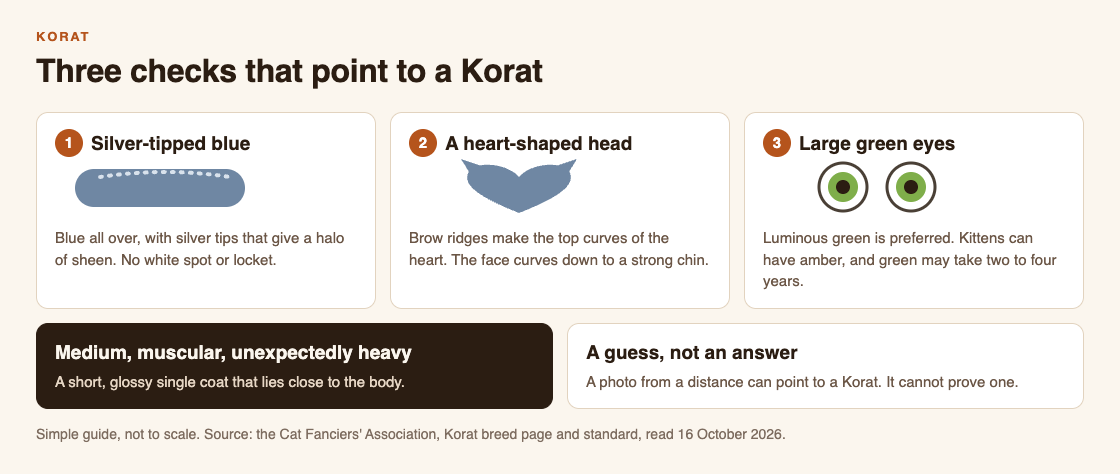
Three checks that point to a Korat, from the CFA's page and standard.
Two details change with age. The CFA says a Korat does not reach full maturity until two to four years of age. Kittens and adolescents can have yellow or amber to amber-green eyes, and the standard says the final eye color is not usually reached until the cat is mature.
On size, the CFA says it is not unusual for a mature male to match or exceed 10 pounds, and that females are usually smaller.
Temperament: bright, talkative and attached
The CFA calls the Korat extremely intelligent. It says a Korat can be taught tricks, but only with its consent. Because it craves stimulation, the CFA recommends interactive toys and games, puzzle toys and plenty of treats to keep it entertained and challenged.
The same page says this is a cat that demands attention and considers itself the head of its family. Korats form a strong bond with their owners, seek out contact with them and take a keen interest in every activity.
On noise and company, the CFA says Korats can make a wide range of noises and are not afraid to speak up if they want your attention. They are energetic but not hyperactive, and generally interact well with other household pets. The CFA adds one caution: if a new pet enters the household, keep a significant focus on the Korat so that its head-of-the-family role stays unchallenged, which should help prevent jealousy.
As with any cat, one animal can differ from the breed description. Read these lines as what the CFA says about the breed, not a promise about a single cat.
Grooming and health, as the CFA describes them
The CFA says Korats do not need much grooming. Their shiny single coat sheds only lightly, and it suggests brushing weekly to keep the coat in good condition. It also says the weekly brushing can help strengthen the bond with the person doing it. As with all cats, it says owners should regularly trim the nails, brush the teeth and keep the ears clean.
On allergies, the CFA says the hair of a Korat does not float off when it is stroked or petted, so the level of allergens in the air of your home should stay relatively tolerable for the occasional allergic visitor. It adds that this does not mean Korats are a low-allergen breed.
On health, the CFA calls the Korat a natural breed that is typically relatively healthy. Before buying a kitten, it says you should ask for the kitten's health documentation to make sure its vaccinations have been completed. It says most breeders are committed to managing the health of their breeding cats and kittens, and will help you learn how to care for your cat.
For anything about one particular cat, ask your vet. A breed page cannot speak for a single animal.
How to check a blue-grey cat you meet
Here is a worked example. You see a blue-grey cat on a fence during your walk, and you wonder whether it is a Korat.
- Look from a distance. Let the cat go about its day, and do not approach or touch it. Our post on telling whether a cat is mixed breed gives the longer checklist.
- Look at the coat. The standard wants a short, close-lying coat in silver-tipped blue all over, with a silver sheen. A cat with white on it does not fit, since the standard disqualifies a white spot or locket.
- Look for markings. Adults should show no shading or tabby markings in the standard. Faint ghost tabby markings are allowed only in kittens.
- Look at the head. A heart shape seen from the front, with a strong chin, is what the standard describes. It lists any pinch or narrowness between or across the eyes as undesirable.
- Look at the eyes. Large and green fits the standard, and an amber cast is acceptable. In a young cat, yellow or amber can still be normal.
- Do not stop at the color. A blue-grey coat alone cannot tell you the breed.
At the end, you have a guess, not an answer. A blue-grey cat with green eyes can still be a mixed breed cat.
If you would like to meet the breed for real, the CFA says Korats are seen more often at CFA cat shows, and that visiting one is the best way to connect with a breeder. It says the number of breeders is relatively small, so you may have to wait for a kitten, but that locating one should not be challenging. For a post on another breed that the CFA describes by its coat color and eyes, see what a Bombay cat is.
Cat Go and breeds
Cat Go is a game you play in your web browser. You walk anywhere, photograph a real cat, lure it with food and catch it. After a cat is spotted, the game asks "Which breed is it?" and gives you a list with a search box, so you can type something like "Siamese" or "curly".
The game also says "Most cats you meet are mixed breed" and "Mixed breed is always a safe pick." That fits what you just read. A blue-grey cat with bright eyes can still be a mixed breed cat, and you choose the breed yourself. The game counts 34 breeds in total, and every catch is saved to your Catdex with its breed and the place you found it.

Cat Go's map. The game needs your location to record where each cat was caught.
Cat Go needs the camera and location allowed in your browser. When you take the photo, the game says to fit the whole cat in the frame.
Frequently asked questions
Where does the Korat come from?
Thailand. The CFA says the breed was first discovered in Amour Pimai, part of the Korat province, and that its history goes back to the 1300s.
What color is a Korat?
Silver-tipped blue all over. The CFA standard disqualifies any other color, and prefers luminous green eyes, with an amber cast acceptable.
Is a Korat an affectionate cat?
The CFA calls it loyal and says it forms a strong bond with its owners and seeks out contact with them. It also says the Korat demands attention and considers itself the head of its family.
Does a Korat need a lot of grooming?
No. The CFA says Korats do not need much grooming, and suggests brushing weekly. It says their single coat sheds only lightly.
Does Cat Go tell me if a cat is a Korat?
No. After you take a photo, you pick the breed yourself from a list, and "Mixed breed is always a safe pick."
Get started
Ready to try the "Which breed is it?" question on a real cat? Play Cat Go in your browser: walk anywhere, photograph a real cat, lure it with food and catch it.
Comments
No comments yet.
Sign in or make an account to comment.