What is a Maine Coon cat? The gentle giant, explained plainly
What is a Maine Coon cat? In the words of the Cat Fanciers' Association (CFA), a large pedigreed cat registry, it is "the gentle giant of the cat fancy": perhaps the most popular breed to have been born in America, and the largest of all pedigreed cats. It is a shaggy, rugged longhair with a documented history going back to the 1850s.
Everything in this guide comes from the CFA's own Maine Coon page and breed standard: where the breed came from, how to recognise one, what it is like, and why the big fluffy cat on your street may not be one.
What is a Maine Coon cat? The short answer
The CFA describes a sturdy, rugged breed well suited to the frosty winters of the north-east United States. It has a heavy, flowing coat for protection from the cold, and broad, well-tufted paws that look made for snow.
Its breed standard opens the same way. The Maine Coon was originally a working cat: solid, rugged, and able to endure a harsh climate, with a smooth, shaggy coat as its distinctive mark. The standard also insists on balance: "Quality should never be sacrificed for size."
Where the Maine Coon came from, and the raccoon myth
The "Coon" in the name comes from an old theory. The bushy, ringed tails of brown tabby Maine Coons led people to think cats had mated with raccoons. The CFA notes this was before anyone realised the combination is genetically impossible.
Its real roots, the CFA says, lie in New England, where short-haired ship cats landed with the early settlers. Many legends try to explain the longer coat, including Turkish Angoras owned by Marie Antoinette set loose in the Maine woods, and a sea captain named Coon with a ship full of longhaired cats. The CFA lists them as myths and legends.
The show record is firmer. Maine Coons were at the first US cat show in 1895, where a brown tabby named Cosey was chosen Best Cat. Other longhairs then took over the show halls in the early 20th century, and the breed faded. Breeders worked through the 1960s and 70s, and in 1976 the breed earned CFA Championship status. The CFA says it has been among the top ten breeds it registers for many years.
How to recognise a Maine Coon
The CFA's description gives five things to look for.
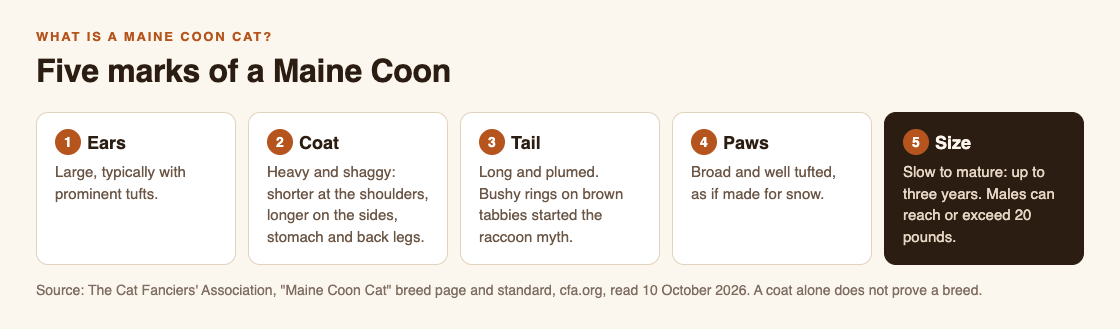
Five marks of a Maine Coon, from the CFA's breed page and standard.
- The coat: thick, shorter at the shoulders and longer on the sides, stomach and back legs. The standard calls it heavy and shaggy, and says a ruff at the front is desirable.
- The tail: long and plumed.
- The ears: large, typically with prominent tufts.
- The head: rectangular, with a square, strong muzzle.
- The paws: broad and well tufted.
How big does a Maine Coon get?
Big, and slowly. The CFA calls it a slow-maturing breed that can take up to three years to reach full growth. It says it is not unusual for a mature male to reach or exceed 20 pounds, while females are usually smaller.
The CFA also says Maine Coons are larger than many small dogs, so children and other pets can be wary of one at first, even though the breed gets on well with both.
Colours: far more than brown tabby
The brown tabby is the classic look, and Cosey, the 1895 winner, was one. But the CFA's breed card says many colours and patterns are available, and the standard's colour list runs from solids such as black and red, through classic, mackerel and ticked tabbies, to silvers, including a chinchilla silver in its shaded and smoke class.
The standard rules out a few: cats showing chocolate, lavender or the Himalayan pattern are disqualified. If you want to know what a chinchilla coat is, our guide to chinchilla cats explains it, and our tabby guide covers the stripes.
Temperament and care
The CFA describes Maine Coons as sociable, loyal and, like many breeds that were once working cats, quite intelligent. They enjoy every member of the family and tend to go from lap to lap rather than choosing a favourite. Many are fond of water, watching a dripping tap or washing their toys.
They are fairly independent and need a moderate amount of attention, which they will insist on when you are around. Their talk, the CFA says, includes chirps, trills and purrs with an occasional meow, but they are not a talkative breed. Our guide to why cats meow covers what those sounds mean.
For grooming, the CFA says breeders recommend combing two or three times a week, in sessions of five or ten minutes, to control shedding and prevent mats. Most do not need regular bathing. It adds that breeders test for hip dysplasia and hypertrophic cardiomyopathy, a heart condition, to keep the breed healthy.
Is that big fluffy cat a Maine Coon?
Maybe not. The CFA's coat and color descriptions make the point that a coat's colour and pattern do not tell you the breed: tabby, for one, is a pattern, not a breed. A large, long-haired brown tabby on a garden wall could be a Maine Coon, or a mixed-breed cat that shares the look.
Cat Go is a game that plays in your web browser, where that question comes up on every catch: "Walk anywhere, photograph a real cat, lure it with food and catch it."
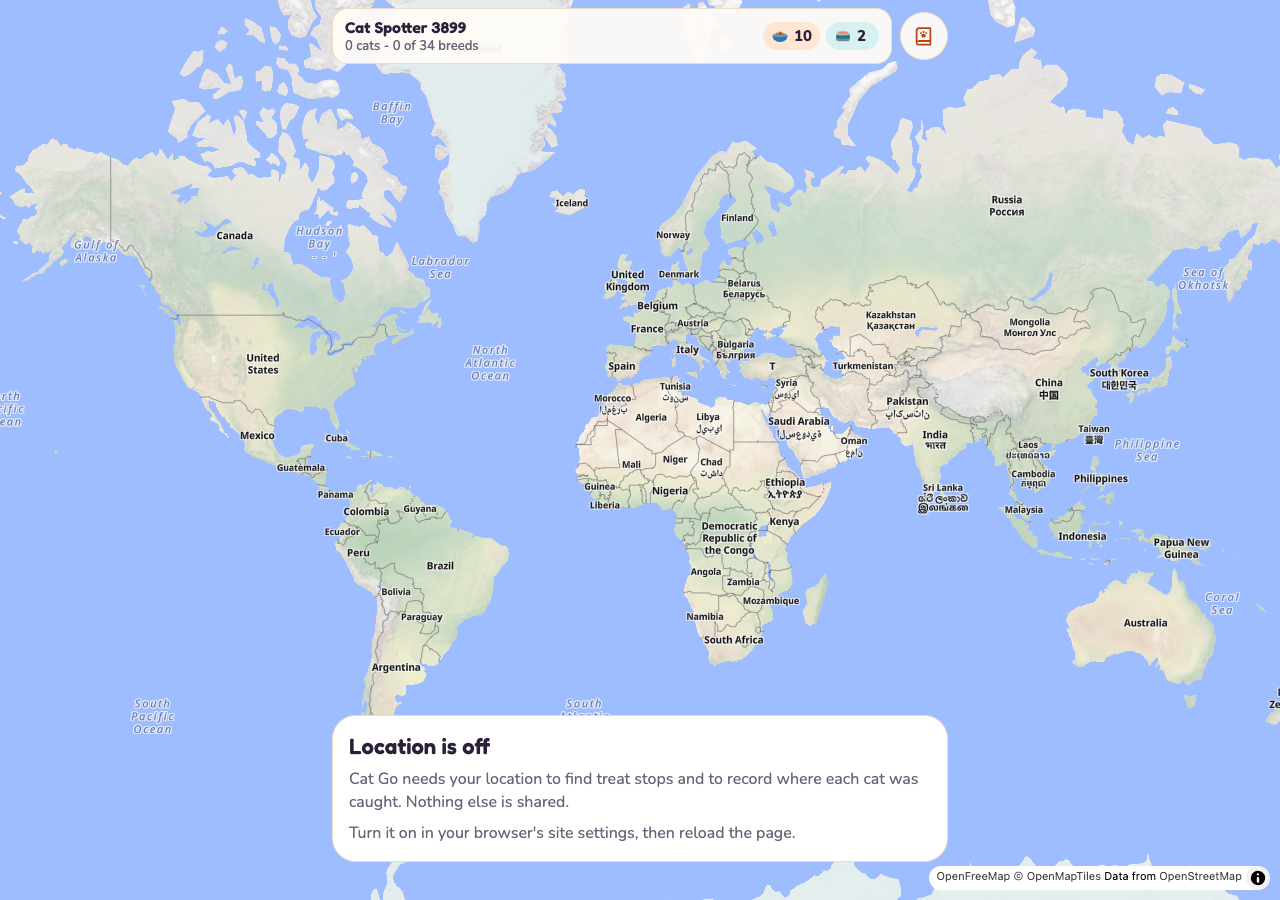
The bar at the top counts your cats and breeds out of the game's 34.
Here is how to handle a maybe-Maine-Coon on a walk:
- Stay where you are and tap the camera. The screen says "Fit the whole cat in the frame", which matters for a long tail.
- The game asks "Which breed is it?" and gives you a list with a search box. You pick; the game does not decide for you.
- Check the five marks above. If you cannot be sure, the game itself says "Mixed breed is always a safe pick."
- Toss in-game treats to win it over. The screen warns that rarer breeds are warier, and that tuna works much better on wary cats.
The catch keeps its breed and where you found it. Our guide on whether a cat is a mixed breed helps with the choice.
Frequently asked questions
Why is it called a Maine Coon?
An old theory said the breed came from cats mating with raccoons, because of its bushy ringed tail. The CFA says that is genetically impossible; the breed's roots are in New England ship cats.
How big is a Maine Coon?
The CFA calls it the largest of all pedigreed cats. A mature male can reach or exceed 20 pounds, females are usually smaller, and growth can take up to three years.
Are Maine Coons talkative?
Not especially. The CFA says they chirp, trill and purr, with an occasional meow, but are not considered a talkative breed.
How often does a Maine Coon need grooming?
The CFA says breeders recommend combing two or three times a week, for five or ten minutes.
Get started
Next time you see a big, shaggy cat with a plumed tail, check the ears, the paws and the coat at the shoulders. Then take a walk and see who you meet.
Play Cat Go in your browser: walk anywhere, photograph a real cat, lure it with food and catch it.
Comments
No comments yet.
Sign in or make an account to comment.